
Loading, please wait...
_900x900.jpg "Large Amlash Terracotta Idol")
_200x200.jpg "Large Amlash Terracotta Idol")
_900x900.jpg "Large Amlash Terracotta Idol")
_200x200.jpg "Large Amlash Terracotta Idol")
.jpg "Large Amlash Terracotta Idol")
.jpg "Large Amlash Terracotta Idol")
LOT 0272
Large Amlash Terracotta Idol
1ST MILLENNIUM B.C.
9 in. (386 grams total, 23 cm including stand).
Comprising a thin, extended neck developing into a largely unmarked face, represented only as a low-relief oval across its width; small arms folded into the chest emerging just beside two raised breasts; body curving inwards to suggest a feminine waist, before widening dramatically at the hips and buttocks; legs tapering gradually towards the base, with small marks delineating toes; mounted on a custom-made stand.
ProvenanceDr Werner Alder, Carona, Switzerland, acquired in the 1960s.
Private collection M.R., Lugano, Switzerland.
Accompanied by an academic report by Dr Raffaele D’Amato.
Accompanied by a thermoluminescence analysis report no.N126a11 from Oxford Authentication.
This lot has been checked against the Interpol Database of stolen works of art and is accompanied by search certificate number no.13015-246792.
Cf. Bailey, D.W., ‘The Figurines of Old Europe’, in Anthony, D.W.The Lost World of Old Europe, The Danube Valley, 5000-3500 BC, Princeton, 2010, item 18; for a similar but smaller prototype from Europe; Christie's, Paris Archeologie: Collection Pierre et Claude Verité auction sale 1063, December 20, 2011, lot 9; Lloyd, G., Terracotta fertility figurines of prehistoric Eurasian design from modern East Africa, 2013, figs.1.9,1.10.
FootnotesThe Amlash ceramics of Iron-Age Iran are named after a small modern town in the northern province of Gilan, just south of the Caspian Sea. Although the town is in close vicinity to Mesopotamia, the objects found there have a distinct local style, perhaps due to the natural boundaries of the Elburz and Zagros mountain ranges. The ceramic vessels and statuettes of both humans and animals from this region are by far the most important source we have on the Amlash culture of this period. Much of what has survived seems to have held spiritual or ritual functions, for example, votive idols and libation vessels. Human representations are generally found in burial sites and may therefore represent deities or specific individuals. These terracotta figurines, distinguished by their exaggerated, rounded hips and thighs, are believed to date from the late 2nd to early 1st millennium B.C. and are widely interpreted as fertility symbols or representations of a mother goddess.
CONDITIONTimeLine Auctions follows a vetting process to ensure the authenticity and legality of all items, reinforcing our commitment to integrity and responsible trading. Each antiquity, antique, and coin lot undergoes thorough examination by a vetting committee of at least ten external specialists, professional trade association members, scientists, and archaeologists: Our Vetting Process
AUCTIONS:
TimeLine is a leading auction house specialising in antiquities, ancient art, collectables, natural history, coins, medals, and books. Our auctions offer museums, collectors, historians, and enthusiasts the opportunity to acquire unique and historically significant pieces.
-
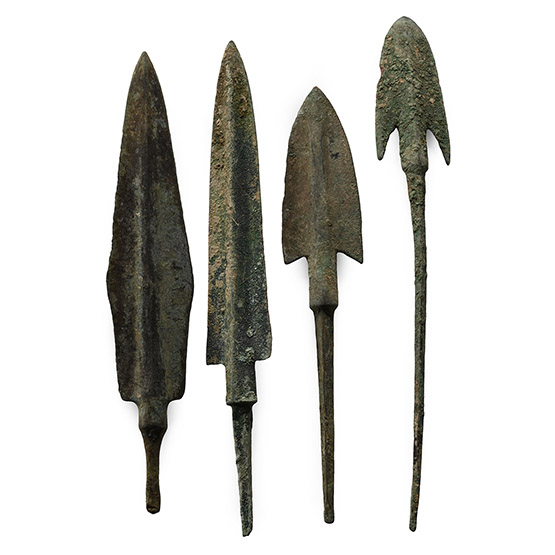
Luristan Bronze Arrowhead Collection
2nd-1st millennium B.C.Sold for (Inc. bp): £130
Comprising: two large tanged arrowheads, mainly of triangular type with mid-rib; two arrowheads with barbed shoulders, midrib and a stop on the blade with a long tang. 122 grams total, 12.7-15 cm
Acquired in the 1990s. Ex Abelita family collection.
One category of the represented arrowheads has a sharp blade, the ends of which extend to form wings or barbs, and a prominent midrib extending into a long tang that has a stop; the blade shape varies from deltoid to more triangular. The other form has no barbs, but it has a prominent midrib extending to the tang, and a rhomboid or tringular blade. Godard claimed that both types of heads, barbed and not barbed, came from Luristan. -
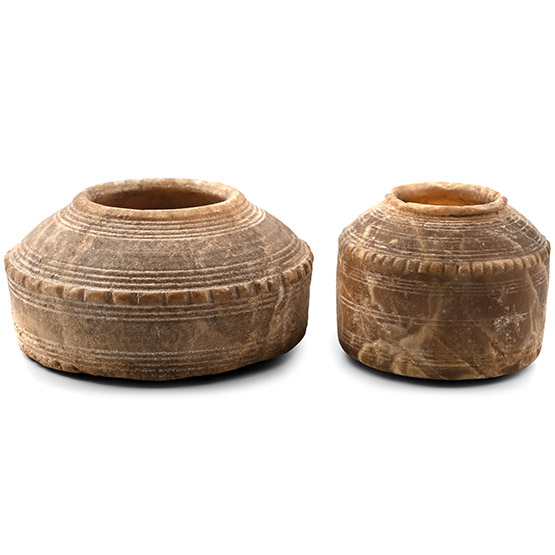
Mesopotamian Stone Bowl Collection
2nd millennium B.C.Estimate: £700 - 900 (+bp*)
Opening Bid: £350
Barrel-shaped in profile with a flat base, ribbed rim to the tapering neck with raised rim; incised lines to the outer face. 199 grams total, 51-75 mm
UK private collection before 2000. Acquired on the UK art market. Private collection, London, UK. -
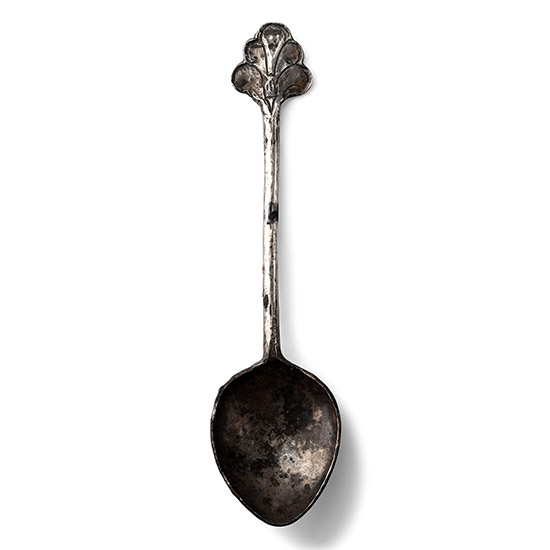
Late Kushan Period Silver Spoon with Brahmi Inscription
5th-6th century A.D.Sold for (Inc. bp): £455
Comprising a shallow piriform bowl with flange rim, round-section shank and palmette finial; incised legend to reverse. 84 grams, 19.8 cm
London, UK gallery, 1971-early 2000s. Private collection, London, UK.
