
Loading, please wait...


LOT 2310
Knightia Multiple Fossil Fish Plate
EOCENE PERIOD, CIRCA 58-36 MILLION YEARS B.P.
5 5/8 in. (192 grams, 14.4 cm).
An oval matrix with four small and one large Knightia alta specimens. [No Reserve]
ProvenanceFrom Wyoming, USA.
From a Lincolnshire, UK, collection.
In southwest Wyoming (and parts of Colorado and Utah), in the Green River Formation, are found some of the world's most outstanding specimens of fossil fish. The Green River system was composed of three lakes: Lake Uinta, Lake Gosiute and Fossil Lake. These Eocene lakes lay in a series of intermountain basins formed by geological events that uplifted the Rocky Mountains during the early Tertiary time. The climate was much different from the desert-like climate of this area today. Both the fauna (crocodiles, alligators, boa constrictors and some subtropical fish families) and the flora (such as large palm trees) indicate a climate much like that found along the Gulf Coast today. Large amounts of ash found in the sediments indicate that volcanoes were particularly active at this time.
CONDITIONTimeLine Auctions follows a vetting process to ensure the authenticity and legality of all items, reinforcing our commitment to integrity and responsible trading. Each antiquity, antique, and coin lot undergoes thorough examination by a vetting committee of at least ten external specialists, professional trade association members, scientists, and archaeologists: Our Vetting Process
AUCTIONS:
TimeLine is a leading auction house specialising in antiquities, ancient art, collectables, natural history, coins, medals, and books. Our auctions offer museums, collectors, historians, and enthusiasts the opportunity to acquire unique and historically significant pieces.
-
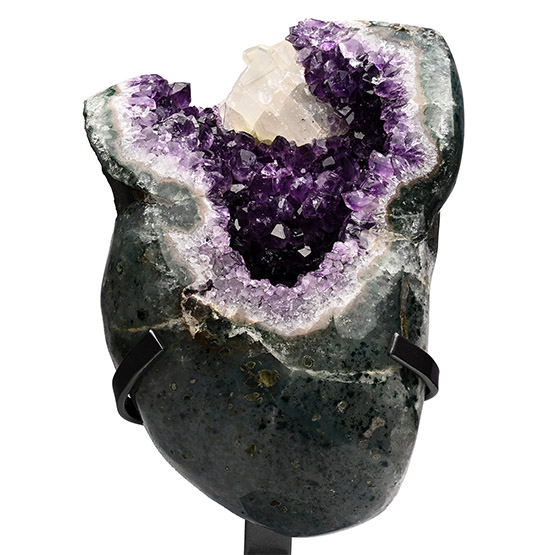
Polished Amethyst Crystal Geode Display with Calcite
Circa 140-120 million years B.P.Estimate: £1,000 - 1,400 (+bp*)
Opening Bid: £550
The outer layer of green celadonite beautifully polished, the interior with dark purple prismatic amethyst crystals, and at the top, an aggregate of white rhombohedral calcite crystals; mounted on a custom-made display stand. 5.68 kg, 27 x 20 x 10 cm
From Artigas, Uruguay. Property of a London lady. -

Large Iridescent Placenticeras Ammonite from Alberta
Bear Paw Formation, Upper Cretaceous Period, circa 76-73 million years B.P.Sold for (Inc. bp): £5,980
Placenticeras costatum with gem quality fossilised shell with some visible suture lines, conserved and stabilised with natural polish and acrylic lacquer, with excellent iridescence showing red, green, orange and gold colours. 952 grams, 26 cm
Found St Mary River Valley, Lethbridge Mining District, Alberta, Canada. Property of a Bristol, UK, gentleman collector. Accompanied by a certificate of authenticity, exportable under Moveable Cultural Property Permit no.7021-25-12-22-0102.
The striking iridescence of these ammonites from Alberta, Canada, termed 'ammolite', was given the status of a gemstone by CIBJO in 1981. An iridescent opal-like play of colour is shown in fine specimens, and is caused by the microstructure of aragonite, the same mineral contained in pearls and nacre. The thicker the structural layers, the more reds and greens are produced; the thinner the layers, the more blues and violets predominate. The ammonites are a group of molluscs that lived in the seas from the mid-Devonian (approximately 400 million years ago) to the end of the Cretaceous (65 million years ago). The sequence of events that famously killed off the dinosaurs also drove the ammonites to extinction. -

Large Group of Four Hundred [400] Cut and Polished Mini Agate Geode Halves
Sold for (Inc. bp): £46
Large group of cut geodes with internal cavities, most with crystal-lined interiors. 2.02 kg total, 16-40 mm
From Brazil. Ex Mineral Imports, London, UK. Gregory, Bottley & Lloyd (Gregory's), Harwich, UK.
