
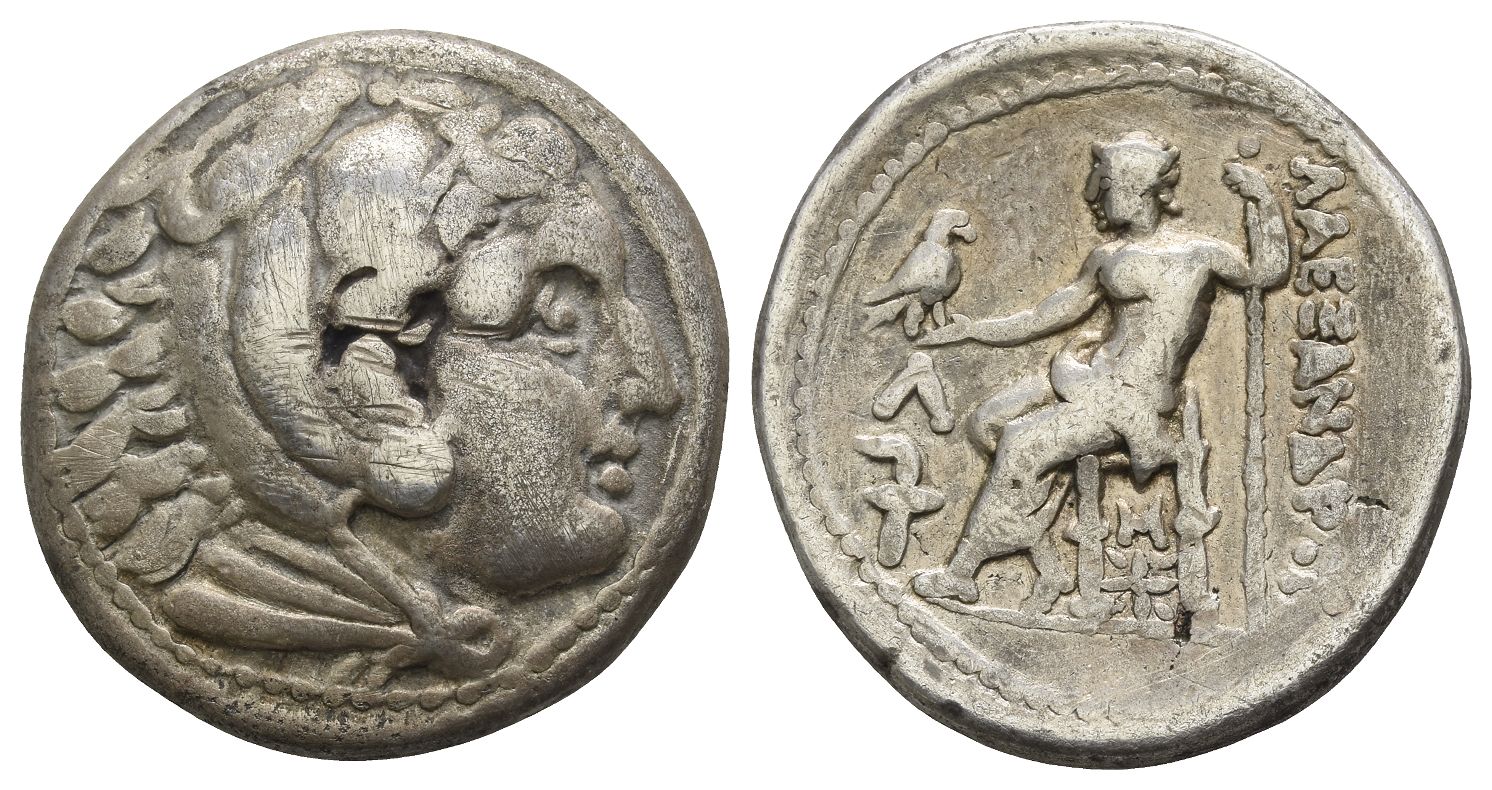
LOT 2606
Kingdom of Macedon, Kassander, as regent or king. 317-305 BC or 305-298 BC.
Amphipolis mint. Struck circa 307-297 BC. In the name and types of Alexander III. Head of Herakles to right, wearing lion skin headdress, paws tied beneath chin / ΑΛΕΞΑΝΔΡΟΥ, Zeus seated to left on backless throne, right leg drawn back, holding long sceptre in his left hand and, in his right, eagle standing to right with closed wings; in left field, Λ above torch; beneath throne, M above star. Price 481; Ehrhardt 22. Near Very Fine.(16.51gr, 26mm, 5h.).
ProvenanceEx German art market, 2000s.
Acquired from an EU collector living in London.
From the collection of a Surrey, UK, gentleman.
TimeLine Auctions follows a vetting process to ensure the authenticity and legality of all items, reinforcing our commitment to integrity and responsible trading. Each antiquity, antique, and coin lot undergoes thorough examination by a vetting committee of at least ten external specialists, professional trade association members, scientists, and archaeologists: Our Vetting Process
AUCTIONS:
TimeLine is a leading auction house specialising in antiquities, ancient art, collectables, natural history, coins, medals, and books. Our auctions offer museums, collectors, historians, and enthusiasts the opportunity to acquire unique and historically significant pieces.
-
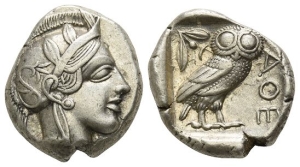
Attica, Athens AR Tetradrachm. Circa 454-404 BC.
Sold for (Inc. bp): £676
Head of Athena with profile eye to right, wearing disc earring, pearl necklace and a crested Attic helmet adorned with three olive leaves and a pi-style palmette / ΑΘΕ, owl standing to right, head facing the viewer, olive sprig with berry and crescent moon in upper left field, all within incuse square. Kroll 8; Dewing 1591-8; SNG Copenhagen 31; HGC 4, 1597. 17.16gr, 26mm, 2h.
Good Very Fine. Nice light old cabinet tone.
Property of a West London, UK, gentleman. -
![Group of Seven [7] Ancient AE Coins.](https://timelineauctions.com/upload/images/items/small/224340-s.jpg)
Group of Seven [7] Ancient AE Coins. 3rd-1st century BC.
Sold for (Inc. bp): £20
Various types. 115gr total.
Near Fine to Near Very Fine.
From a private, UK, collection in the 1980s. Property of a London, UK, antiquarian. -
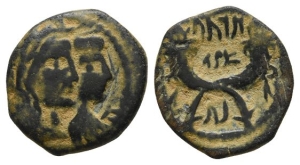
Nabataea, Aretas IV, with Shaqilat, AE 19mm. 9 BC-AD 40.
Sold for (Inc. bp): £65
Petra mint; struck AD 20-40. Jugate busts of Aretas and Shaqilat to right; [H] - F in Nabataean across fields / Crossed cornucopiae; legend in Nabataean between and below. Meshorer, Nabataea 114. 3.75gr, 19mm, 12h.
Very Fine.
Property of a North London, UK, gentleman.
