
Loading, please wait...
_900x900.jpg "Khorasan Blue Glazed Jar with Decoration")
_200x200.jpg "Khorasan Blue Glazed Jar with Decoration")
.jpg "Khorasan Blue Glazed Jar with Decoration")
LOT 0994
Khorasan Blue Glazed Jar with Decoration
12TH-13TH CENTURY A.D.
6 in. (366 grams, 15.2 cm high).
Composed of a globular body with broad ribbed neck and shallow foot, the body painted with vertical dashes and scrolling forms, some restoration; rim chipped.
Provenancewith a London, UK gallery 1971-early 2000s.
CONDITIONTimeLine Auctions follows a vetting process to ensure the authenticity and legality of all items, reinforcing our commitment to integrity and responsible trading. Each antiquity, antique, and coin lot undergoes thorough examination by a vetting committee of at least ten external specialists, professional trade association members, scientists, and archaeologists: Our Vetting Process
AUCTIONS:
TimeLine is a leading auction house specialising in antiquities, ancient art, collectables, natural history, coins, medals, and books. Our auctions offer museums, collectors, historians, and enthusiasts the opportunity to acquire unique and historically significant pieces.
-
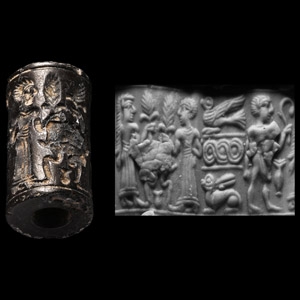
Western Asiatic Haematite Cylinder Seal with Figures
2nd-1st millennium B.C.Sold for (Inc. bp): £572
With frieze of standing figures, fronds, vases, scrolls, birds and other items. 2.13 grams, 15 mm
Acquired 1970s-1996. Property of a North American collector; collection no.030. London collection, 2016. -
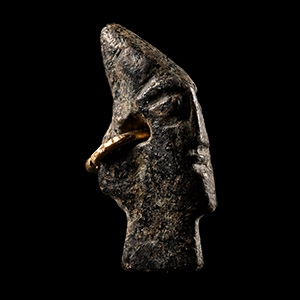
Syro-Neo-Hittite Bearded Figure Amulet and Gold Pendant Mount
Mid-1st millennium B.C.Estimate: £400 - 600 (+bp*)
Opening Bid: £160
Carved as a slender human head wearing a conical cap with stylised facial features, drilled for suspension and mounted on a later gold hoop. 4.14 grams, 28 mm
From a family collection formed 1900-1950; by descent circa 1980. -
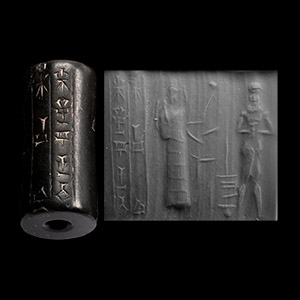
Old Babylonian Haematite Cylinder Seal for (the god) Ea and (the goddess) Dangalnuna
Circa 1894-1595 B.C.Sold for (Inc. bp): £650
With large central hole, incised frieze of a standing nude hero facing and a figure in tiered floor-length garment, two columns of cuneiform text to the rear. 9.18 grams, 28 mm
Acquired 1970s-1996. Property of a North American collector; collection no.033. London collection, 2016.
