
Loading, please wait...
LOT 1063
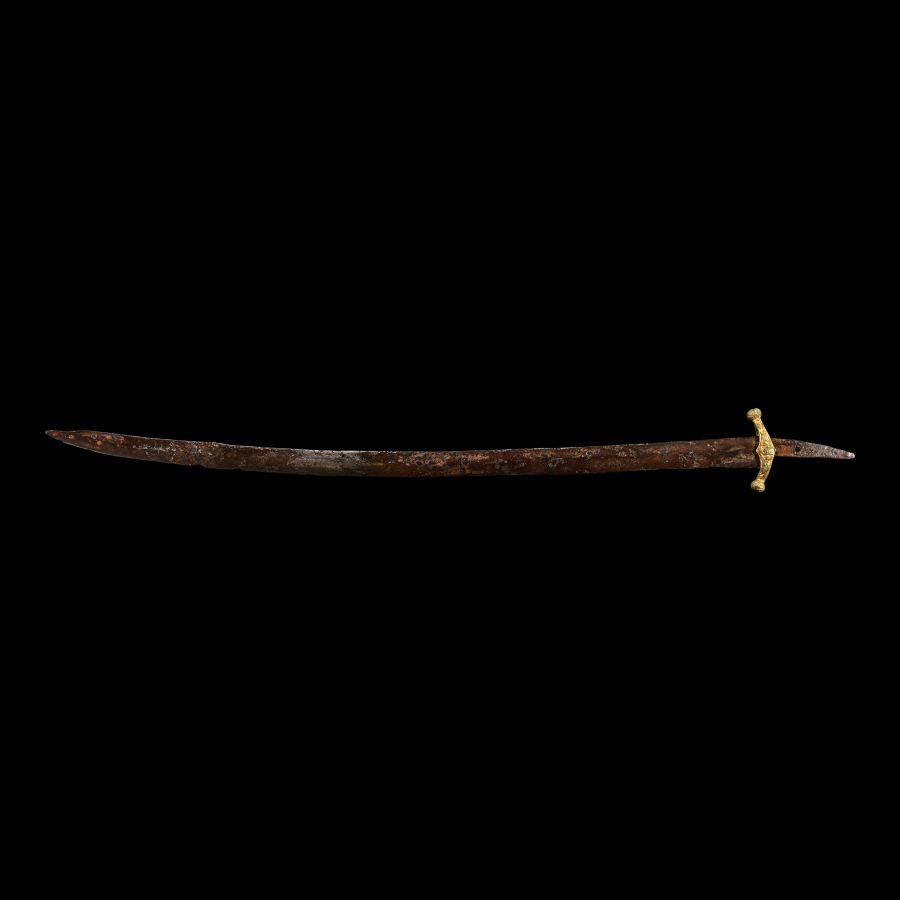
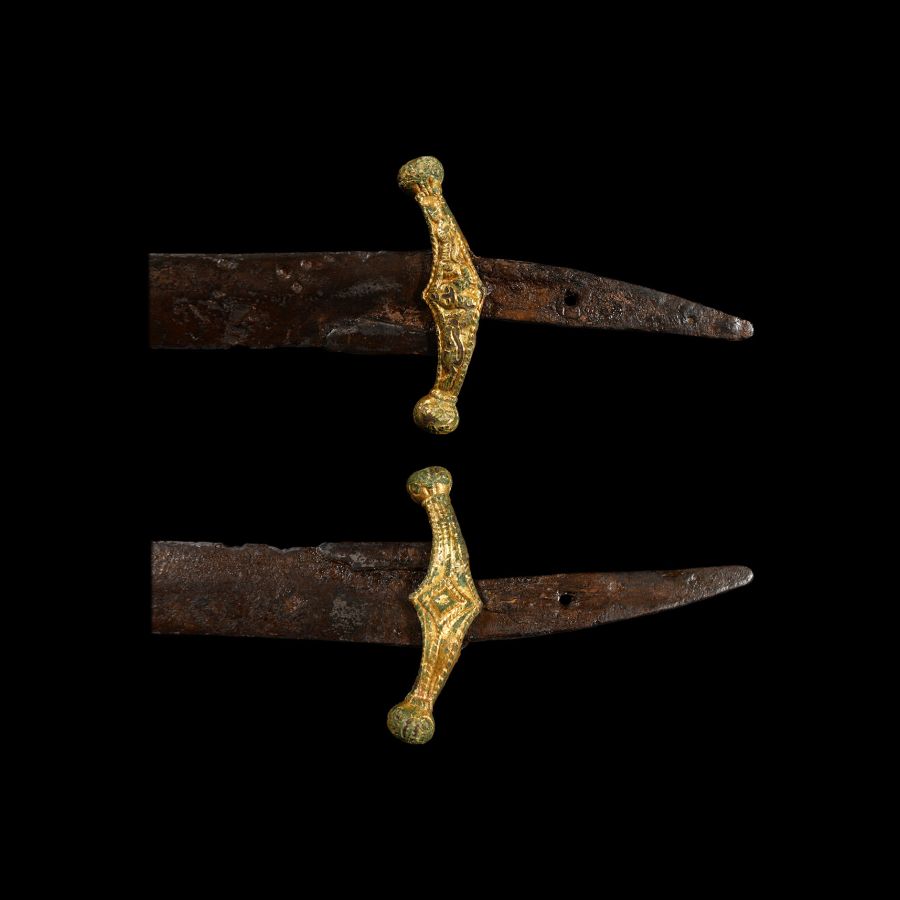
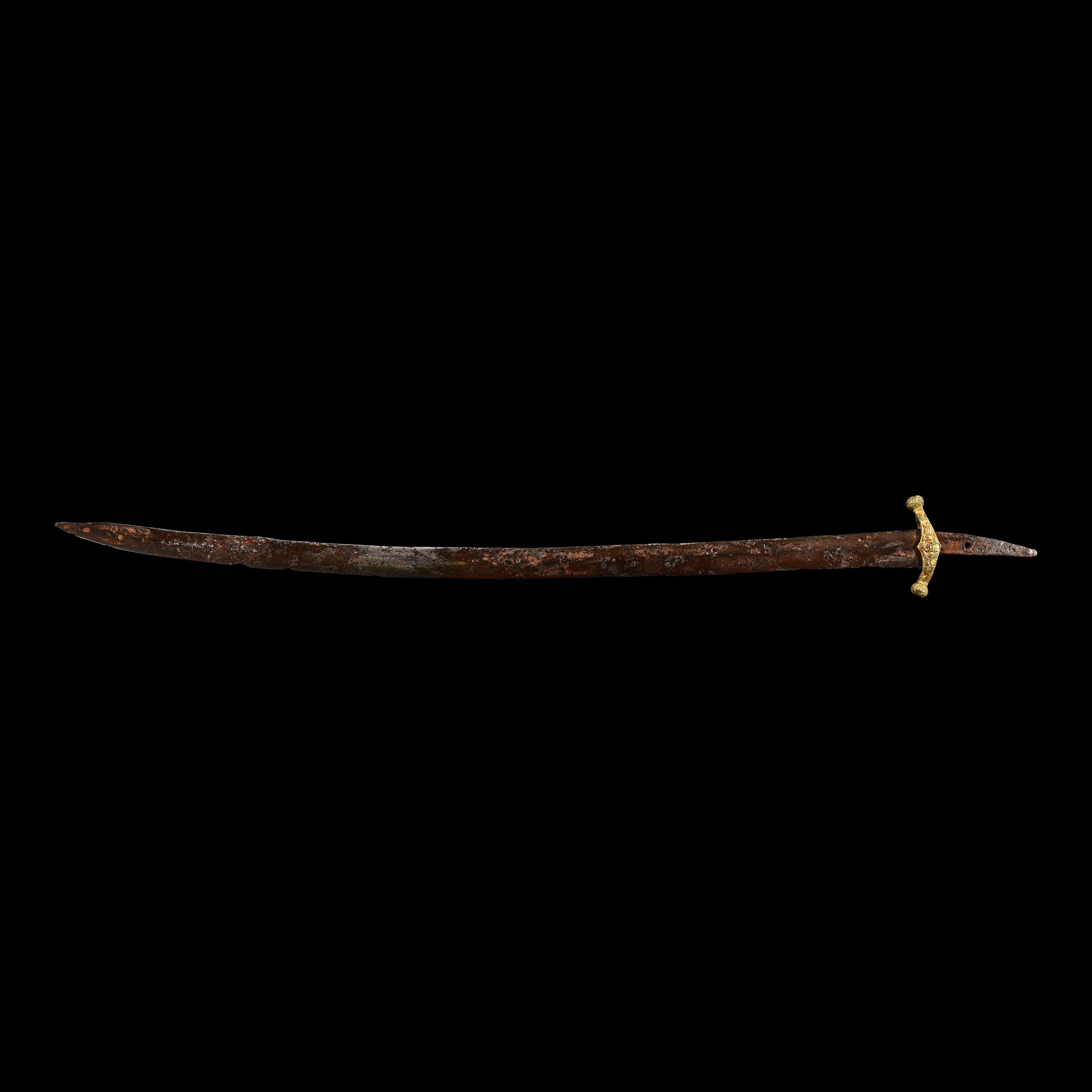
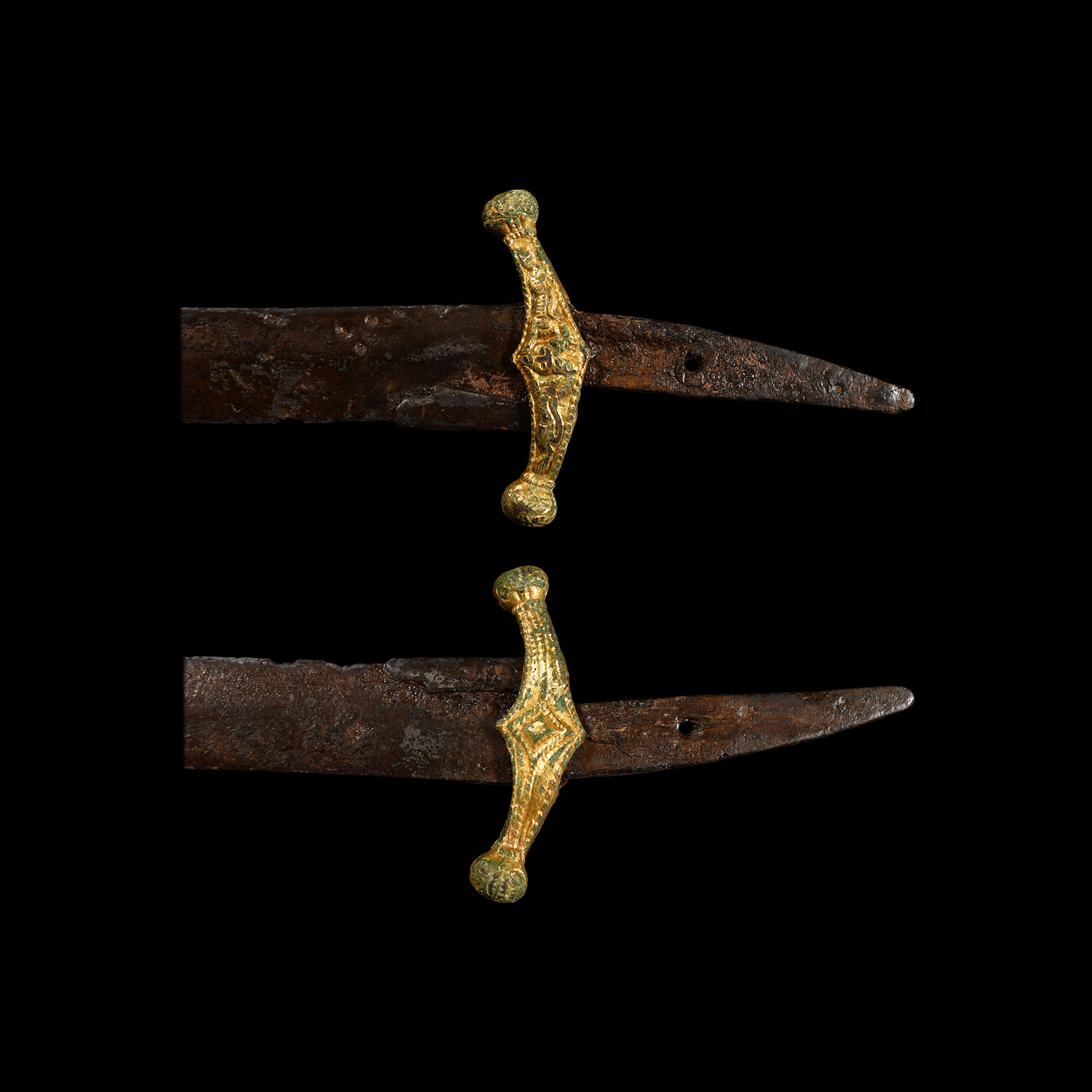
Khazar Sabre with Gilt Cross Guard with Face
9TH CENTURY A.D.
31 5/8 in. (610 grams, 80.5 cm).
A single-edged hand-forged sabre with a gently curving blade, an iron band welded beneath the cross guard, together with a tongue along the side of the blade; the separate gilt cross guard with spherical ornamented finials to the quillons, the central panel with a stylised face flanked by a pair of leaping lions biting the top of the head, the other side with a lozenge within a ropework frame. [No Reserve]
ProvenanceAcquired 1971-1972.
From the collection of the vendor's father.
Property of a London, UK, collector.
Accompanied by an academic report by military specialist Dr Raffaele D'Amato.
This lot has been checked against the Interpol Database of stolen works of art and is accompanied by search certificate no.114437-196034.
Cf. similar specimens in Zakharow, A., Arendt, W., Studia Levedica, Archaeologischer Beitrag zur Geschichte der Altungarn im IX JH., Budapest, 1935, fig.21, p.54, fig.22, p.56 (guards), pls. III,VI nos. 3,5; Lebedinsky, I., De l’epée scythe au sabre mongol, Paris, 2008, pp.172ff.; Gorelik, M., ‘The image of the men-warrior in Kabaria-Ugria-Russia (in Russian)’ in Archaeology of the Eurasian Steppes, no.5, Kazan, 2017, pp.257-267, fig.1, nos.1,5; Fodor, I., Revesz, L., Wolf, M., Nepper, I.M., Morigi Govi, C., Gli Antichi Ungari, nascita di una nazione, Bologna, 1998, p.132, no.117 (cat.515); Bashir, M., The Arts of the Muslim Knight, The Furusiyya Art Foundation Collection, Milano, 2008, p.34.
FootnotesThis exceptional sabre shows similarity with examples from the Caucasus and Kuban regions. The blade could be Khazar-Magyar, and certainly its best parallels are the specimens from Verchne-Szaltovo area. According to M. Gorelik, some of these sabres were produced by the Kabarians, a breakaway tribe from the Khazar State, who formed an alliance with the Magyars. The extra band welded beneath the quillons, together with the side tongue, not only protected the scabbard from being cut by the blade but, more importantly, defended the warrior’s fingers which were wrapped around the quillons when fighting.
CONDITIONTimeLine Auctions follows a vetting process to ensure the authenticity and legality of all items, reinforcing our commitment to integrity and responsible trading. Each antiquity, antique, and coin lot undergoes thorough examination by a vetting committee of at least ten external specialists, professional trade association members, scientists, and archaeologists: Our Vetting Process
AUCTIONS:
TimeLine is a leading auction house specialising in antiquities, ancient art, collectables, natural history, coins, medals, and books. Our auctions offer museums, collectors, historians, and enthusiasts the opportunity to acquire unique and historically significant pieces.
-
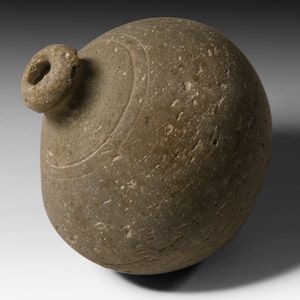
Byzantine 'Greek Fire' Fire Bomb or Hand Grenade
9th-11th century A.D.Sold for (Inc. bp): £182
A ceramic vessel with a piriform body and domed mouth, two incised rings to the shoulder; intended to be filled with explosive liquid and wick, used as a hand grenade. 470 grams, 10.2 cm
Previously in a private collection since the 1990s. Property of a Sussex, UK, teacher. Accompanied by an academic paper by military specialist Dr Raffaele D'Amato, dated 15 July 2019 and titled 'Eastern Roman Empire - Greek Fire Bomb or Hand Grenade (μεσαίον kακάβιον) 9th-11th century AD'.
Apart from the use of siphons or manual flame-throwers called cheirosiphona, special corps of Roman soldiers employed terracotta grenades, in the form of small jars, abundantly evidenced in archaeological excavations. Such were the γανωτα, vessels (sometimes also of bronze) used for Greek fire. They were called μεσαία kακαβιά or κυτροκακάβια where the former had a bulbous shape and the latter a more cylindrical form. -
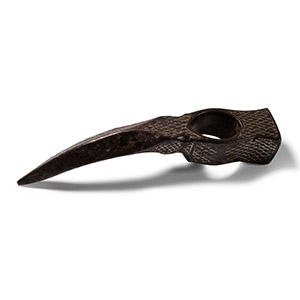
Eastern European Silver Inlaid War-Hammer
16th century A.D.Sold for (Inc. bp): £598
A copper-alloy war-hammer composed of ellipsoidal socket, waisted butt with shallow conical face and tapering, lozenge-section head, inlaid with a silver 'net' design. 453 grams, 18.5 cm
Private collection of Mr M.B., Mainz, Germany, 1990s. Property of a London businessman. This lot has been checked against the Interpol Database of stolen works of art and is accompanied by search certificate no.11203-186235.
The name obuch is Polish and means 'the blind end of an axe', but already at the beginning of the 15th century it meant a [unspecified] war hammer. According to Polish sources of 17th century, the war-hammer could have been formed into the shape of an axe (czekan), or in the form of a thick, slightly sloping spike (nadziak), or curved like a round cracknel (obuch). A 17th century description states: 'It was a terrible instrument in the hand of a Pole...With the sabre one could cut off somebody’s hand, cut the face, injure the head, and the running blood of the adversary would calm down the rancour. But with the obuch one could cause a deadly wound without even seeing the blood, and – not seeing it – he would not calm down instantly, but would strike several times without cutting the skin, breaking ribs and bones at the same time.' -
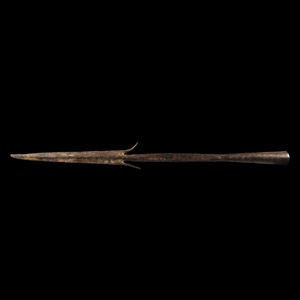
Medieval Socketted Catapult Dart
14th-16th century A.D.Sold for (Inc. bp): £169
An iron catapult dart formed with a tapering cylindrical socket, square-section neck and barbed triangular head with full-length medial rib to both faces. 94 grams, 29 cm
Acquired before 2000. From the collection of a European gentleman living in the UK.
