
Loading, please wait...
LOT 0851
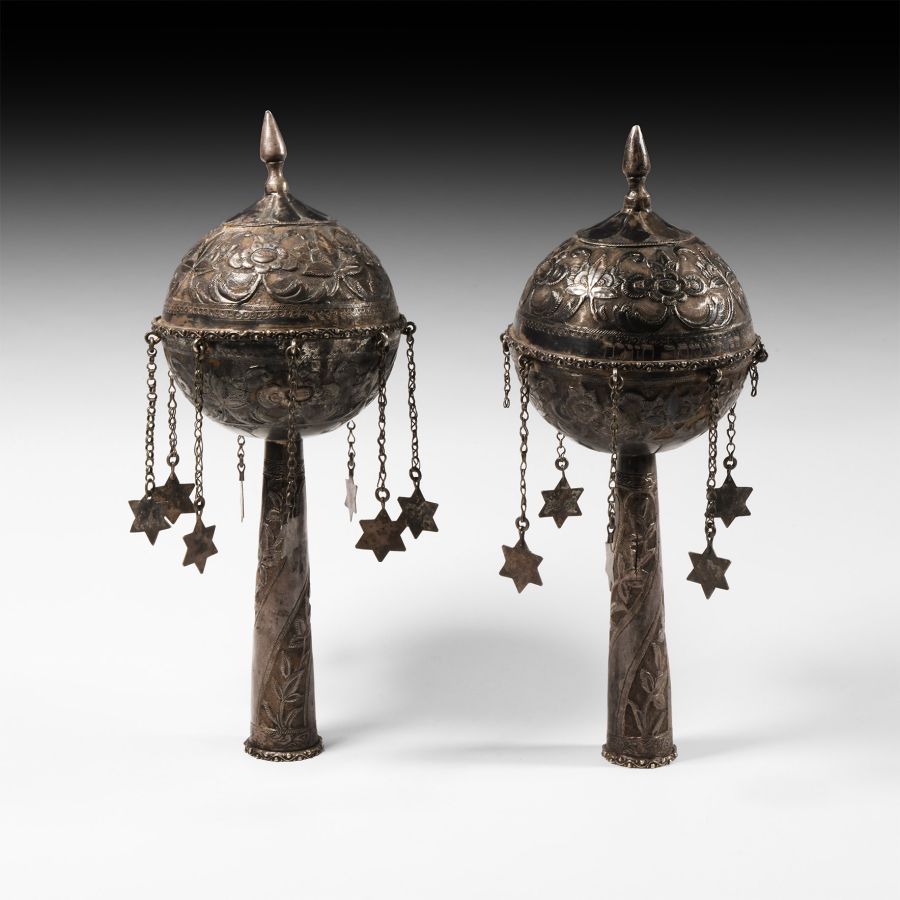
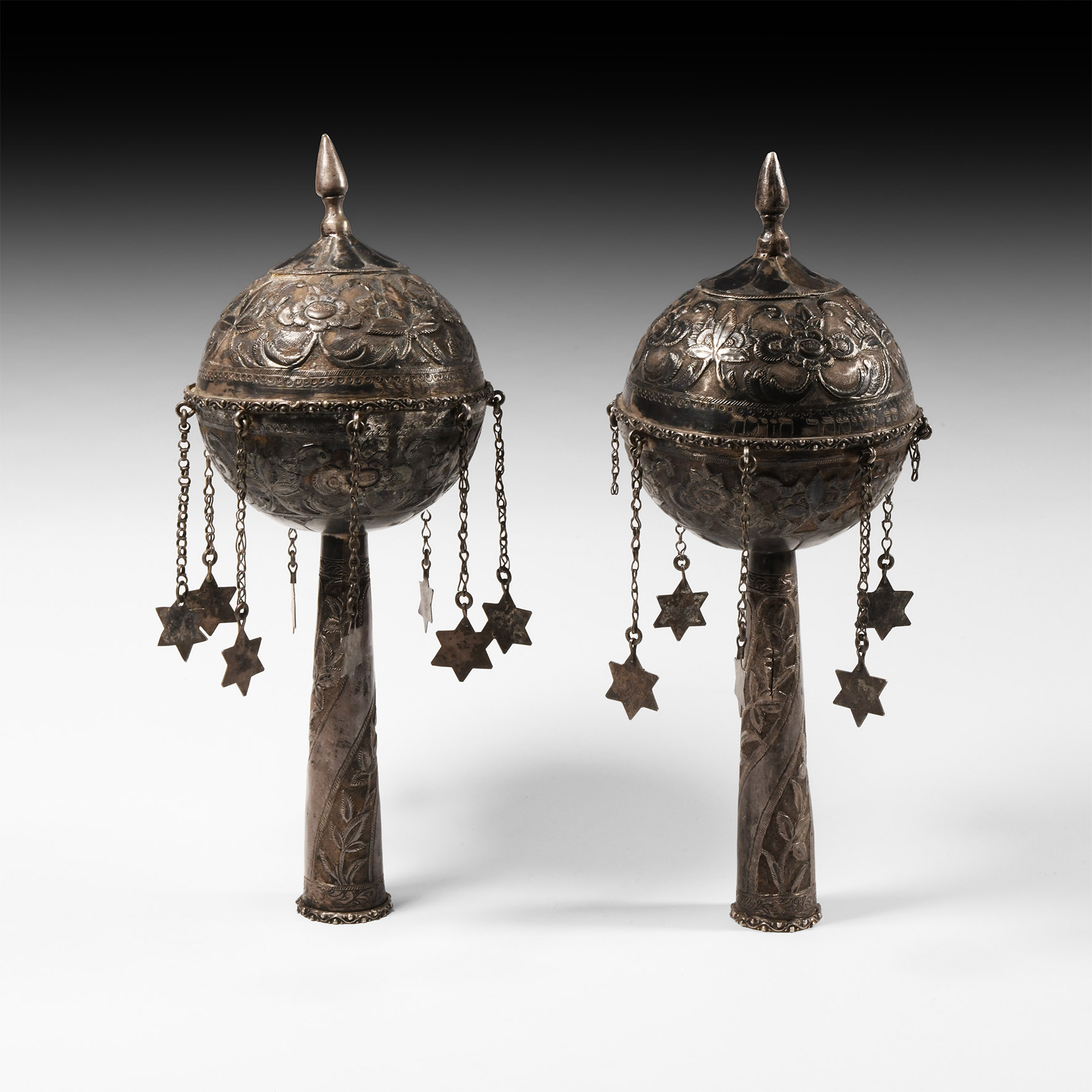
Jewish Silver Rimonim Group
19TH CENTURY A.D.
10 5/8 in. (734 grams total, 27 cm each).
A group of two silver rimonim or Torah finials, each comprising a spherical body with conical finial and tapering cylindrical socket, medial band of dangles with inscription above, embossed and chased stylised floral and foliate motifs to body and socket. [2]
ProvenanceFrom a UK private collection.
CONDITIONTimeLine Auctions follows a vetting process to ensure the authenticity and legality of all items, reinforcing our commitment to integrity and responsible trading. Each antiquity, antique, and coin lot undergoes thorough examination by a vetting committee of at least ten external specialists, professional trade association members, scientists, and archaeologists: Our Vetting Process
AUCTIONS:
TimeLine is a leading auction house specialising in antiquities, ancient art, collectables, natural history, coins, medals, and books. Our auctions offer museums, collectors, historians, and enthusiasts the opportunity to acquire unique and historically significant pieces.
-
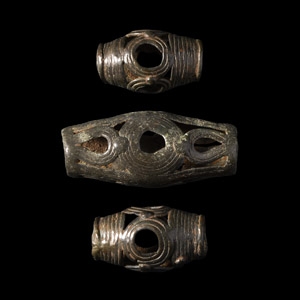
Amlash Cage Bead Collection
2nd-1st millennium B.C.Estimate: £120 - 170 (+bp*)
Opening Bid: £67
A group of three bronze cage beads, each composed of a biconical body featuring openwork geometric motifs and pellets. 68 grams total, 38-63 mm
Fine condition.
Acquired before 1983. Ex London gallery, 1990s. -
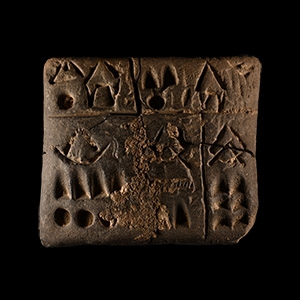
Mesopotamian Pictographic Tablet Relating to Cattle
Uruk III, circa 3000 B.C.Sold for (Inc. bp): £3,120
A bifacial pillow-shaped clay tablet bearing pictographs relating to cattle to both principal faces; repaired. 130 grams, 56 mm wide
Specialised collection of cuneiform texts, the property of a London gentleman and housed in London before 1992. Thence by descent to family members. Examined by Professor Wilfrid George Lambert FBA (1926-2011), historian, archaeologist, and specialist in Assyriology and Near Eastern archaeology, in the late 1980s and early 1990s. The collection is exceptional for the variety of types, including some very rare and well preserved examples.
Early writing was used primarily as a means of recording economic data. At the end of the 4th millennium B.C., written language developed in Mesopotamia as pictographs, later evolving into abstract forms called cuneiform. Pictographs were drawn in the clay with a pointed implement. Circular impressions alongside the pictographs represented numerical symbols. Cuneiform (meaning wedge-shaped) script was written by pressing a reed pen or stylus with a wedge-shaped tip into a clay tablet. -
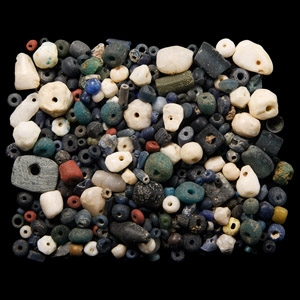
Western Asiatic Mixed Bead Group
Circa 1st millennium B.C.Estimate: £100 - 140 (+bp*)
Opening Bid: £50
A mixed group of glass, stone and shell beads of oblate, tabular, cylindrical and other types. 88 grams total, 1-18 mm
Acquired 1970-2010. Collection of a late Japanese gentleman.
