
Loading, please wait...
LOT 0429
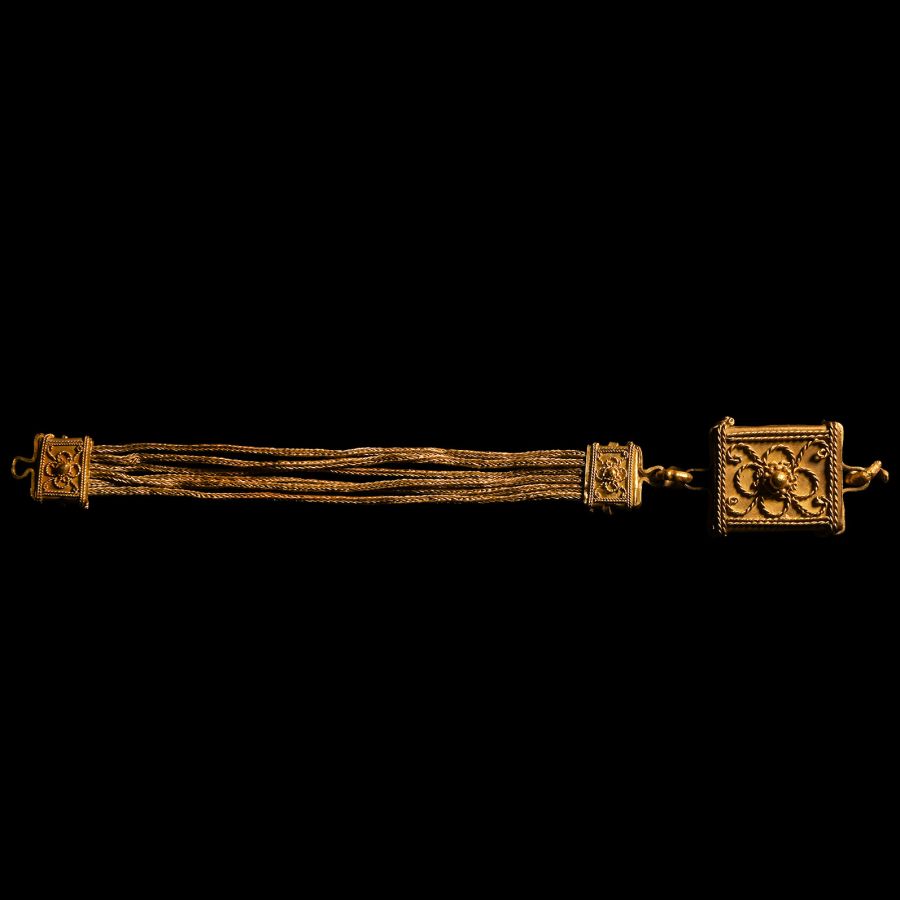
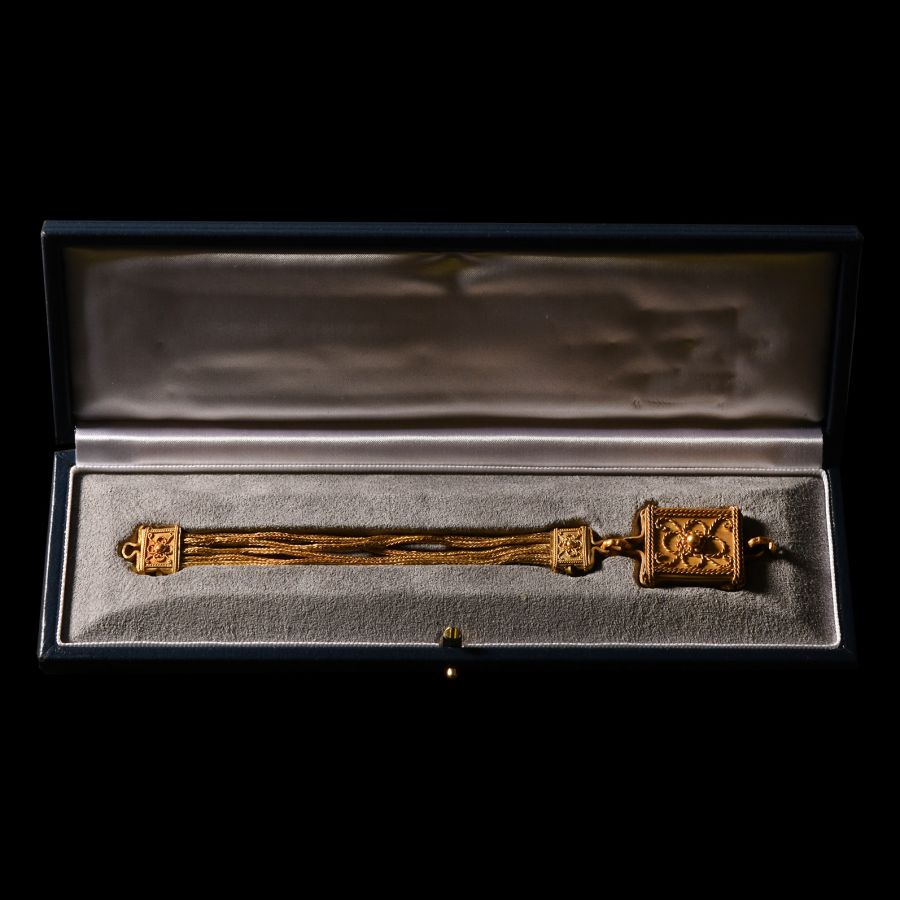
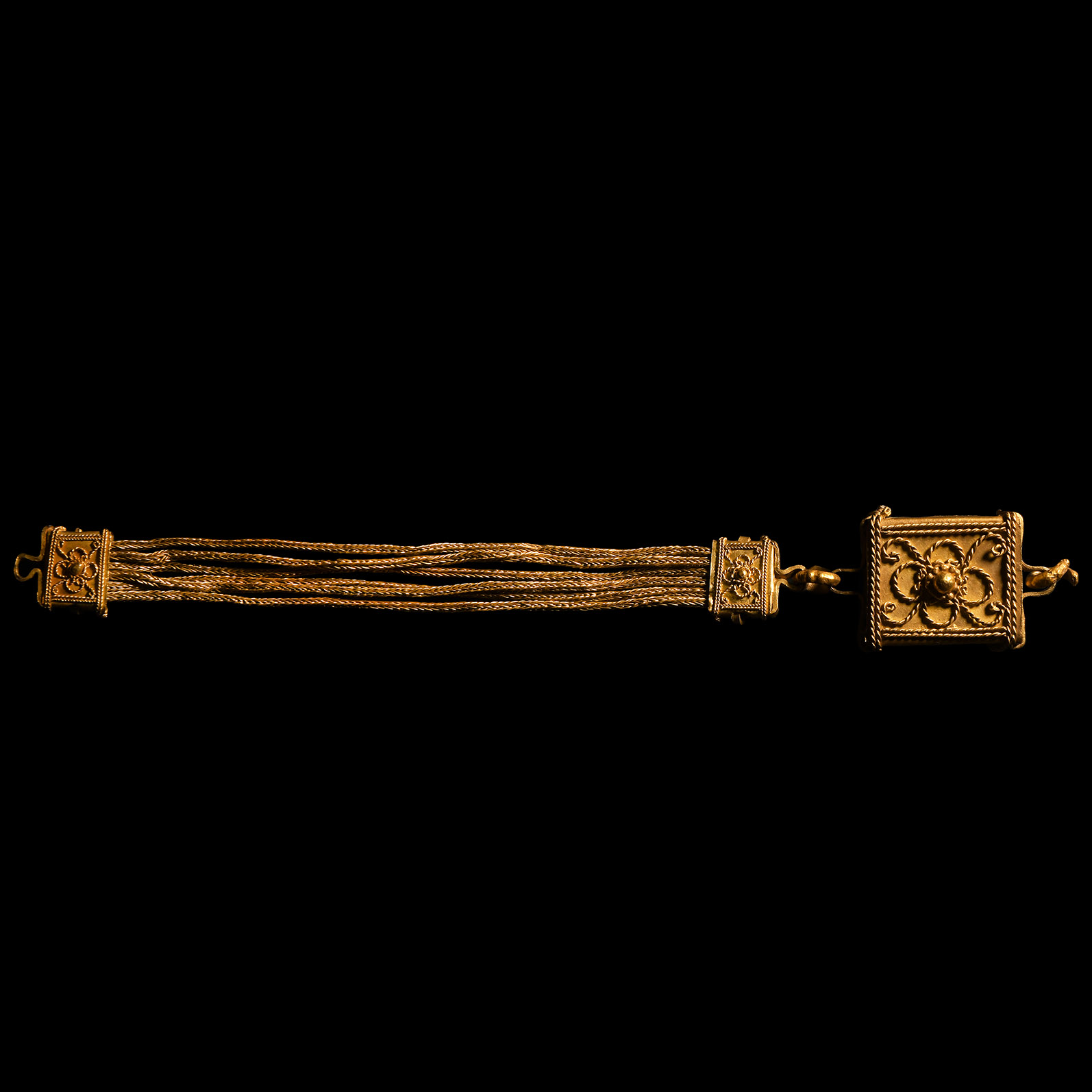
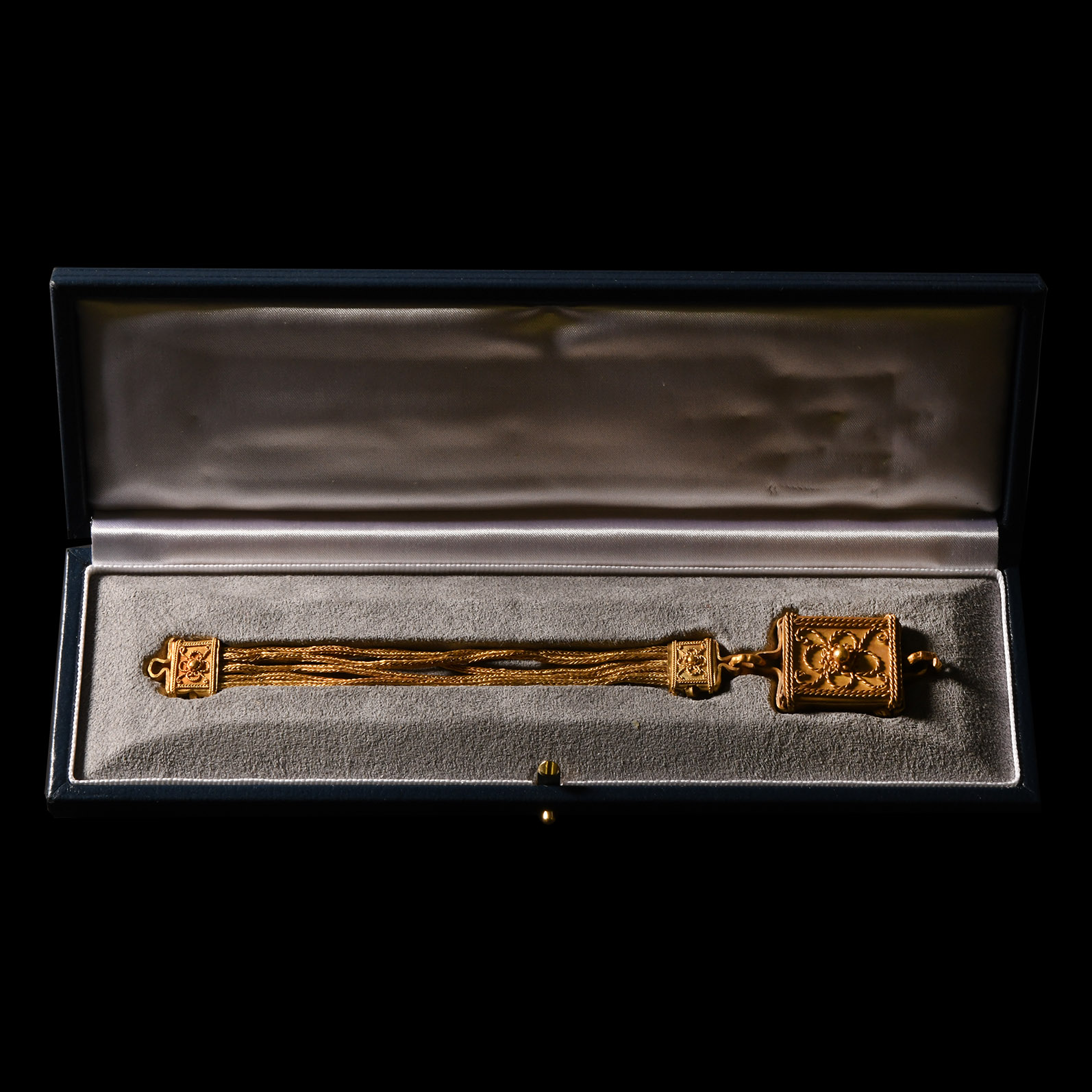
Javanese Gold Child's Decorated Bracelet
12TH-14TH CENTURY A.D.
6 1/4 in. (23.80 grams, 16 cm long).
A gold decorated bracelet comprising six strands of tightly braided trichinopoly between two rectangular and panels with applied filigree floral motifs within braided filigree borders and with a granule to the centre; larger rectangular hollow-formed sheet-gold fastener with applied filigree motifs and granule, loop closure.
Provenancewith Sotheby's, Hong Kong, 28 July 2021, lot 1121.
Private collection, acquired from the above sale.
Important North West London collection.
This lot has been checked against the Interpol Database of stolen works of art and is accompanied by search certificate number no.11711-199722.
TimeLine Auctions follows a vetting process to ensure the authenticity and legality of all items, reinforcing our commitment to integrity and responsible trading. Each antiquity, antique, and coin lot undergoes thorough examination by a vetting committee of at least ten external specialists, professional trade association members, scientists, and archaeologists: Our Vetting Process
AUCTIONS:
TimeLine is a leading auction house specialising in antiquities, ancient art, collectables, natural history, coins, medals, and books. Our auctions offer museums, collectors, historians, and enthusiasts the opportunity to acquire unique and historically significant pieces.
-

Chinese Shang Stone Cong
Shang Dynasty, circa 13th-12th century B.C.Estimate: £5,000 - 7,000 (+bp*)
Opening Bid: £2,500
A stone ritual 'cong' artefact of cuboidal form with cylindrical socket open at both ends, raised lip to both opening, the rectangular faces decorated with four corner panels, each divided into four horizontal panels displaying geometric motifs composed of circles and horizontal bands, possibly representing figurative zoomorphic motifs. 573 grams, 95 mm
Acquired in Hong Kong, 1980s. Ex Kelvin Choi's collection, circa 2009. UK private collection. This lot has been checked against the Interpol Database of stolen works of art and is accompanied by search certificate number no.11708-198350.
The name cong is applied to a straight tube with a circular bore and square outer section. The outer faces are often decorated with masks which may be related to the taotie motifs found on bronze vessels. Its original function is unknown. -
South East Asian Seated Statue of Buddha
12th-13th century A.D.Sold for (Inc. bp): £598
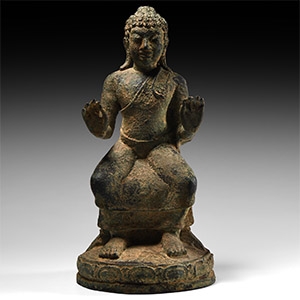
A bronze figure of Buddha in an earlier style, on a lotus-flower disc base with lotus-petal rim; Buddha is seated on a low block, his legs spread, and his hands raised, wearing a tight-fitting ankle-length paridhana. 2.14 kg, 24 cm high
Fine condition.
Acquired 1960s to early 1970s. Ex ‘Buckingham Collection’, the late Nik Douglas (1944-2012), renowned author, curator and Asian art expert. -
Chinese Tang Cuju Football Player Pair
Tang Dynasty, 618-907 A.D.Sold for (Inc. bp): £5,200
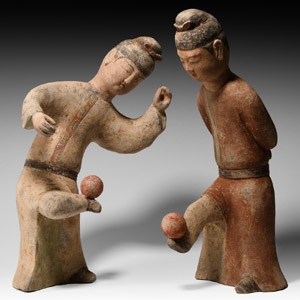
A pair of ceramic male figures modelled standing in dynamic poses, likely playing a game of cuju, each wearing a floor-length robe and balancing a ball on one foot; one figure leaning forwards with his arms held behind his back, looking down towards the ball balanced on the end of his raised right foot; one figure moving his arms in opposite directions in an attempt to regain his balance, head leaning left, his right leg bent across his body at the knee, balancing a ball on the heel of his foot; each with semi-naturalistic facial features and hair tied in a top knot; extensive remains of polychrome pigmentation. 6.85 kg total, 38.5-42.5 cm high
Ex Hong Kong collection. London Mayfair gallery, UK. Accompanied by thermoluminescence analysis report nos. C122k26 and C122k25 from Oxford Authentication. This lot has been checked against the Interpol Database of stolen works of art and is accompanied by search certificate number no.11697-199217.
Cuju is the earliest recorded game of football which involved kicking a ball through a net without the use of the hands.
