
Loading, please wait...


LOT 0557
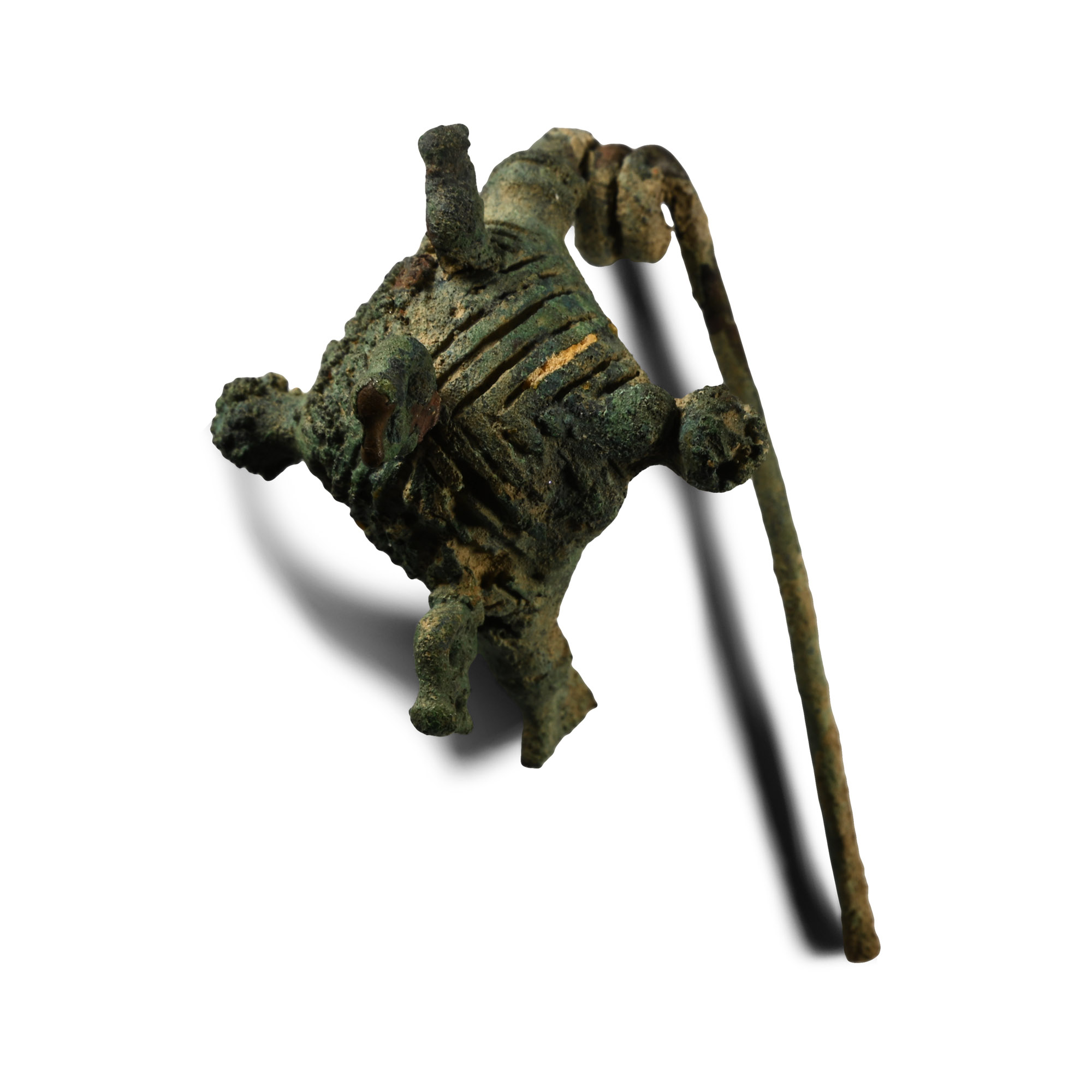
Italic Navicella Bronze Fibula with Figural Decoration
7TH CENTURY B.C.
2 5/8 in. (29.4 grams, 68 mm).
With navicella-shaped bow decorated with incised parallel lines, three miniature appliqués in the form of stylised monkeys and two lateral knops, foot preserved, pin tip absent. [No Reserve]
ProvenanceW. Rosenbaum, Ascona, before 1984.
Accompanied by a copy of an Art Loss Register certificate no.S00091284.
This lot is accompanied by an illustrated lot declaration signed by the Head of the Antiquities Department, Dr Raffaele D’Amato.
Cf. less ornate example in the Metropolitan Museum of Art, under accession no.20.260.
CONDITIONTimeLine Auctions follows a vetting process to ensure the authenticity and legality of all items, reinforcing our commitment to integrity and responsible trading. Each antiquity, antique, and coin lot undergoes thorough examination by a vetting committee of at least ten external specialists, professional trade association members, scientists, and archaeologists: Our Vetting Process
AUCTIONS:
TimeLine is a leading auction house specialising in antiquities, ancient art, collectables, natural history, coins, medals, and books. Our auctions offer museums, collectors, historians, and enthusiasts the opportunity to acquire unique and historically significant pieces.
-
Archaic Greek Figural Terracotta Alabastron
6th century B.C.Estimate: £700 - 900 (‡+bp*)
Opening Bid: £350
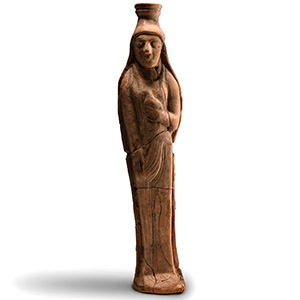
The free-standing perfume vase modelled as a standing and draped female figure, the neck and mouth of the vessel possibly formed as a modius worn on her head, holding what is possibly a dove to her chest; moulded and painted detailing to her face and garments; heavily repaired. 269 grams, 22 cm high
Acquired in Europe before 2001. This lot is accompanied by an illustrated lot declaration signed by the Head of the Antiquities Department, Dr Raffaele D’Amato. -
Greek Gold Earring Fragment
4th-3rd century B.C.Sold for (Inc. bp): £104
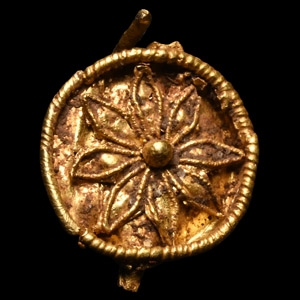
Disc with beaded wire rim and applied filigree rosette, loop to reverse. 0.69 grams, 12 mm
From the collection of a London antiquarian, formed since the 1980s. This lot is accompanied by an illustrated lot declaration signed by the Head of the Antiquities Department, Dr Raffaele D’Amato. -
Greek Attic Black-Glazed Terracotta Squat Askos
Circa 350 B.C.Sold for (Inc. bp): £598
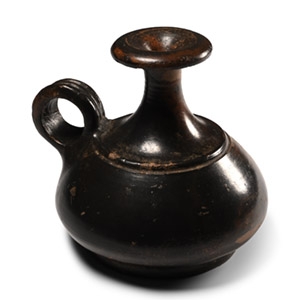
With carination and off-set ring at shoulder, loop handle with triple-band profile; slender neck and flaring lip. 192 grams, 99 mm wide
Ex Mr Guy Talbot, acquired between 1963-1982, Brussels. Large parts of his collection were acquired from Mr d'Allemagne, curator of the Château de Laarne, Belgium. with Bailly-Pommery & Voutier Associes, Paris, 17 March 2006. Accompanied by a copy of an Art Loss Register certificate no.S00075547. This lot is accompanied by an illustrated lot declaration signed by the Head of the Antiquities Department, Dr Raffaele D’Amato.
