
Loading, please wait...
_900x900.jpg "Italic Carnelian Scarab with Satyr Mounted in a Gold Swivel Ring")
_200x200.jpg "Italic Carnelian Scarab with Satyr Mounted in a Gold Swivel Ring")
.jpg "Italic Carnelian Scarab with Satyr Mounted in a Gold Swivel Ring")
LOT 0099
Italic Carnelian Scarab with Satyr Mounted in a Gold Swivel Ring
4TH-3RD CENTURY B.C.
1 in. (5.30 grams, 23.85 mm overall, 14.56 x 17.70 mm internal diameter (approximate size British J 1/2, USA 5, Europe 9.32, Japan 9)).
Carved scarab with detailed carapace, legs and mouth; underside with intaglio standing figure holding an amphora; set into a later gold swivel ring.
ProvenancePrivate collection, Europe.
Acquired on the English art market.
Cf. Chadour, A.B., Rings. The Alice and Louis Koch Collection, volume I, Leeds, 1994, items 40, 44, 45, for type.
FootnotesIt is clear that the sculptor devoted more care and attention to carving the scarab itself rather than its intaglio.
CONDITIONTimeLine Auctions follows a vetting process to ensure the authenticity and legality of all items, reinforcing our commitment to integrity and responsible trading. Each antiquity, antique, and coin lot undergoes thorough examination by a vetting committee of at least ten external specialists, professional trade association members, scientists, and archaeologists: Our Vetting Process
AUCTIONS:
TimeLine is a leading auction house specialising in antiquities, ancient art, collectables, natural history, coins, medals, and books. Our auctions offer museums, collectors, historians, and enthusiasts the opportunity to acquire unique and historically significant pieces.
LOT 0099
Italic Carnelian Scarab with Satyr Mounted in a Gold Swivel Ring
Sold for (Inc. bp): £1,404
-
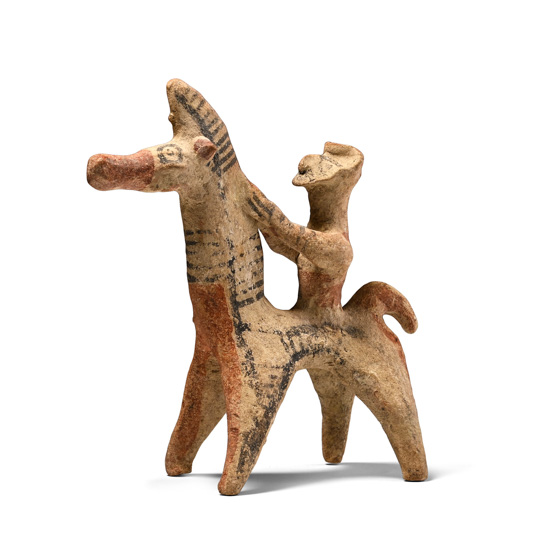
Cypriot Terracotta Horse and Rider Figure
8th-6th century B.C.Sold for (Inc. bp): £1,560
A horse and rider figure modelled in the round, standing on elongated stub legs, stout neck with stylised painted mane and coat detailing, waisted muzzle with raised almond-shaped eyes defined by painted roundels, solid colouring to the muzzle and short tail; rider represented by a torso and D-shaped head, arms reaching for the horse's neck and gripping its mane, painted detailing to the arms, hands and face. 206 grams, 15.5 cm wide
Fine condition.
London deceased estate, 1960s-1970s. Property of a Cambridgeshire, UK, gentleman. From the private collection of John Meredith, acquired since the 1990s; thence by descent.
Terracotta figurines of horse and rider were common grave offerings in Boeotia, northwest of Attica, particularly during the 6th century B.C. Representations of warriors on horseback were already diffused in the Geometric Period, and widely employed in Cyprus, in this same period. The image of our rider, although influenced by Cypriot designs, does not show typical Cypriot characteristics, and indeed his kausia cap suggests a northern Greek origin. -
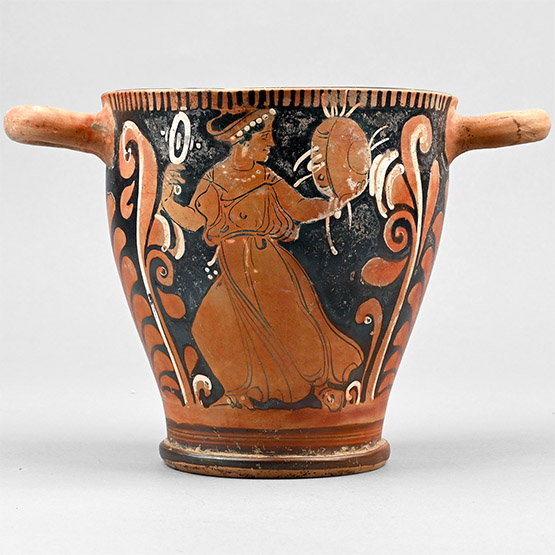
Large Greek Red-Figure Skyphos with Lady of Fashion
Campanian, 3rd-2nd century B.C.Sold for (Inc. bp): £1,235
With mammiform body, pedestal base and two loop handles; ovolo patterns in ochre beneath the rim and palmette beneath each handle; Side A: lady of fashion in advancing pose holding up a dish and a mirror, white detailing to the stephane and necklace; Side B: standing figure in a himation with a stephane. 640 grams, 23 cm wide
Acquired on the art market between the late 1990s and mid-2000s. Estate of the late Barry Paul Buxton (1944-2024), Oakham, Rutland. Acquired on the UK art market, 2025. -
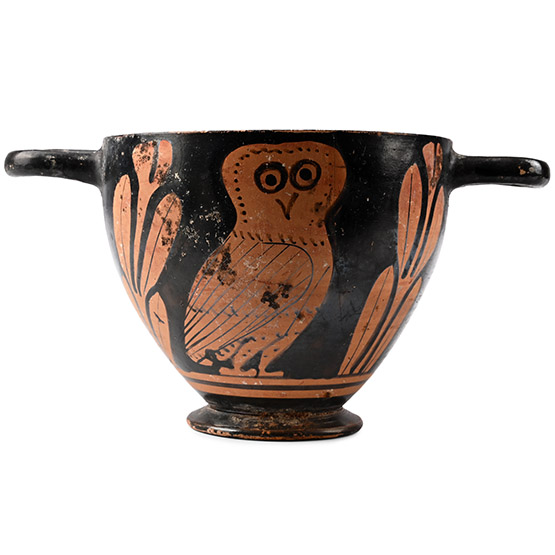
Greek Red-Figure Owl Skyphos
Attic, 4th century B.C.Sold for (Inc. bp): £1,235
Mammiform body with flared pedestal base and two loop handles to the rim; each side with a facing image of an owl between laurel fronds; concentric circles to the base, Attic workmanship. 115 grams, 15.2 cm wide
Acquired on the art market between the late 1990s and mid-2000s. Estate of the late Barry Paul Buxton (1944–2024), Oakham, Rutland. Acquired on the UK art market, 2025.
