
Loading, please wait...
LOT 0115
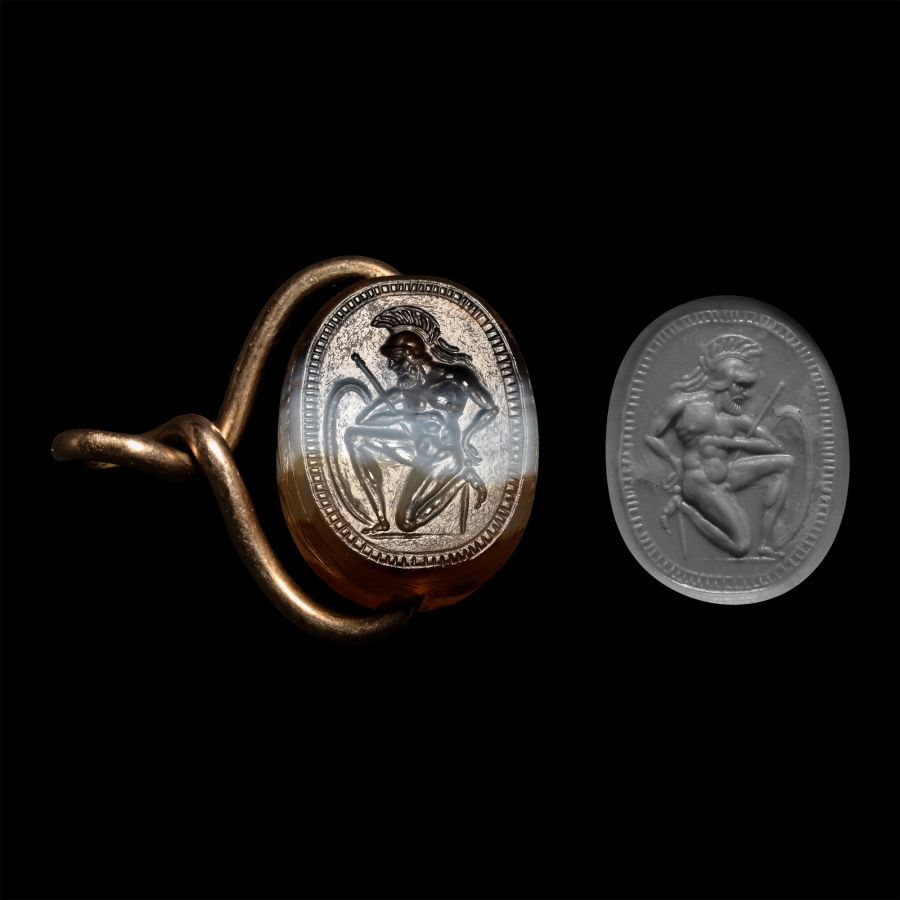
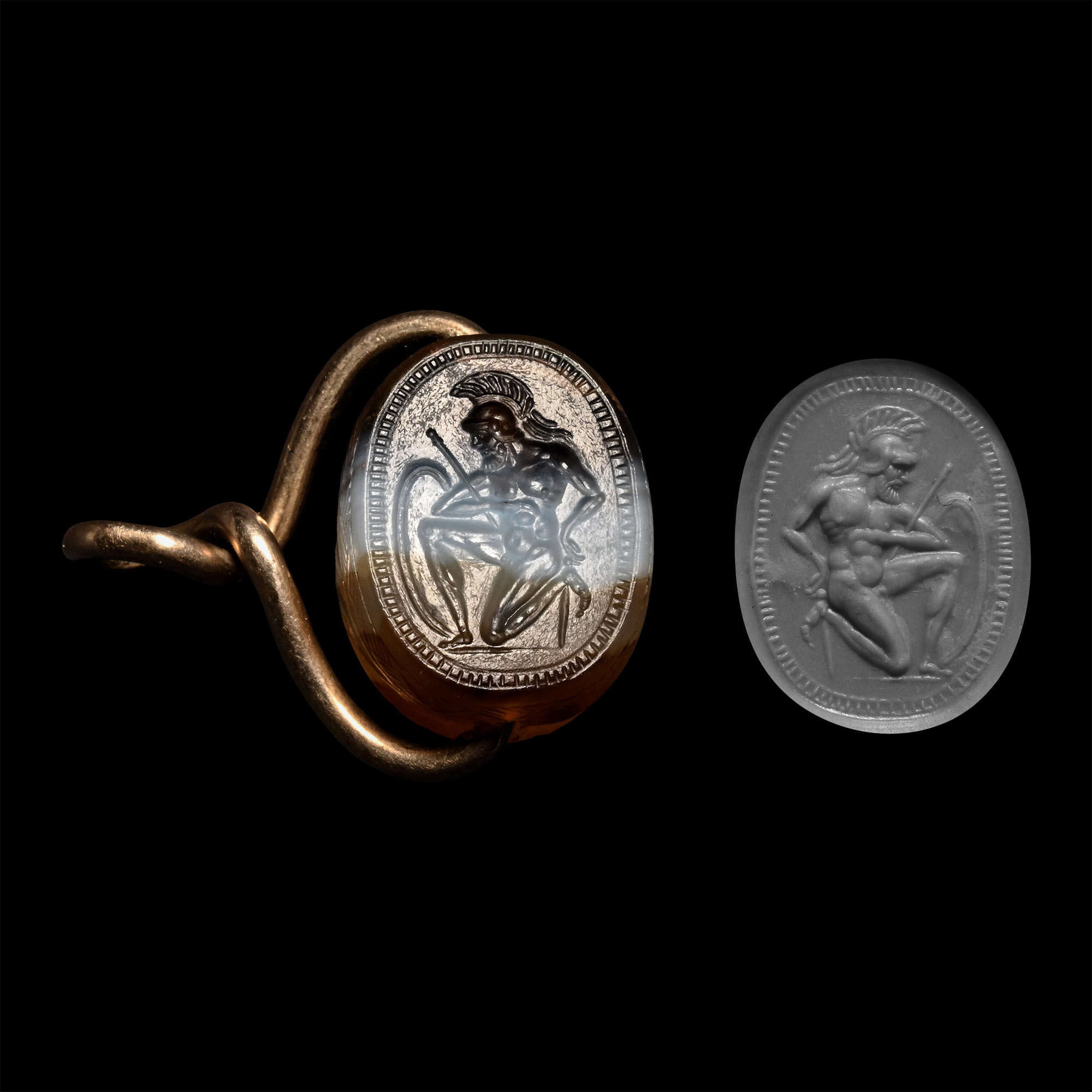
Italic Banded Agate Scarab with Kneeling Warrior in Gold Mount
3RD CENTURY B.C.
1 in. (5.24 grams, 25 mm).
Scarab bezel with carapace detailing and intaglio of a kneeling male nude wearing a helmet, holding a shield, sword and a spear; set into a later gold swivel ring; supplied with a museum-quality impression.
ProvenanceEnglish private collection.
Acquired on the English art market.
This lot has been checked against the Interpol Database of stolen works of art and is accompanied by search certificate number no.13110-248399.
See Boardman, J. and Vollenweider, M-L., Catalogue of the Engraved Gems and Finger Rings, I: Greek and Etruscan, Oxford, 1978, item 237; The Metropolitan Museum of Art, object number 48.11.1.; Chadour, A.B. Rings. The Alice and Louis Koch Collection, volume I, Leeds, 1994, item 123 for intaglio.
FootnotesThe intaglio can depict Capaneus, a legendary, strong, skilled, but arrogant warrior. He was one of the Seven Against Thebes, who boasted that not even Zeus could stop him from scaling the city walls. However, as he climbed them, Zeus struck him down with a bolt of lightning, illustrating divine punishment for his hubris. Evadne, his wife, then threw herself onto the funerary pyre in her grief. The story of strength but excessive pride was reflected in Dante's Inferno, where Capaneus is in the seventh circle as a condemned blasphemer.
CONDITIONTimeLine Auctions follows a vetting process to ensure the authenticity and legality of all items, reinforcing our commitment to integrity and responsible trading. Each antiquity, antique, and coin lot undergoes thorough examination by a vetting committee of at least ten external specialists, professional trade association members, scientists, and archaeologists: Our Vetting Process
AUCTIONS:
TimeLine is a leading auction house specialising in antiquities, ancient art, collectables, natural history, coins, medals, and books. Our auctions offer museums, collectors, historians, and enthusiasts the opportunity to acquire unique and historically significant pieces.
LOT 0115
Italic Banded Agate Scarab with Kneeling Warrior in Gold Mount
Sold for (Inc. bp): £11,700
-
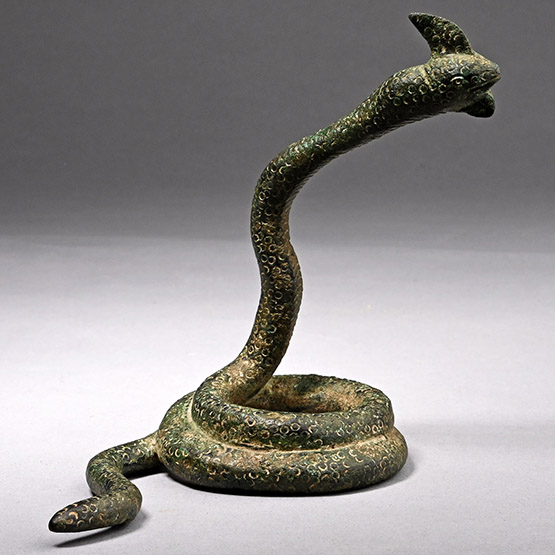
Greek Bronze Statuette of a Coiled Rearing Snake
Archaic, 6th-5th century B.C.Estimate: £6,000 - 8,000 (‡+bp*)
Opening Bid: £3,000
Modelled in the round with coiled body and rearing head, barbed fin to the forehead, punched annulet texturing on the body. 312 grams, 11 cm
Private collection, Neuchâtel, Switzerland, assembled in the 1980s. Acquired in 1995 by a European private collector. Private collection, since the late 1990s. This lot has been checked against the Interpol Database of stolen works of art and is accompanied by a search certificate number no.12856-241689. -
.jpg)
Greek Red-Figure Kantharos with Lady of Fashion
Apulian, 3rd-2nd century B.C.Sold for (Inc. bp): £1,040
High-handled cup with flared body and a tall offset foot with a collar, coiled lateral handles; profile 'ladies of fashion' busts with white and cream detailing to the hair, diadem and earrings. 415 grams, 18.6 cm
Acquired on the art market between the late 1990s and mid-2000s. Estate of the late Barry Paul Buxton (1944–2024), Oakham, Rutland. Acquired on the UK art market, 2025. -
.jpg)
Greek Bronze Ring with Goddess Nike
4th-2nd century B.C.Sold for (Inc. bp): £364
With discoid bezel, showing the Greek goddess of victory, Nike, holding a victory wreath in one hand, and the long ribbons of the latter in the other, the ring itself probably was part of a victory price for the winner of a contest (agon). 8.87 grams, 25.51 mm overall, 22.53 x 21.73 mm internal diameter (approximate size British Y, USA 12, Europe 27.51, Japan 26)
Acquired on the European art market in the 2000s. Private collection, England.
