
Loading, please wait...
LOT 0324
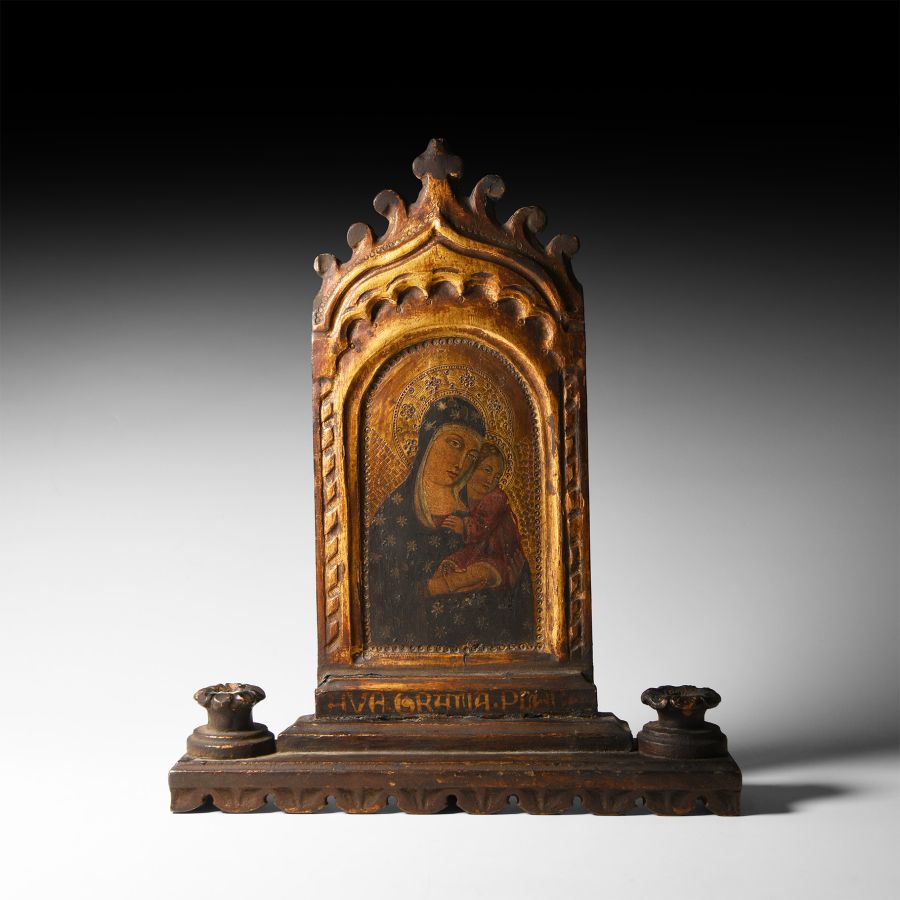
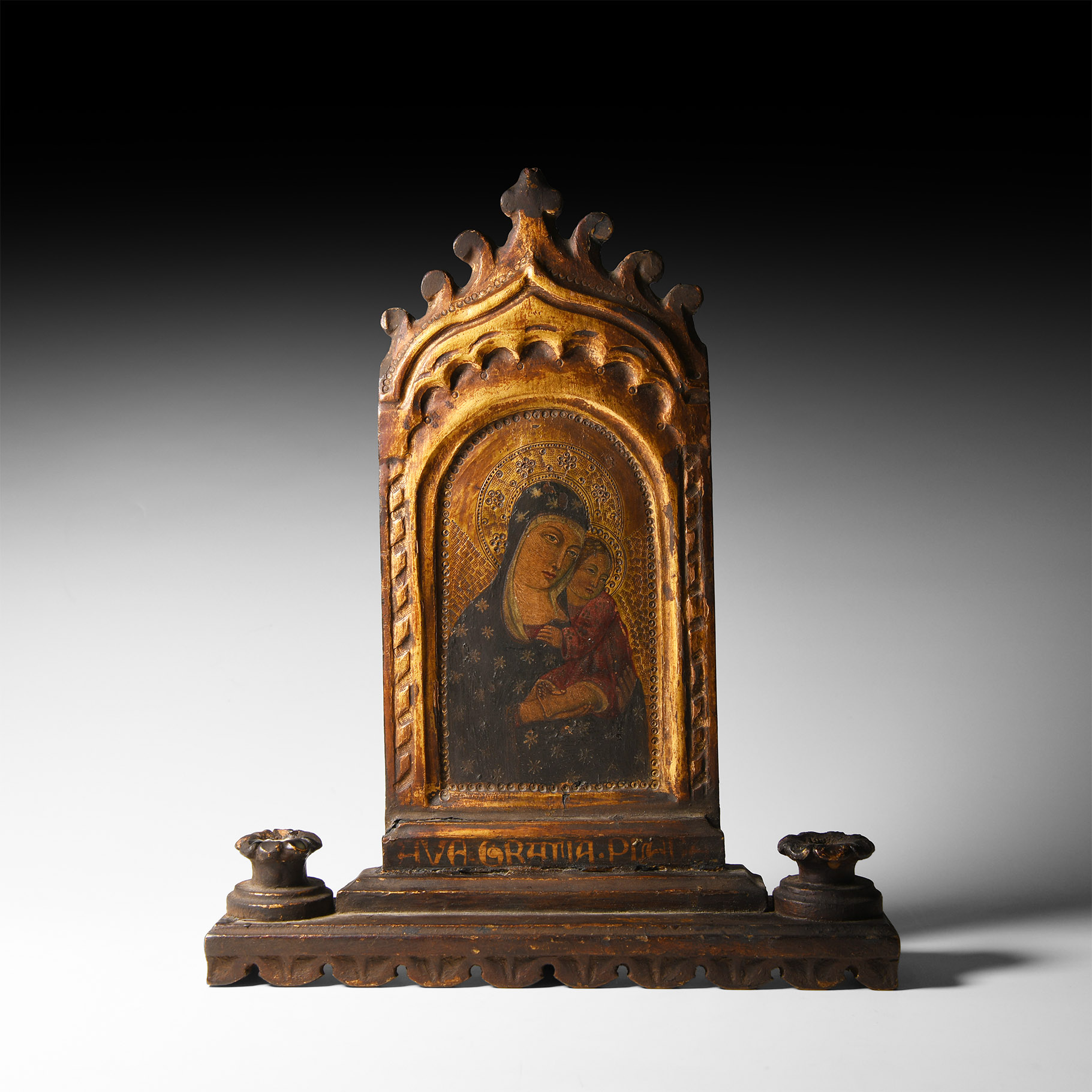
Italian Virgin of Tenderness Icon
CIRCA 19TH CENTURY A.D.
11 5/8 in. (279 grams, 29.5 cm high).
A painting on wood of the Virgin of Tenderness, copying an earlier work, depicting Mary dressed in blue robe ornamented with gold stars with an off-white veil delicately framing her face; gently supporting the Child dressed in red tunic; both figures nimbate and affectionately leaning towards each other with their cheeks touching; the scene enclosed in a gilt pseudo-Gothic crenelated frame, an inscription in new Gothic uncial style to the bottom reading 'AVE GRATIA PLENA' for 'hail full of grace'; mounted on a 19th century crenelated wooden pedestal fitted with candle holder to each side in the shape of a flower.
ProvenanceProperty of a London lady, part of her family's collection.
LiteratureCf. the Virgin with the Child of Sano di Pietro, in the Metropolitan Museum of Art, accession number 1975.1.51, for similar painting; cf. also Mazzoni, G., Falsi d'autore. Icilio Federico Joni e la cultura del falso tra Otto e Novecento, Siena, 2004, p.162, no.43.
FootnotesThe panel has many stylistic similarities with that of Icilio Federico Joni (1866-1946) assigned to the style of Sano di Pietro. Compared to that, the head of the Virgin has been realised in a more archaic Gothic style. With their faces gently pressed together, the interaction between the Virgin and the Child evokes a tender intimacy. This motif appears in numerous works by Sano di Pietro and his workshop (for example, in another painting in the Lehman Collection in MET, 975.1.39). The particular manner of concealing the Child’s right cheek behind the Virgin’s face was probably inspired by Madonna painted by the Sienese master Ambrogio Lorenzetti (Pinacoteca Nazionale, Siena).
CONDITIONTimeLine Auctions follows a vetting process to ensure the authenticity and legality of all items, reinforcing our commitment to integrity and responsible trading. Each antiquity, antique, and coin lot undergoes thorough examination by a vetting committee of at least ten external specialists, professional trade association members, scientists, and archaeologists: Our Vetting Process
AUCTIONS:
TimeLine is a leading auction house specialising in antiquities, ancient art, collectables, natural history, coins, medals, and books. Our auctions offer museums, collectors, historians, and enthusiasts the opportunity to acquire unique and historically significant pieces.
LOT 0324
Italian Virgin of Tenderness Icon
Estimate £700 - 900€810 - 1,040 (for guidance only)$950 - 1,220 (for guidance only)
-
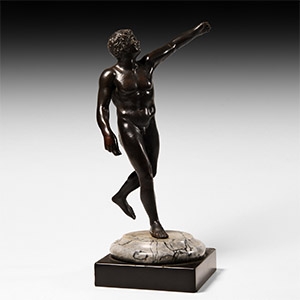
Post Medieval Bronze Statue of a Male
19th century A.D.Estimate: £600 - 800 (+bp*)
Opening Bid: £300
A bronze nude and muscular male figure modelled naturalistically in the round, standing in a dynamic pose; mounted on a tiered display base; repaired. 1.46 kg total, 24 cm high including stand
English private collection. -
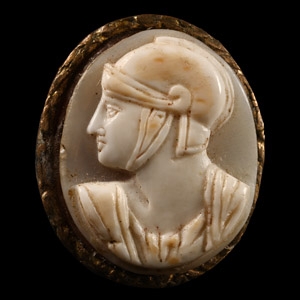
Cameo with Bust of a Roman Soldier
19th century A.D.Sold for (Inc. bp): £33
A shell cameo portraying the draped and cuirassed bust of a Roman soldier facing left, wearing a helmet; attached to an agate backed gilt copper-alloy setting. 4.97 grams, 24 mm
Acquired 1960s-1990s. From the late Alison Barker collection, a retired London barrister. -
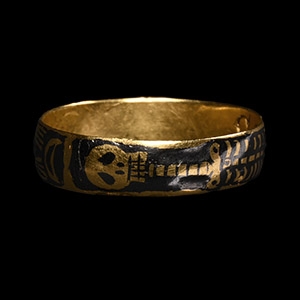
Early Georgian Gold Enamelled Memento Mori Skeleton Ring for 'S N'
Dated 1717 A.D.Sold for (Inc. bp): £4,420
A gold George I period memento mori ring decorated around the exterior with a stylised human skeleton against a black enamelled field, the body featuring an elongated neck, exaggerated numbers of ribs and disproportionately short legs, with a crescent at the base of the feet; interior engraved 'SN 17.17'. 3.15 grams, 20.76 mm overall, 18.77 mm internal diameter (approximate size British Q 1/2, USA 8 1/4, Europe 18.12, Japan 17)
Acquired in the late 1990s-2000. Property of an East London gentleman.
