
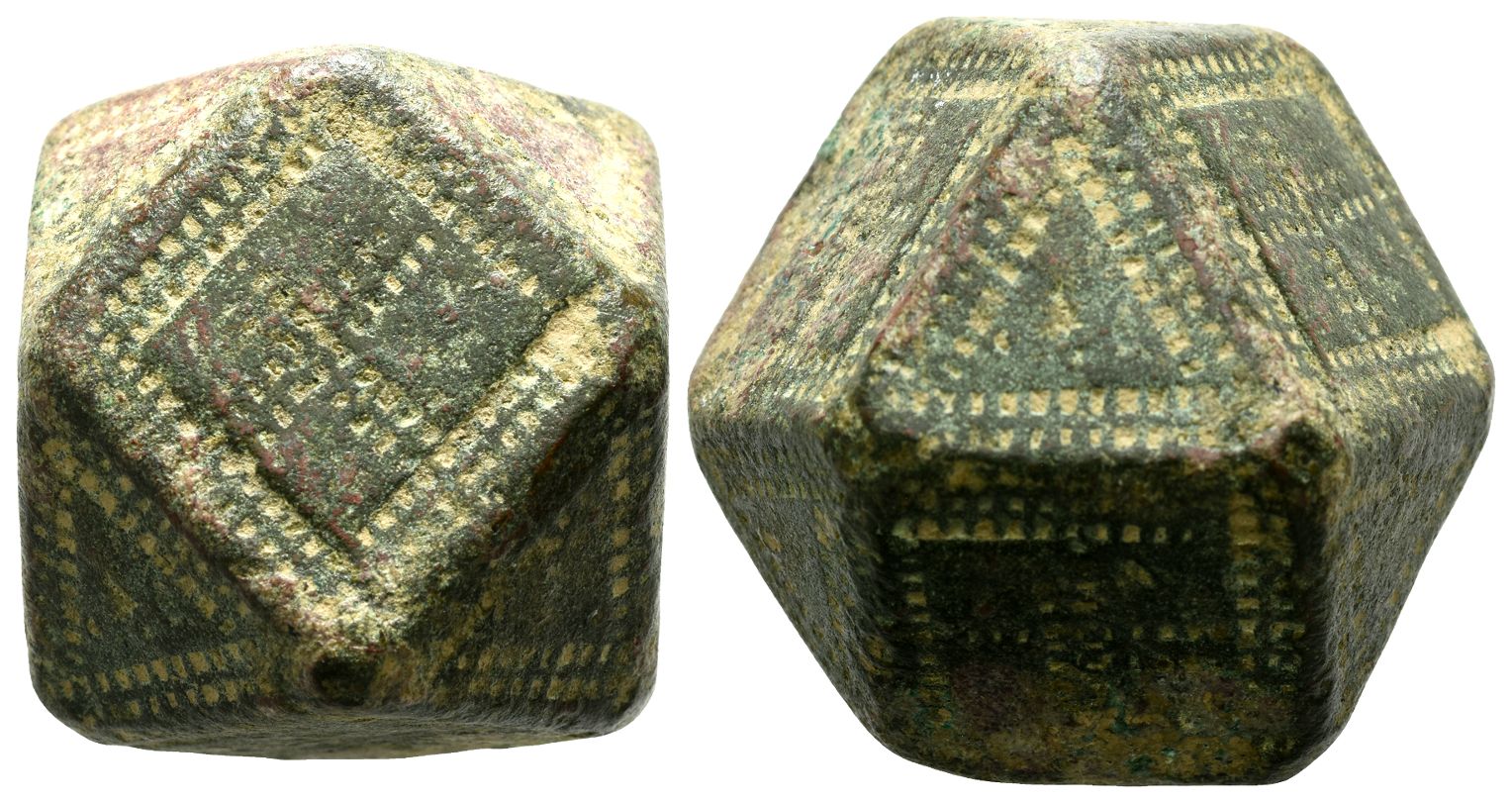
LOT 4179
Islamic Polyhedral Bronze Weight of 50 Dirham. Circa 12th-15th century AD.
Fourteen-sided cubic weight, the sides decorated with pointillé border to each face; the square faces with cruciform pointillé infill. Cf. CPAI 1, 359. Condition as seen.1 1/2 in. (169gr, 38mm.).
ProvenanceAcquired in 1994.
Private collection, thence by descent.
Private collection, since the late 1990s.
TimeLine Auctions follows a vetting process to ensure the authenticity and legality of all items, reinforcing our commitment to integrity and responsible trading. Each antiquity, antique, and coin lot undergoes thorough examination by a vetting committee of at least ten external specialists, professional trade association members, scientists, and archaeologists: Our Vetting Process
AUCTIONS:
TimeLine is a leading auction house specialising in antiquities, ancient art, collectables, natural history, coins, medals, and books. Our auctions offer museums, collectors, historians, and enthusiasts the opportunity to acquire unique and historically significant pieces.
LOT 4179
Islamic Polyhedral Bronze Weight of 50 Dirham.
Estimate £1,000 - 1,400€1,160 - 1,620 (for guidance only)$1,350 - 1,890 (for guidance only)
-
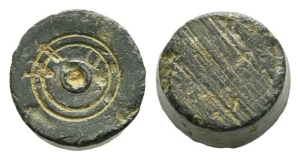
England. Stuart Period Bronze Weight of Sixpence. After 1690.
Sold for (Inc. bp): £33
Circular punch within double circle; VI D(retrograde) around punch / Striated surface. 2.88gr, 11mm.
Condition as seen.
Found whilst searching with a metal detector near Nettlestead, Suffolk, UK. Recorded at British Museum's Portable Antiquities Scheme (PAS) no.SF-8DFBBE.
From PAS: Dr Lisa Brundle comments on LIN-2CB2A6: A weight marked XXX D would have been used to ensure that payment of thirty pence (or half-a-crown) contained the correct amount of silver, rather than silver coins whose face value was thirty pence but which were seriously underweight. Other denominations in this series are VI D (sixpence), XII D (a shilling), and V S (a crown). Weights of both series have been recorded with initials stamped on them, and in several cases, these initials correspond to the initials of the founders who put their names on coin-weight. It is this series that links firmly with the monetary conditions of the 1690s, when the silver coin in circulation was very worn, a situation which eventually led to a major recoinage. -
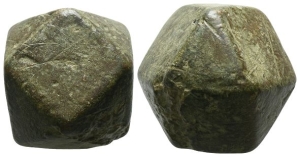
Ottoman Polyhedral Bronze Weight of 100 Dirham. Circa 17th-19th century AD.
Sold for (Inc. bp): £39
Fourteen-sided cubic weight with six large square facets, and eight triangle facets. Cf. Pondera Online 11385. 304gr, 34mm.
Condition as seen.
Ex German art market, 2000s. Acquired from an EU collector living in London. From the collection of a Surrey, UK, gentleman. -
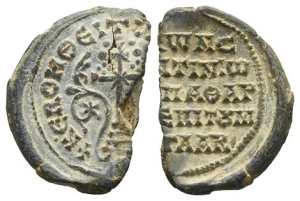
Byzantine Iconographic Lead Seal in the name of Constantine, Imperial Protospatharios(?) and Epi Tou Manglaviou. 10th century AD.
Sold for (Inc. bp): £52
✠ KЄ ROΗΘЄI TѠ [...], large cross set on base and three steps; tendrils and pellets in fields / ✠ [...]ധNC-[...]NTINധ [...]ΠΑΘΑΡ [...]ЄΠΙ ΤᏌ Μ -[...]ΓΛAR' in five lines. Translation: Lord, help [thy servant], Constantine, [Imperial Proto?]spatharios and epi tou manglaviou. DOCBS -; BLS I -; BLS II -. 5.40gr, 26mm, 12h.
Condition as seen. Cut. Unpublished in the standard references.
Acquired on the European coin market. Property of a Kent, UK, gentleman.
