
Loading, please wait...
_900x900.jpg "Iron Age Thracian Iron Machaira Sword with Chape")
_200x200.jpg "Iron Age Thracian Iron Machaira Sword with Chape")
.jpg "Iron Age Thracian Iron Machaira Sword with Chape")
LOT 0269
Iron Age Thracian Iron Machaira Sword with Chape
3RD CENTURY B.C.-1ST CENTURY A.D.
33 in. (1.34 kg total, 84 cm long).
Single-edged iron blade with sturdy back and slightly curved inner cutting edge; fixing pegs with rosette finials for a scale-tang hilt and ellipsoid pommel above with pierced upper face; scabbard chape with trumpet-shaped foot.
ProvenanceEx German art market, 2000s.
Acquired from an EU collector living in London.
From the collection of Surrey, UK, gentleman.
Accompanied by an academic report by Dr Raffaele D'Amato.
This lot has been checked against the Interpol Database of stolen works of art and is accompanied by search certificate no.12495-230594.
This lot has been cleared against the Art Loss Register database, and is accompanied by an illustrated lot declaration signed by the Head of the Antiquities Department, Dr Raffaele D’Amato.
Cf. Torbov, N., Antique Weapons, Plovdiv, 2016, pp.24-25, for similar examples; Webber, C., The Thracians, 700 BC-AD 46,, Oxford, 2001, p.38 for similar examples; Marazov, I., Thracian Warrior, Sofia, 2005, p.15, for similar machaira from Orlovo.
CONDITIONTimeLine Auctions follows a vetting process to ensure the authenticity and legality of all items, reinforcing our commitment to integrity and responsible trading. Each antiquity, antique, and coin lot undergoes thorough examination by a vetting committee of at least ten external specialists, professional trade association members, scientists, and archaeologists: Our Vetting Process
AUCTIONS:
TimeLine is a leading auction house specialising in antiquities, ancient art, collectables, natural history, coins, medals, and books. Our auctions offer museums, collectors, historians, and enthusiasts the opportunity to acquire unique and historically significant pieces.
-
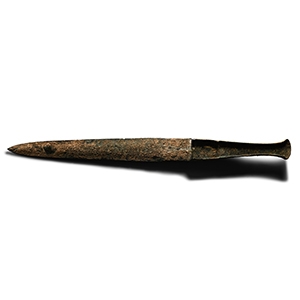
Luristan Bronze Dirk
13th-12th century B.C.Estimate: £300 - 400 (‡+bp*)
Opening Bid: £150
With lentoid-section blade, tongue-shaped in plan, integral tapering hilt with flared finial, lateral flanges to accept a panel of bone or wood to each face forming the grip. 174 grams, 34 cm
Ex Joseph J. Gancie (1923-2010), Washington, Silver Spring, Maryland. with Alex Cooper Auctioneers Inc., sale 1035, 27 January 2013, lot 162a. This lot is accompanied by an illustrated lot declaration signed by the Head of the Antiquities Department, Dr Raffaele D’Amato.
The dirk belongs to the type III in the Medvedskaya classification, used in Near East from the 13th to the 6th century B.C. The type is the 32a of the Maxwell-Hyslop study. The Asiatic daggers of this type are confined to Syria and Persia, but Transcaucasia also provides an interesting analogy from Kalekent on the Baku peninsula, where a pointed straight-sided dagger blade has a flanged hilt with the whole of the side flanges bent over the centre. -
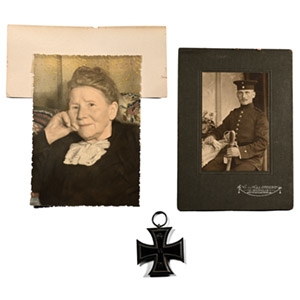
WWI Imperial German Iron Cross with Military Photograph
1914-1918 A.D.Sold for (Inc. bp): £33
2nd class; with KO' on ring, probably for 'Königliches Munzamt Orden, Berlin'; offered with a photograph of the awardee, and another of his relative. 49 grams, 5.8-17 cm
Ex Leipzig collection, Germany. From a Leicestershire, UK, collection. This lot is accompanied by an illustrated lot declaration signed by the Head of the Antiquities Department, Dr Raffaele D’Amato. -
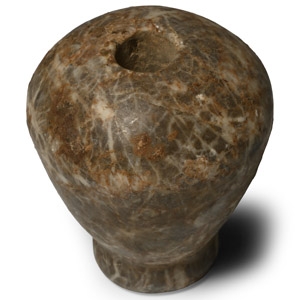
Western Asiatic Stone Macehead
3rd-2nd millennium B.C.Sold for (Inc. bp): £117
Tubular in form with tapering profile and balustered socket. 342 grams, 75 mm
From the collection of a London, UK, gentleman, 1990s. This lot is accompanied by an illustrated lot declaration signed by the Head of the Antiquities Department, Dr Raffaele D’Amato.
