
Loading, please wait...
LOT 0268
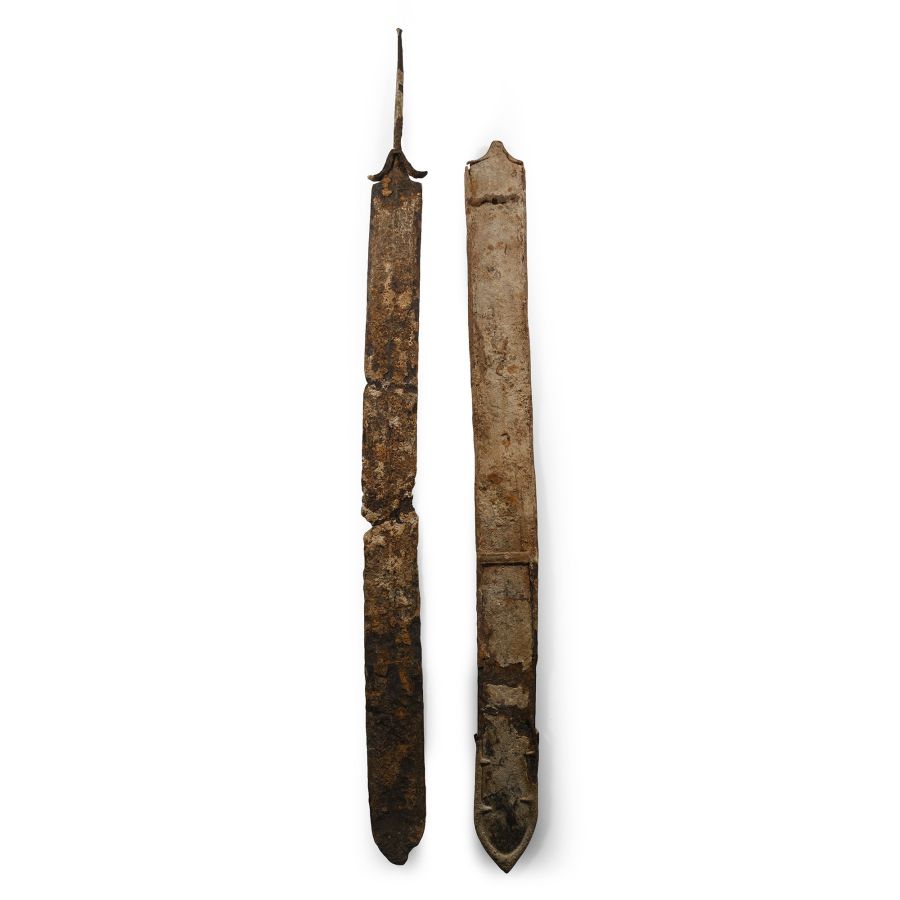
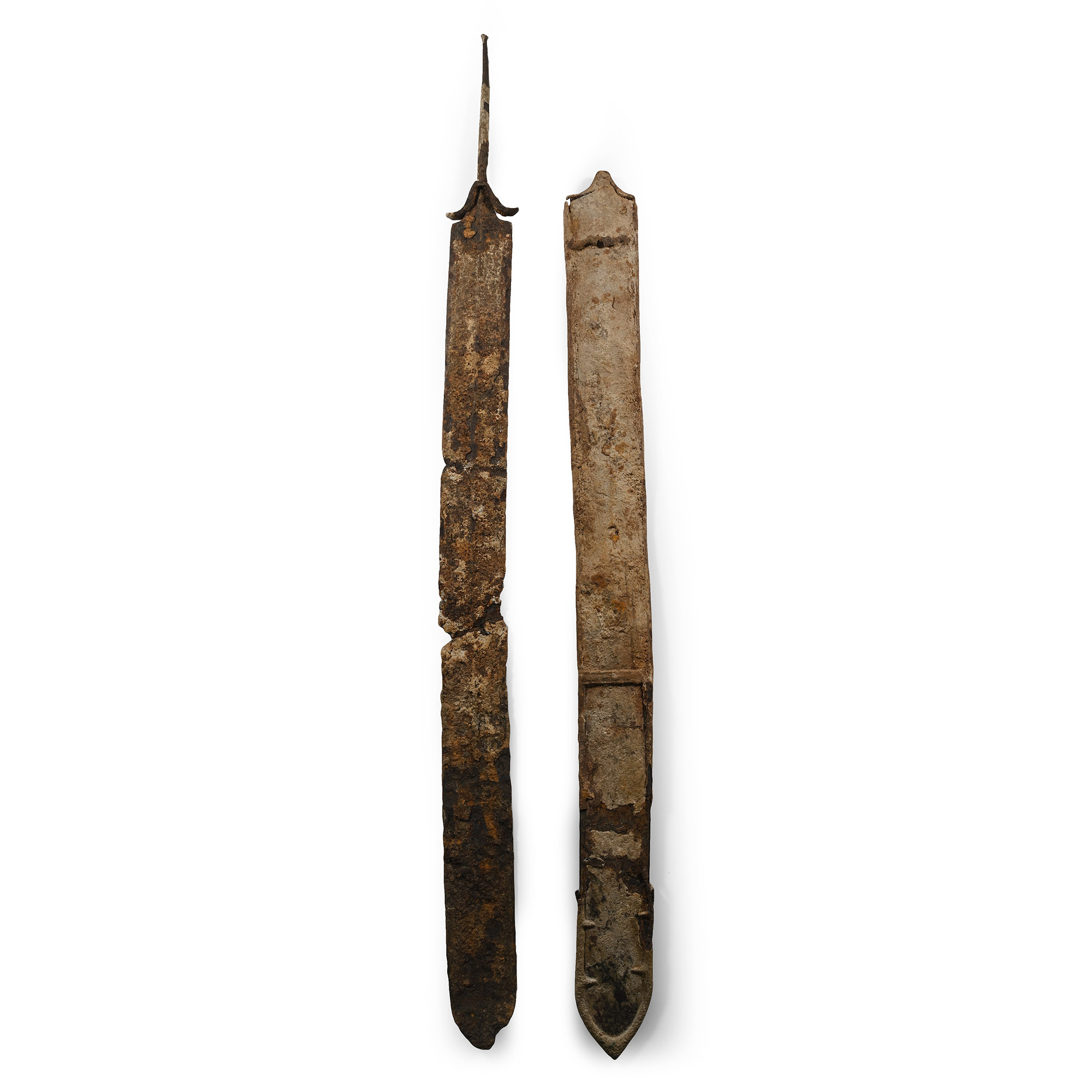
Iron Age Celtic Iron La Tene Sword with Scabbard
250-120 B.C.
25 1/4 - 30 in. (1.06 kg total, 64-76 cm).
Comprising a double-edged sword, the blade terminating in a round point, a shallow groove running along both sides of the blade, lozenge-section grip with four edges; supplied with a curved guard and a small cylindrical pommel; the scabbard with edged borders and the slide scabbard for the fastening of the suspension chain. [2]
ProvenanceEx German art market, 2000s.
Acquired from an EU collector living in London.
From the collection of Surrey, UK, gentleman.
This lot is accompanied by an illustrated lot declaration signed by the Head of the Antiquities Department, Dr Raffaele D’Amato.
Cf. Connolly, P., Greece and Rome at war, London, 2006, pp.116-117, esp. figs. 7,7a, 20; Torbov, N., Antique Weapons, Plovdiv, 2016, pp.47-64, for similar examples.
FootnotesThe sword belongs to the period of the last Celtic deeds in Europe, when their warriors succeededin sacking the Holy Sanctuary of Delphi in Greece. Livy, based upon the text of Polybius generically speaks of 'Gallica arma' and 'ferrum', the latter synonymous of a sword (Livy, XXI, 42, 1-4). Diodorus tells us that the swords were worn by the Celts on the right side, hanging from a belt tied around his waist and were not carried hanging from a baldric over the shoulder like the Greeks or the Etruscans (V, 30, 3). He describes (V, 29 and 30) the fighting techniques of the Celts (combat chariot) and a list of all the weapons used: shields as tall as a man which exhibit embossed figures of animals in rolled brass with both decorative and protective function; the brass helmets with high crests, horns, or with figures of birds and quadrupeds to the top; a chainmail armour in iron; long swords hanging from the right side by means of iron and bronze chain; spears; javelins; war trumpets with hoarse sounds; and gold or silver plated belts.
CONDITIONTimeLine Auctions follows a vetting process to ensure the authenticity and legality of all items, reinforcing our commitment to integrity and responsible trading. Each antiquity, antique, and coin lot undergoes thorough examination by a vetting committee of at least ten external specialists, professional trade association members, scientists, and archaeologists: Our Vetting Process
AUCTIONS:
TimeLine is a leading auction house specialising in antiquities, ancient art, collectables, natural history, coins, medals, and books. Our auctions offer museums, collectors, historians, and enthusiasts the opportunity to acquire unique and historically significant pieces.
LOT 0268
Iron Age Celtic Iron La Tene Sword with Scabbard
Estimate £1,200 - 1,700€1,390 - 1,970 (for guidance only)$1,620 - 2,300 (for guidance only)
-
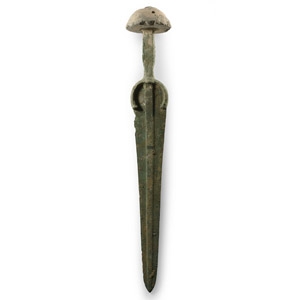
Luristan Bronze Sword
Late 2nd millennium B.C.Sold for (Inc. bp): £468
With solid cast hilt and penannular guard, a massive grip with a later mushroom pommel, blade with central flat midrib tapering to a sharp tip. 967 grams, 52.5 cm
Acquired 1980-2015. Ex Abelita family collection. This lot is accompanied by an illustrated lot declaration signed by the Head of the Antiquities Department, Dr Raffaele D’Amato.
This sword is typical of the North-Western Iranian regions at the end of 2nd millennium B.C. Corresponding specimens found in Amarlu or other localities (Gheshlag Mazandaran Province) show that they were fitted with hollow-cast bronze mushroom pommels. The hilt was solid cast with penannular guard, and the blade was usually multi-fullered, but the specimen from Northern Iran published by Khorasani is fitted with a single fuller like our sword. -
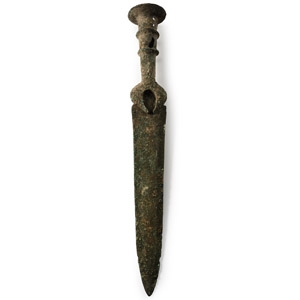
North-Western Persian Bronze Dagger
Late 2nd-early 1st millennium B.C.Sold for (Inc. bp): £1,170
The blade with shallow midrib, hilt cast with two horizontal grooves and crescentic guard. 354 grams, 31.5 cm
Acquired 1980-2015. Ex Abelita family collection. This lot is accompanied by an illustrated lot declaration signed by the Head of the Antiquities Department, Dr Raffaele D’Amato.
Moorey, Gordon and Khorasani created a classification of bladed weapons, according to which daggers are edged weapons not greater than 36cm in length, dirks (short swords) are between 36cm and 50cm in length, and swords are edged weapons greater than 50cm in length. -
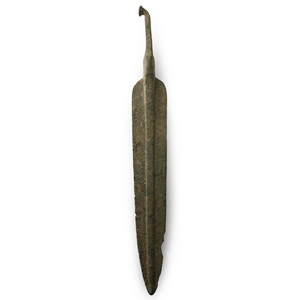
Massive Amlash Bronze Spearhead Blade
13th-12th century B.C.Estimate: £100 - 140 (+bp*)
Opening Bid: £50
With large ovate blade, broad midrib, rounded shoulders and rectangular-section tang with bent tip ending with a button. 370 grams, 42.5 cm
Acquired 1980-2015. Ex Abelita family collection. This lot is accompanied by an illustrated lot declaration signed by the Head of the Antiquities Department, Dr Raffaele D’Amato.
The massive spearhead belongs to type 1 of the Khorasani classification. Similar excavated examples from Marlik attest the use of such spearheads with bent tang in the area, and Stutzinger dated such weapons to 1200-1100 B.C. The type was the evolution of a typology which began much earlier in Mesopotamia and the fertile crescent, the type 4 of the Stronach classification, with straight square-section tang, usually thickened at the base with a button tang.
