
Loading, please wait...
_900x900.jpg "Iron Age British Celtic Enamelled Bronze Dragonesque Brooch")
_200x200.jpg "Iron Age British Celtic Enamelled Bronze Dragonesque Brooch")
.jpg "Iron Age British Celtic Enamelled Bronze Dragonesque Brooch")
LOT 0327
Iron Age British Celtic Enamelled Bronze Dragonesque Brooch
1ST-2ND CENTURY A.D.
1 5/8 in. (6.12 grams, 41.6 mm).
Delicately moulded brooch with low-relief detailing, cells to accept enamel fill; S-curved pin in situ, the broad end wound around the shank.
ProvenanceFound Norfolk, Southern England.
Acquired on the UK art market in the 1980s.
From an East Anglian private collection.
Accompanied by an old Norfolk Castle Museum record slip.
TimeLine Auctions follows a vetting process to ensure the authenticity and legality of all items, reinforcing our commitment to integrity and responsible trading. Each antiquity, antique, and coin lot undergoes thorough examination by a vetting committee of at least ten external specialists, professional trade association members, scientists, and archaeologists: Our Vetting Process
AUCTIONS:
TimeLine is a leading auction house specialising in antiquities, ancient art, collectables, natural history, coins, medals, and books. Our auctions offer museums, collectors, historians, and enthusiasts the opportunity to acquire unique and historically significant pieces.
LOT 0327
Iron Age British Celtic Enamelled Bronze Dragonesque Brooch
Sold for (Inc. bp): £520
-
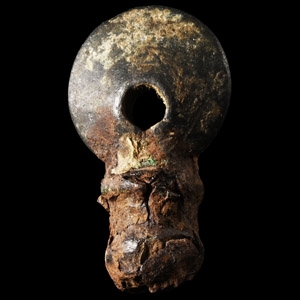
Iron Age Celtic Bronze Lynch Pin Terminal
1st century B.C.-1st century A.D.Sold for (Inc. bp): £20
Comprising a ferrous shank and bronze finial formed as a waisted bulb and biconvex disc with eccentrically placed hole. 26.6 grams, 38 mm
Found Hampshire, UK. -
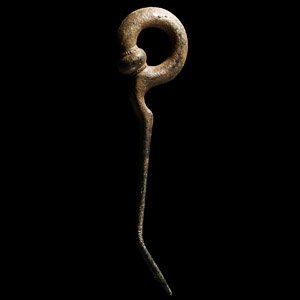
Iron Age British Celtic Bronze Decorated Ring-Headed Pin
Late 1st millennium B.C.Sold for (Inc. bp): £109
With tapering shank and integral ring with bulb finial; shank pierced below the junction with the bulb. 16 grams, 87 mm
Found Norfolk, Southern England. Acquired on the UK art market in the 1980s. From an East Anglian private collection. Accompanied by an old Norfolk Castle Museum record slip. -
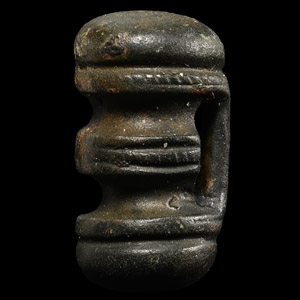
Iron Age Celtic 'Published' Bronze Toggle Fastener
Circa 1st century B.C.-1st century A.D.Sold for (Inc. bp): £72
Of dumbell type comprising two globular hemispherical terminals joined by a D-sectioned shaft with central raised semi-circular moulding, integral raised collars are present where the shaft and terminals meet, each with transverse grooved decoration. 17.3 grams, 23 mm
Found whilst searching with a metal detector near Langtoft, East Riding of Yorkshire, UK, circa 2018. Accompanied by a copy of the British Museum's Portable Antiquities Scheme (PAS) report no.YORYM-C8A176.
