
Loading, please wait...
LOT 1019
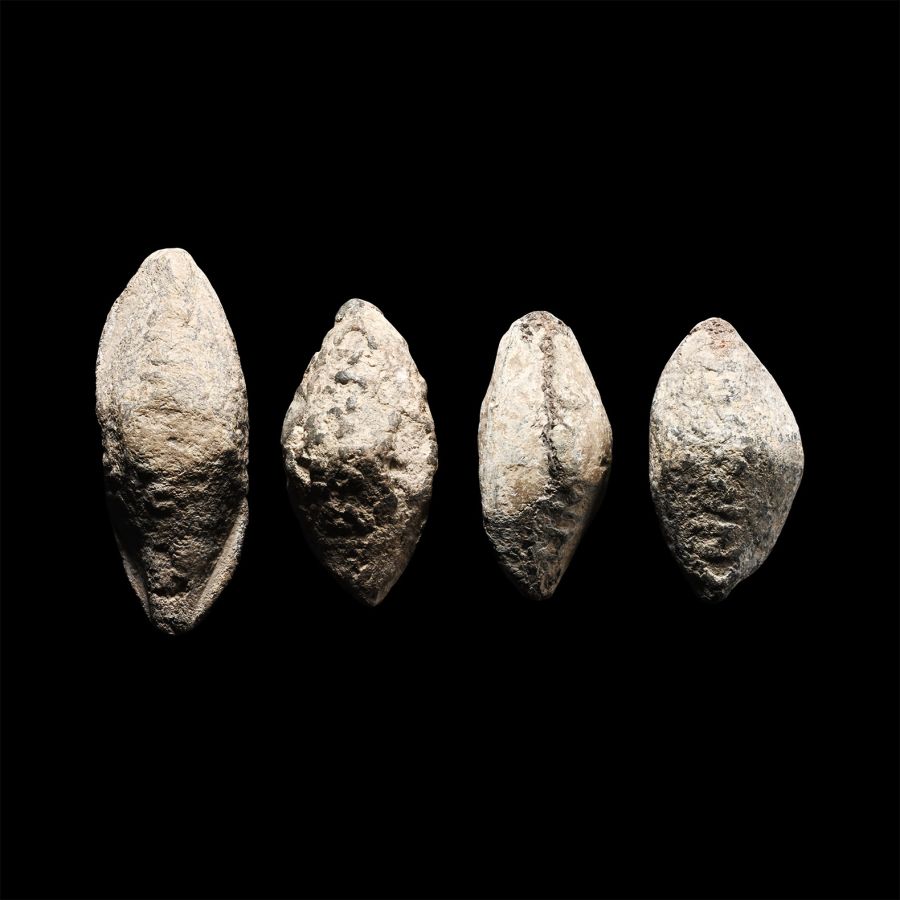
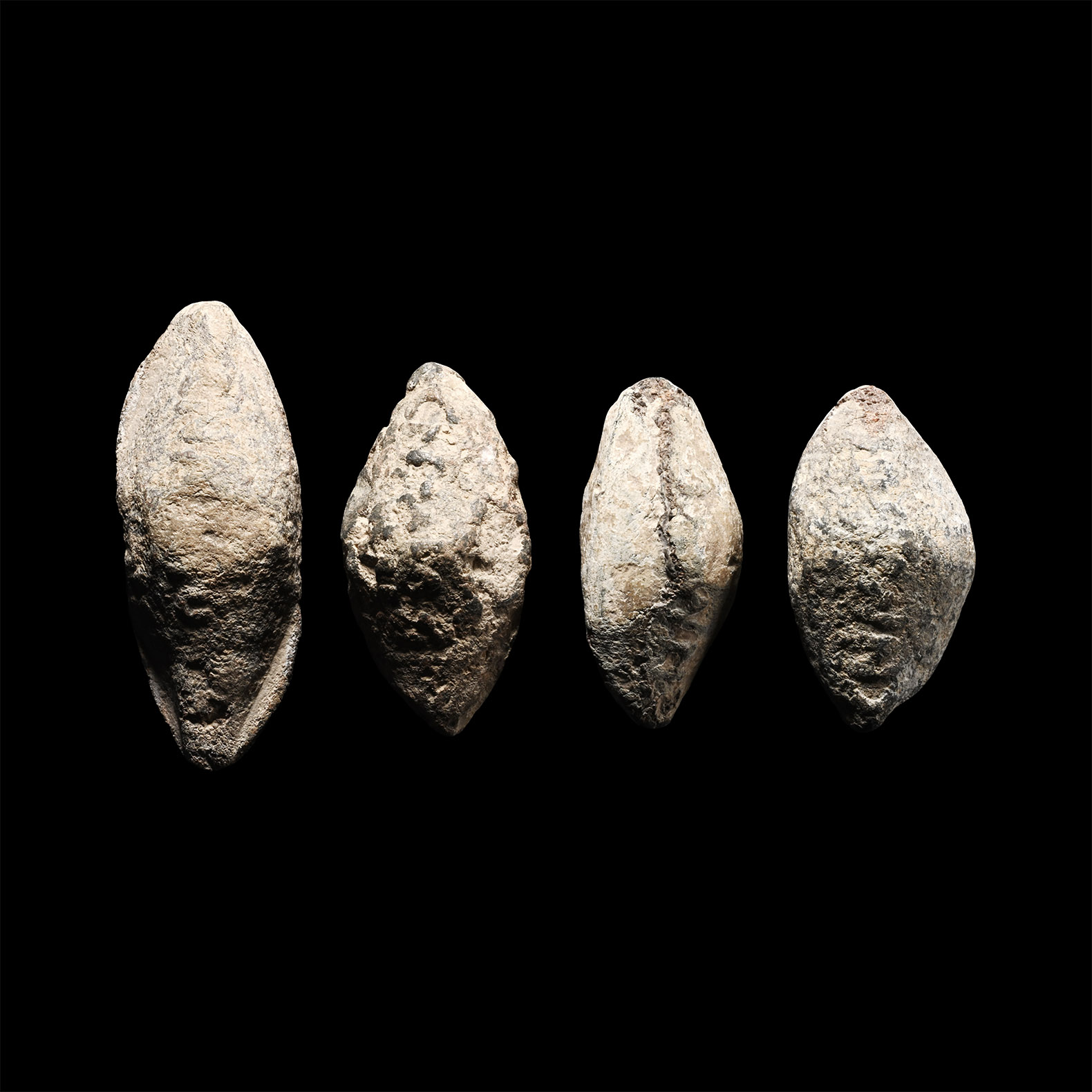
Roman Inscribed Lead Slingshot Group
17 MARCH 45 B.C.
1 1/2 - 2 in. (216 grams total, 37-50 mm).
Comprising four scaphoid lead slingshots (glandes), each with traces of low-relief inscription(s) referring to 'CN P[OMPEIUS]'. [4, No Reserve]
ProvenanceEx M.Cummings, UK, 1990s.
LiteratureCf. D'Amato, R. and Sumner, G., Arms and Armour of the Imperial Roman Soldier: From Marius to Commodus, 112 BC-AD 192, London, 2009, fig.32, p.45, for similar glandes from Zaragoza Museum, the one with the name of Pompey inscribed coming from Munda battlefield.
FootnotesThese shots (mainly of type IIb of the Völling classification) are marked with the abbreviated name of Cn.Pompeius; they were used in quantity at the Battle of Monda (or Munda) against the Caesarian troops, by the followers of Pompey, on 17th March 45 B.C. Similar missiles were used in
the civil war between Pompey and Caesar, and in all Caesar's wars. The projectiles of the slingers could be in lead (glandes) or in pottery or stone (lapides). Sometimes they were signed with the name of the general, or used to report some injuries, for example the sling missile found in Alesia with the name of Labienus.
TimeLine Auctions follows a vetting process to ensure the authenticity and legality of all items, reinforcing our commitment to integrity and responsible trading. Each antiquity, antique, and coin lot undergoes thorough examination by a vetting committee of at least ten external specialists, professional trade association members, scientists, and archaeologists: Our Vetting Process
AUCTIONS:
TimeLine is a leading auction house specialising in antiquities, ancient art, collectables, natural history, coins, medals, and books. Our auctions offer museums, collectors, historians, and enthusiasts the opportunity to acquire unique and historically significant pieces.
-
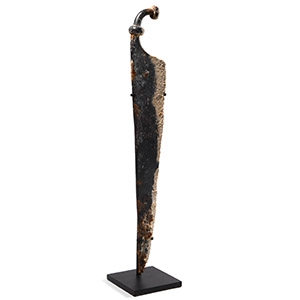
Iron Age Celtic La Tene Dagger
1st century B.C.-1st century A.D.Sold for (Inc. bp): £975
Featuring a gently curved single-edged iron blade and one-sided fuller, curved handle with knot pommel; mounted on a custom-made display stand. 525 grams total, 35 cm high including stand
Dutch art market. Private collection of K.S., Cologne, Germany, acquired 1996.
One of the military insignia of a Celtic warrior was the war-knife, usually between 33 and 35 cm long. For example, in the collection of Celtic military equipment from Galish-Lovachka, the archaeologists have found a short sword with an X-shaped handle (l = 41 cm), two middle La Tène swords (72.5 and 75 cm long), 12 large curved knives, 27 spearheads, two javelin heads, 14 arrowheads, and nine iron chain belts for hanging a sword. The war-knife was also used for hunting, as a spare weapon, or to cut the throat of an enemy in a surprise attack. -
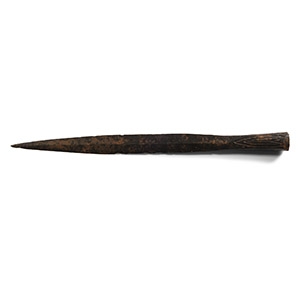
Viking Age Socketted Iron Spearhead
9th-10th century A.D.Sold for (Inc. bp): £195
Type E with leaf-shaped blade with curved edges, socket tending towards a square internal cross-section and decorated with chiselled longitudinal grooves. 126 grams, 28.5 cm
Ex private collection of Mr M.B., Mainz, Germany, since the 1980s. Acquired from the above, 2004.
The spearheads of type E, of which this type is, belongs to the first group of Viking spearheads, i.e. the Frankish spearheads, which appeared between 750 and 950 A.D. These account for one third of the spears found in Viking sites; most of them are pattern forged with herringbone design. -
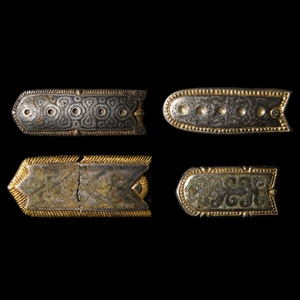
Viking Rus Silver-Gilt Sword Belt End Group
10th century A.D.Sold for (Inc. bp): £338
Comprising four sword belt strap ends of roughly rectangular form, with one rounded or gabled end and one fishtail end, each bearing a different nielloed decorative scheme, comprising: one with split front plate bearing geometric foliage framed by radiating lines to the perimeter; one with pelletted border and medial scrolled bar; one displaying a medial row of circular recesses and surrounding circular motifs; one decorated with five medial circular recesses on a ground of foliate forms, pellet border; all with a set of mounting lugs to the reverse. 34 grams total, 37-50 mm
Fine condition.
Acquired in the 1980s-1990s. Ex an important central London gallery, London W1.
During the medieval period, belts had a range of functions. They girdled the clothes and enabled suspension of small items such as knives, whetstones, purses and leather bags. The decoration of the belt depended on the social status of its owner: peasants wore woven and simple leather straps, whereas feudal lords, prominent warriors, and princes wore golden belts, which were passed down through the generations.
