
Loading, please wait...
LOT 2664
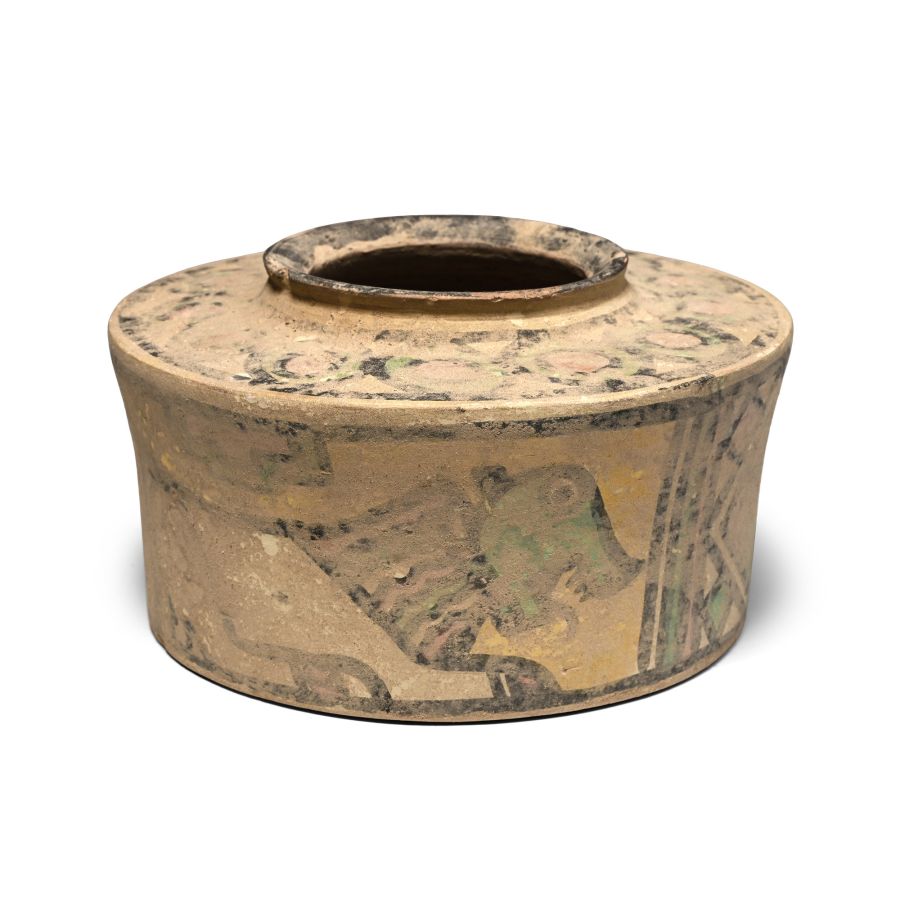
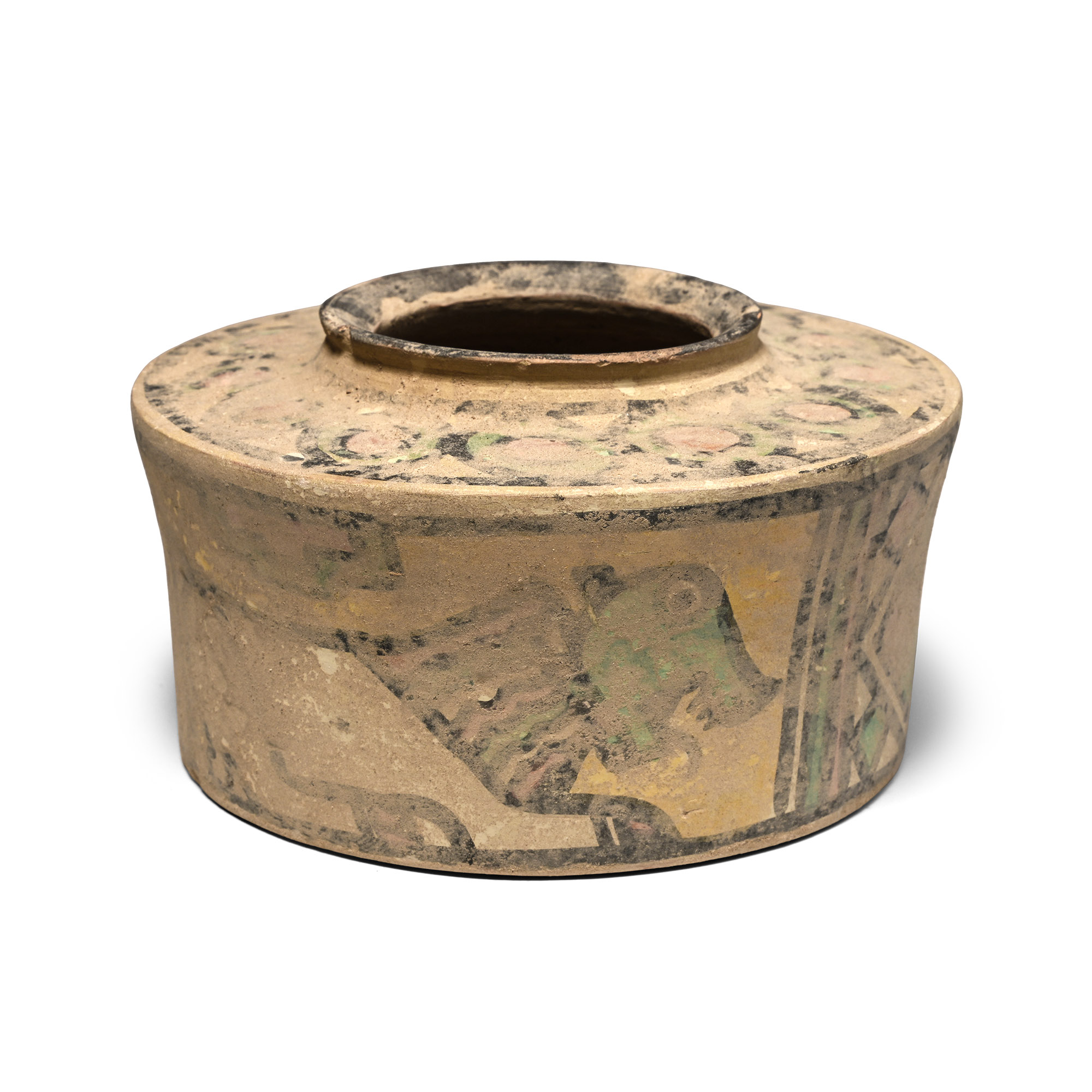
Indus Valley Terracotta Vessel with Animals
3RD-2ND MILLENNIUM B.C.
4 3/4 in. (376 grams, 12 cm wide).
With a sloping sidewall, flat shoulder and everted rim to the broad mouth; painted geometric bands and zoomorphic panels on the side and shoulder. [No Reserve]
ProvenanceFrom the private collection of the late David Gold, 1990s.
David Gold was one of the co founders of the Iconic Lord John brand in Carnaby Street that sparked a style revolution in the swinging sixties dressing The Rolling Stones, The Beatles and The Kinks and were at the heart of 'all things cool'.
See Satyawadi, S., Proto-Historic Pottery of Indus Valley Civilisation: Study of Painted Motifs, Perspectives in Indian Art and Archaeology, vol.2, New Delhi, 1994, colour illustration no.4, for the type of vessel.
FootnotesSimilar bowls were found at Nal, appearing to be canister-like vessels with circular openings. As here, it is a buff ware with traces of blue and red patterns, and repeated geometrical design, here enriched with the image of a wild beast.
CONDITIONTimeLine Auctions follows a vetting process to ensure the authenticity and legality of all items, reinforcing our commitment to integrity and responsible trading. Each antiquity, antique, and coin lot undergoes thorough examination by a vetting committee of at least ten external specialists, professional trade association members, scientists, and archaeologists: Our Vetting Process
AUCTIONS:
TimeLine is a leading auction house specialising in antiquities, ancient art, collectables, natural history, coins, medals, and books. Our auctions offer museums, collectors, historians, and enthusiasts the opportunity to acquire unique and historically significant pieces.
-
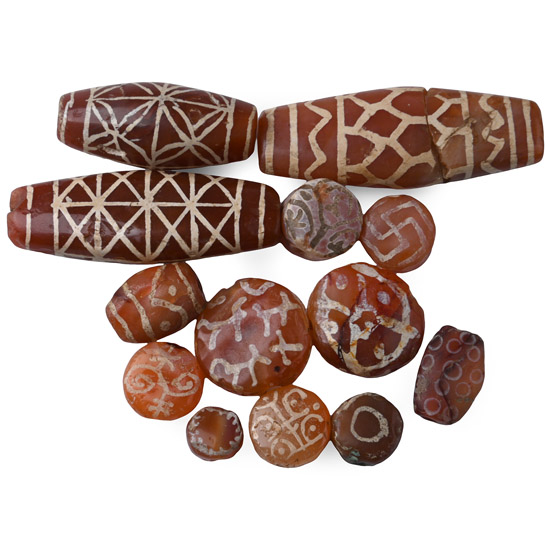
Large Indus Valley Etched Orange Carnelian Necklace Bead Collection
Circa 2nd millennium B.C.Sold for (Inc. bp): £624
Comprising: a barrel-shaped bead with floral decoration, two flattened barrel-shaped beads with geometric motifs, one discoid bead with crux gammata, and other beads with geometric decoration. 61.03 grams total, 9.84-49.06 mm
From the private collection of a European gentleman (1942-2024), formed since the 1970s.
Etched carnelian beads are characteristic of the Indus Valley culture and have been produced since the third millennium B.C. They are a typical product of the Harappa culture, but they are also attested in later millennia and produced elsewhere in Southeast Asia. The oldest specimens come from the Indus Valley and from Mesopotamia. A few specimens were found in the so-called royal cemetery of Ur, where they were identified in the excavation publication as coming from India. -
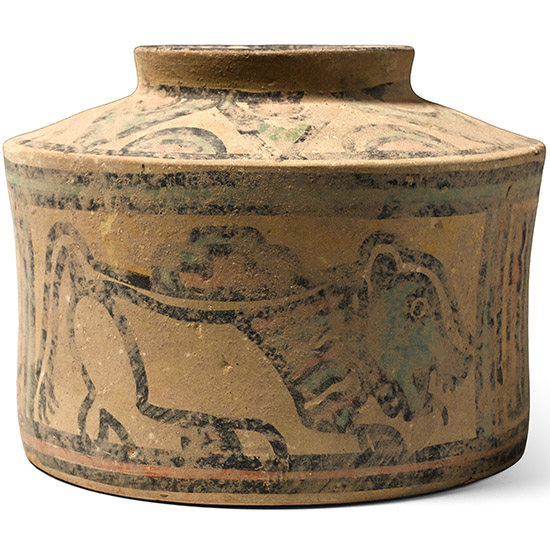
Indus Valley Terracotta Vessel with Animals
3rd-2nd millennium B.C.Sold for (Inc. bp): £164
With slightly sloping sidewall, flat shoulder and everted rim to the broad mouth; painted geometric bands and zoomorphic panels to side and shoulder. 458 grams, 12 cm wide
From the private collection of the late David Gold, 1990s. David Gold was one of the co founders of the Iconic Lord John brand in Carnaby Street that sparked a style revolution in the swinging sixties dressing The Rolling Stones, The Beatles and The Kinks and were at the heart of 'all things cool'.
Similar bowls were found at Nal, appearing to be canister-like vessels with circular openings. As here, it is a buff ware with traces of blue and red patterns, and repeated geometrical design, here enriched with the image of a wild beast. -
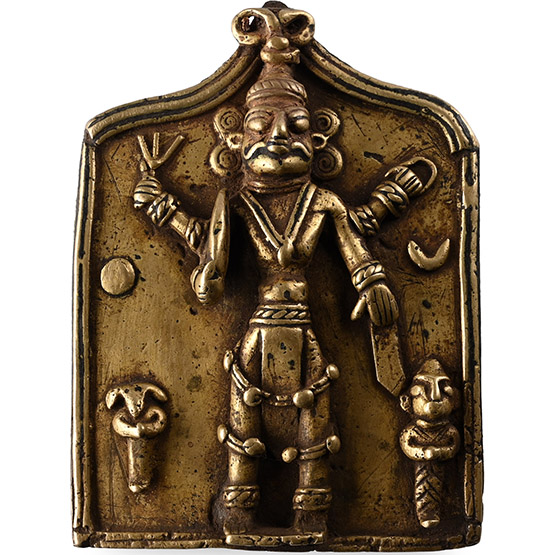
Sacred Brass Plaque with Shiva and Attendants
India, 19th century A.D.Sold for (Inc. bp): £72
Tongue-shaped plaque with half-round figure of Virabhadra Shiva, flanked by attendants. 507 grams, 13.8 cm
From an important collection of Hindu art formed by Jeffrey Romer, 1990s. Ex central London, UK, gallery.
