
Loading, please wait...
_900x900.jpg "Indus Valley Painted Terracotta Bowl Decorated with Figures")
_200x200.jpg "Indus Valley Painted Terracotta Bowl Decorated with Figures")
.jpg "Indus Valley Painted Terracotta Bowl Decorated with Figures")
LOT 0867
Indus Valley Painted Terracotta Bowl Decorated with Figures
CIRCA 2000 B.C. AND LATER
2 5/8 - 5 7/8 in. (727 grams total, 6.8 - 15 cm).
Comprising: a squat biconical bowl with broad base, tiered bands of geometric hatched ornament in red and brown shades; terracotta idol figure with raised arms, dimpled rump and hooked head; offered with a later ceramic figurine and a conical pylon. [4, No Reserve]
ProvenanceAcquired 1980-2015.
Ex Abelita family collection.
TimeLine Auctions follows a vetting process to ensure the authenticity and legality of all items, reinforcing our commitment to integrity and responsible trading. Each antiquity, antique, and coin lot undergoes thorough examination by a vetting committee of at least ten external specialists, professional trade association members, scientists, and archaeologists: Our Vetting Process
AUCTIONS:
TimeLine is a leading auction house specialising in antiquities, ancient art, collectables, natural history, coins, medals, and books. Our auctions offer museums, collectors, historians, and enthusiasts the opportunity to acquire unique and historically significant pieces.
LOT 0867
Indus Valley Painted Terracotta Bowl Decorated with Figures
Sold for (Inc. bp): £416
-

Old Babylonian Clay Cuneiform Tablet with A Letter Possibly Sent to the King of Ešnunna by an Allied King
Late 18th century B.C.Sold for (Inc. bp): £1,950
Displaying the contents of a letter over both principal faces and side edges, reading: 1-2) Say to [...], thus says [...]. 3) About the people who perjured themselves against Sîn and Šamaš, 4) I keep writing to you. You didn't send them to me. 5) The money I find myself constantly looking for is not yours! 6) Isn't it the money of the god of your city and aren't you going to get yourself killed? 7) This money belongs to Sîn and Šamaš. 8-9) Pirhi-Amurru, who took (to marry) the daughter of the leader of the troop, 9-10) had no right since his father, his father's father to kidnap a foreign servant. Now he must give her back in his own hands ten talents of silver and two talents of gold [...]. 12-13) Why did an army of 10,000 soldiers [who] sit before you] not give [to ... but] 14) give the daughter of the chief of the soldiers to Pirhi-Amurru? 15) Now I have just dispatched my messengers to you. 16-17) To Šamaš-tayyar their chief give the daughter of the chief of the soldiers! 18) In addition, let me take Siriša (?) with her. 19-20) I want to see (from you) in these things a complete commitment. [...] 22) Imgur-[... NP...], 23) Ibbi-ilabrat, [NP], 24) Ṣilli-bitum, Gimil-Ak[kadu (?)... and NP], 22-25) send me these people. 26) Why have the citizens of Emut-bal (?) 27-28) who reside before you, taken the lead...? And ... 29-30) Babylon ... sent you a written warning concerning you thus: 'the troops ...' 32) 20 troops of mine [...]. 33) You brought oxes and sheep. 34-35) The fact that I (who am) your ally ... keep writing to you concerning ... and Pirhum...but you did not have me (them) drive. (Lacunar). 1') I keep hearing about... the treasure of Sîn and Šamaš. 2') My messages to you... 3')Write to me (if there is) a difficulty 4'5') so that I may write for the treasure to be loaded (on a boat). [...]. 207 grams, 10.8 cm
Specialised collection of cuneiform texts, the property of a London gentleman and housed in London before 1992. Thence by descent to family members. Examined by Professor Wilfrid George Lambert FBA (1926-2011), historian, archaeologist, and specialist in Assyriology and Near Eastern archaeology, in the late 1980s and early 1990s. The collection is exceptional for the variety of types, including some very rare and well preserved examples. -
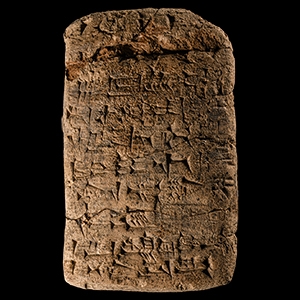
Babylonian Cuneiform Clay Tablet
Circa 2000 B.C.Sold for (Inc. bp): £624
With impressed text to both principal faces, reading: 1) 70 sar of land (1 quarter hectare) 2) [...], 3) (for the price of) 6 shekels of silver, 4-7) Aradmu bought from Huwawa son of Suda and Sugunu son of Itiya. 8-12) Ur-Enlil son of Lu-Nanna, Beli-damiq, Lani priest-oint, Šu-Iškur are the witnesses. 13-14) In the day of the 28th of the month Dukuga, 15-17) the year the governor of Anšan married the king's daughter ; repaired. 116 grams, 83 mm
Acquired before 1990s/early 2000s. From the family collection of Jack Lyttle (1944-2023), Kilmacolm, Scotland; thence by descent to his granddaughter. Property of an East Sussex, UK, gentleman. -
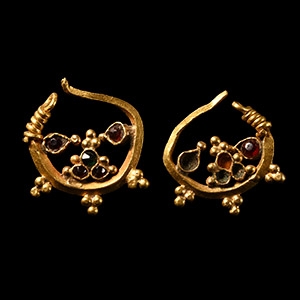
Western Asiatic Gold Gem-Set Earrings
2nd-4th century A.D.Estimate: £600 - 800 (+bp*)
Opening Bid: £333
Comprising two diamond-section penannular hoops with loops; each with three granulated pyramids to the lower edge; the centre of the hoop with a triple-cell set with one green and two red glass (?) gems with granulated outer edges, flanked by two teardrop-shaped cells set with a red glass (?) gem. 2.76 grams total, 19-21 mm
From a late Japanese specialist collector, 1970-2000s.
