
Loading, please wait...
_900x900.jpg "Indus Valley Etched Orange Carnelian Necklace Bead Group")
_200x200.jpg "Indus Valley Etched Orange Carnelian Necklace Bead Group")
.jpg "Indus Valley Etched Orange Carnelian Necklace Bead Group")
LOT 2456
Indus Valley Etched Orange Carnelian Necklace Bead Group
CIRCA 2ND MILLENNIUM B.C.
1/8 - 5/8 in. (7.68 grams total, 3-15 mm).
Comprising polished beads in various sizes with etched geometric designs. [43, No Reserve]
ProvenanceEx UK gallery, early 2000s.
This lot is accompanied by an illustrated lot declaration signed by the Head of the Antiquities Department, Dr Raffaele D’Amato.
Cf. Nandagopal, P., ‘Decorated Carnelian Beads from the Indus Civilization Site of Dholavira (Great Rann of Kachchha, Gujarat)’ in Frenez, D., Jamison, G.M., Randall, W.L., Vidale, M., Meadow, R.H., Walking with the Unicorn Social Organization and Material Culture in Ancient South Asia, Oxford, 2018, pp.475-485, figs.3,8,9.
FootnotesEtched carnelian beads are characteristic of the Indus Valley culture and have been produced since the third millennium B.C. They are a typical product of the Harappa culture, but they are also attested in later millennia and produced elsewhere in Southeast Asia. The oldest specimens come from the Indus Valley and from Mesopotamia. A few specimens were found in the so-called royal cemetery of Ur, where they were identified in the excavation publication as coming from India.
CONDITIONTimeLine Auctions follows a vetting process to ensure the authenticity and legality of all items, reinforcing our commitment to integrity and responsible trading. Each antiquity, antique, and coin lot undergoes thorough examination by a vetting committee of at least ten external specialists, professional trade association members, scientists, and archaeologists: Our Vetting Process
AUCTIONS:
TimeLine is a leading auction house specialising in antiquities, ancient art, collectables, natural history, coins, medals, and books. Our auctions offer museums, collectors, historians, and enthusiasts the opportunity to acquire unique and historically significant pieces.
LOT 2456
Indus Valley Etched Orange Carnelian Necklace Bead Group
Sold for (Inc. bp): £494
-
.jpg)
Indus Valley Etched Orange Carnelian Necklace Bead Group
Circa 2nd millennium B.C.Sold for (Inc. bp): £494
Comprising polished beads in various sizes with etched geometric designs. 7.68 grams total, 3-15 mm
Ex UK gallery, early 2000s. This lot is accompanied by an illustrated lot declaration signed by the Head of the Antiquities Department, Dr Raffaele D’Amato.
Etched carnelian beads are characteristic of the Indus Valley culture and have been produced since the third millennium B.C. They are a typical product of the Harappa culture, but they are also attested in later millennia and produced elsewhere in Southeast Asia. The oldest specimens come from the Indus Valley and from Mesopotamia. A few specimens were found in the so-called royal cemetery of Ur, where they were identified in the excavation publication as coming from India. -
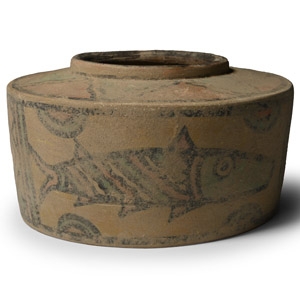
Indus Valley Painted Terracotta Vessel with Fishes
3rd-2nd millennium B.C.Sold for (Inc. bp): £156
Squat in profile with slightly deep shoulder, low neck, flat sidewall, narrow foot; painted polychrome panels with fishes and geometric motifs. 390 grams, 11.8 cm
From the private collection of the late David Gold, 1990-2000s. This lot is accompanied by an illustrated lot declaration signed by the Head of the Antiquities Department, Dr Raffaele D’Amato. -
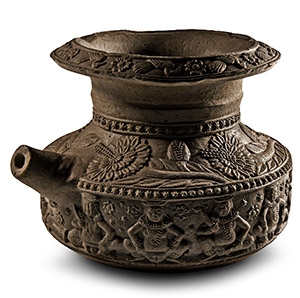
Chandraketugarh Ceramic Vessel with Seated Gods
2nd century B.C.-1st century A.D.Estimate: £500 - 700 (+bp*)
Opening Bid: £250
Squat, drum-shaped pouring vessel with conical spout, broad neck, chamfered rim and rounded base; dense panels of moulded ornament displaying alternating rosettes and birds to the rim, large-headed flowers between band of rosettes to the shoulder, lower body featuring a frieze of squatting male figures displaying their genitalia, all wearing cloth headdresses, ornamental collars, arm-bangles and anklets; some holding knives; chipped. 407 grams, 15.5 cm high
Private collection, 1989. Acquired on the UK art market. This lot is accompanied by an illustrated lot declaration signed by the Head of the Antiquities Department, Dr Raffaele D’Amato.
