
Loading, please wait...
_900x900.jpg "Indo-Persian Inlaid Iron Talwar with Scabbard")
_200x200.jpg "Indo-Persian Inlaid Iron Talwar with Scabbard")
_900x900.jpg "Indo-Persian Inlaid Iron Talwar with Scabbard")
_200x200.jpg "Indo-Persian Inlaid Iron Talwar with Scabbard")
.jpg "Indo-Persian Inlaid Iron Talwar with Scabbard")
.jpg "Indo-Persian Inlaid Iron Talwar with Scabbard")
LOT 1470
Indo-Persian Inlaid Iron Talwar with Scabbard
EARLY-MID 20TH CENTURY A.D.
25 1/4 in. (823 grams, 64 cm).
Comprising a curved damascened steel blade, hilt with horse-head pommel, knuckle-guard and stub quilolons; scabbard with two suspension points, inlaid white-metal detailing.
ProvenancePrivate collection, UK.
LiteratureCf. Mierzejewska, A., Chodiński, A.R., Broń Orientu, (Weapons of the Orient) Catalogue of the Toruń Regional Museum, Toruń, 2009, fig.16, p.29.
FootnotesThis is an example of a saber mass-produced for tourists at the turn of the 19th and 20th centuries. This is evidenced by the carelessly executed decoration of the engraved ornament covering the main part of the scabbard, as well as the inferior technique of decorating the hilt. However, it is a solid replica of the swords used in real combat.
CONDITIONTimeLine Auctions follows a vetting process to ensure the authenticity and legality of all items, reinforcing our commitment to integrity and responsible trading. Each antiquity, antique, and coin lot undergoes thorough examination by a vetting committee of at least ten external specialists, professional trade association members, scientists, and archaeologists: Our Vetting Process
AUCTIONS:
TimeLine is a leading auction house specialising in antiquities, ancient art, collectables, natural history, coins, medals, and books. Our auctions offer museums, collectors, historians, and enthusiasts the opportunity to acquire unique and historically significant pieces.
LOT 1470
Indo-Persian Inlaid Iron Talwar with Scabbard
Estimate £400 - 600€460 - 700 (for guidance only)$540 - 810 (for guidance only)
-
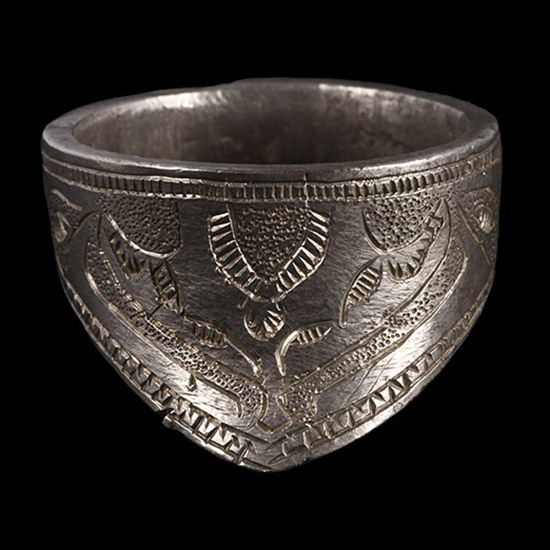
Large Byzantine Silver Archer's Ring
14th-15th century A.D.Sold for (Inc. bp): £1,430
Comprising a hoop with reserved triangular ornament on the edges and triangular plaque with foliage motifs, raised central panel with frond motif. 22.61 grams, 34.77 mm overall, 25.16 mm internal diameter
Acquired in the 1990s. Ex Cambridgeshire, UK, collection.
Archer rings in Late Byzantium and the medieval Balkans were connected with the employment of the powerful composite bow, but very often, in the 14th century they served as insignia of rank for aristocratic noblemen. Archaeological findings of archers’ rings originate mainly from fortified towns, including mining centres. Many were made in bone, simple in design and undecorated. In contrast, the ones made in bronze and silver were usually decorated in rather uniform style, consisting of floral motifs on the head, mostly tulip and foliage, and linear motifs around the edges. This decoration combined Turkish, Central European and Eastern Roman traditional patterns. -
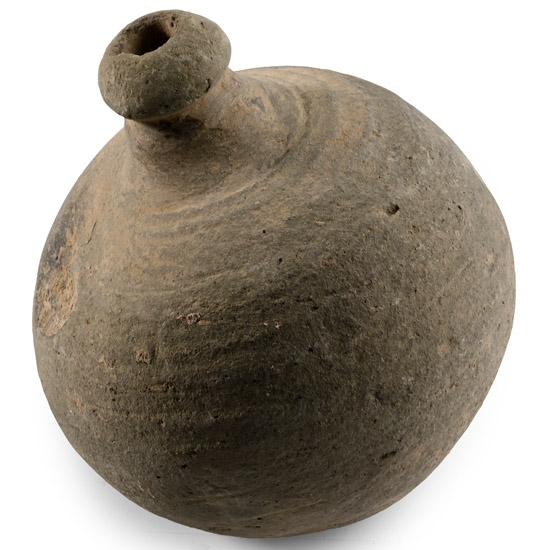
Byzantine 'Greek Fire' Ceramic Fire Bomb or Hand Grenade
9th-11th century A.D.Sold for (Inc. bp): £91
Bulbous body with rounded base and domed filler-hole; intended to be filled with explosive liquid and a wick, and used as a hand grenade. 682 grams, 11.3 cm
From an important specialist collection, London, UK, 1990s. Accompanied by an academic paper by military specialist Dr Raffaele D'Amato, dated 15 July 2019 and titled 'Eastern Roman Empire - Greek Fire Bomb or Hand Grenade (μεσαίον kακάβιον) 9th-11th century AD'.
Apart from the use of siphons or manual flame-throwers called cheirosiphona, special corps of Roman soldiers employed terracotta grenades, in the form of small jars, abundantly evidenced in archaeological excavations. They were called μεσαία kακαβιά or κυτροκακάβια, where the former had a bulbous shape and the latter a more cylindrical form. -
.jpg)
Medieval Iron Hand-and-Half Sword with Bronze Pommel with Coat of Arms
13th century A.D.Sold for (Inc. bp): £4,680
Comprising: two-edged lenticular-section piled blade (Oakshott's Type XII) with gentle taper overall to a narrow point; quillons round in section with taper to ends and hooked finial; broad flat-section tang tapering to the upper end; disc pommel of Oakshott's Type K with scooped border to each face, central disc with beaded rim, inner heater-shaped panel with reserved cross potent. 1.32 kg, 101 cm
From the private family collection of a lady, UK; acquired in Germany, mid-20th century. Accompanied by an academic report by Dr Raffaele D'Amato. This lot has been checked against the Interpol Database of stolen works of art and is accompanied by search certificate number no.13303-257659.
