
Loading, please wait...
_900x900.jpg "Indian Bronze Figural Opium Pipe")
_200x200.jpg "Indian Bronze Figural Opium Pipe")
.jpg "Indian Bronze Figural Opium Pipe")
LOT 2649
Indian Bronze Figural Opium Pipe
20TH CENTURY A.D.
7 in. (284 grams, 18cm).
With separate tapering stem curved at the end and decorated with repoussé scrolls, bowl formed as a deity(?) standing on one leg grasping a leaf-shaped dagger in his right hand, with demonic face above his own with benign expression.
ProvenanceEx property of a Guernsey collector; acquired from Martel Maides, St. Peter Port, Guernsey; formerly acquired in the UK in the early 1990s.
From the private collection of John Meredith, acquired since the 1990s; thence by descent.
TimeLine Auctions follows a vetting process to ensure the authenticity and legality of all items, reinforcing our commitment to integrity and responsible trading. Each antiquity, antique, and coin lot undergoes thorough examination by a vetting committee of at least ten external specialists, professional trade association members, scientists, and archaeologists: Our Vetting Process
AUCTIONS:
TimeLine is a leading auction house specialising in antiquities, ancient art, collectables, natural history, coins, medals, and books. Our auctions offer museums, collectors, historians, and enthusiasts the opportunity to acquire unique and historically significant pieces.
-
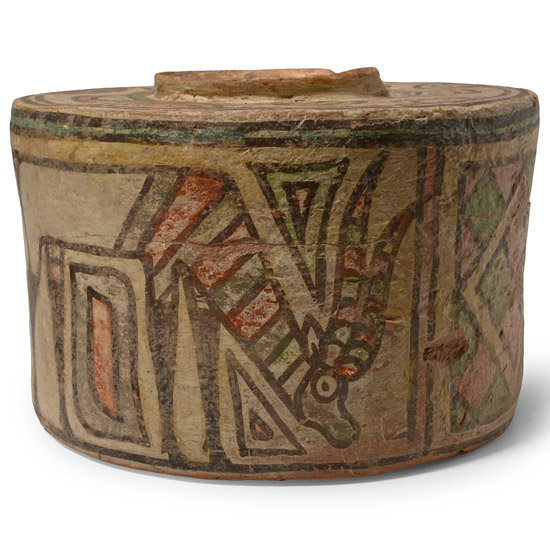
Indus Valley Painted Terracotta Vessel
3rd millennium B.C.Estimate: £300 - 400 (+bp*)
Opening Bid: £135
Drum-shaped vessel with a small mouth, the body with a standing lion and a grazing gazelle with panels of geometric decorations in between, the upper face with concentric circles and hemicircles. 933 grams, 16 cm
From a collection acquired on the UK art market from various auction houses and collections mostly before 2000. From an important Cambridgeshire estate; thence by descent. Private collection, London, UK. -
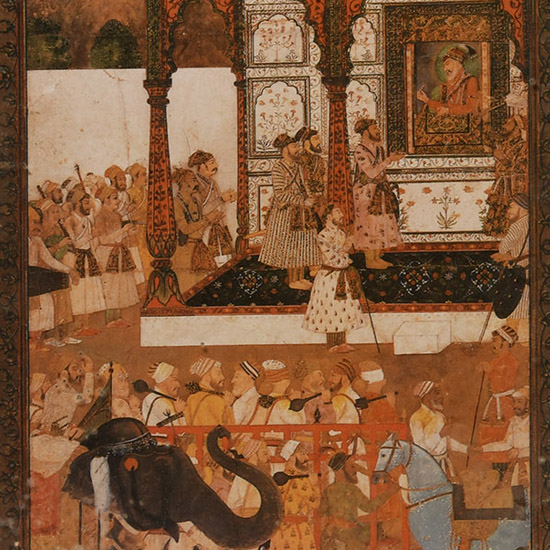
Indian Framed Print with Royal Offering Scene
19th-20th century A.D.Sold for (Inc. bp): £130
A framed and glazed print of an Indian watercolour painting, depicting a figural scene of what is probably an offering of jewels to an emperor, sitting on a throne on a platform above assembled courtiers, surrounded by musicians, an elephant and horse in the foreground; showing what is possibly a daily durbar or public audience. 417 grams, 25.5 x 20.2 cm
Fair condition.
Ex property of a Greater Manchester collector.
Print of a c.17th century original. During the 17th century, it was the artist's duty to record formal occasions for inclusion in the official histories of the reigns of the emperors. Such scenes were worked up after the event from pre-existing portraits of notable attendees, resulting in a 'stiffness' of effect. -
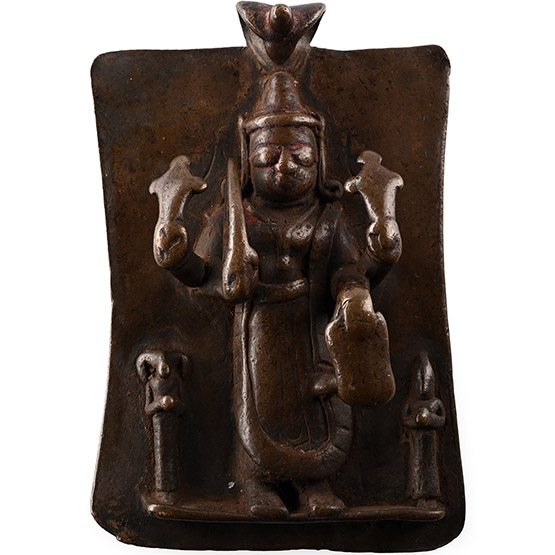
Sacred Copper-Alloy Plaque with Shiva and Attendants
India, 19th century A.D.Sold for (Inc. bp): £20
A rectangular plaque with half-rounded standing figure of Virabhadra Shiva holding various attributes, a hooded cobra at the top, flanked by attendants. 867 grams, 16.5 cm
Worn surface.
From an important collection of Hindu art formed by Jeffrey Romer, 1990s. Ex central London, UK, gallery.
