
Loading, please wait...
LOT 1110
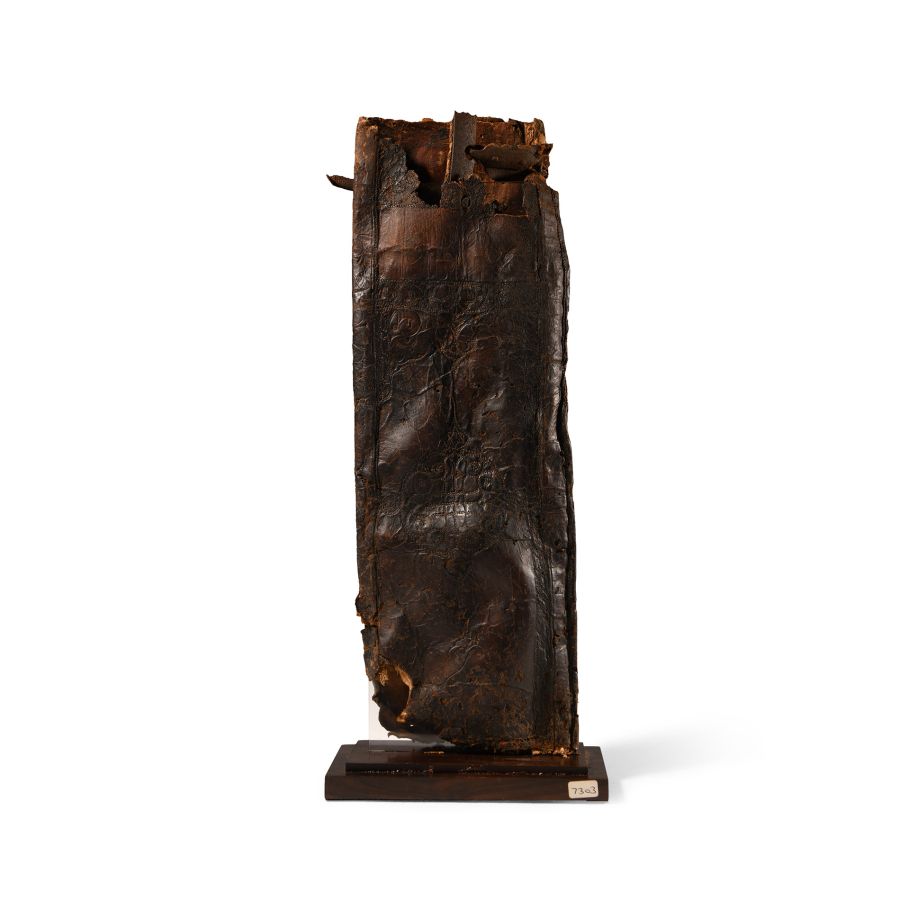
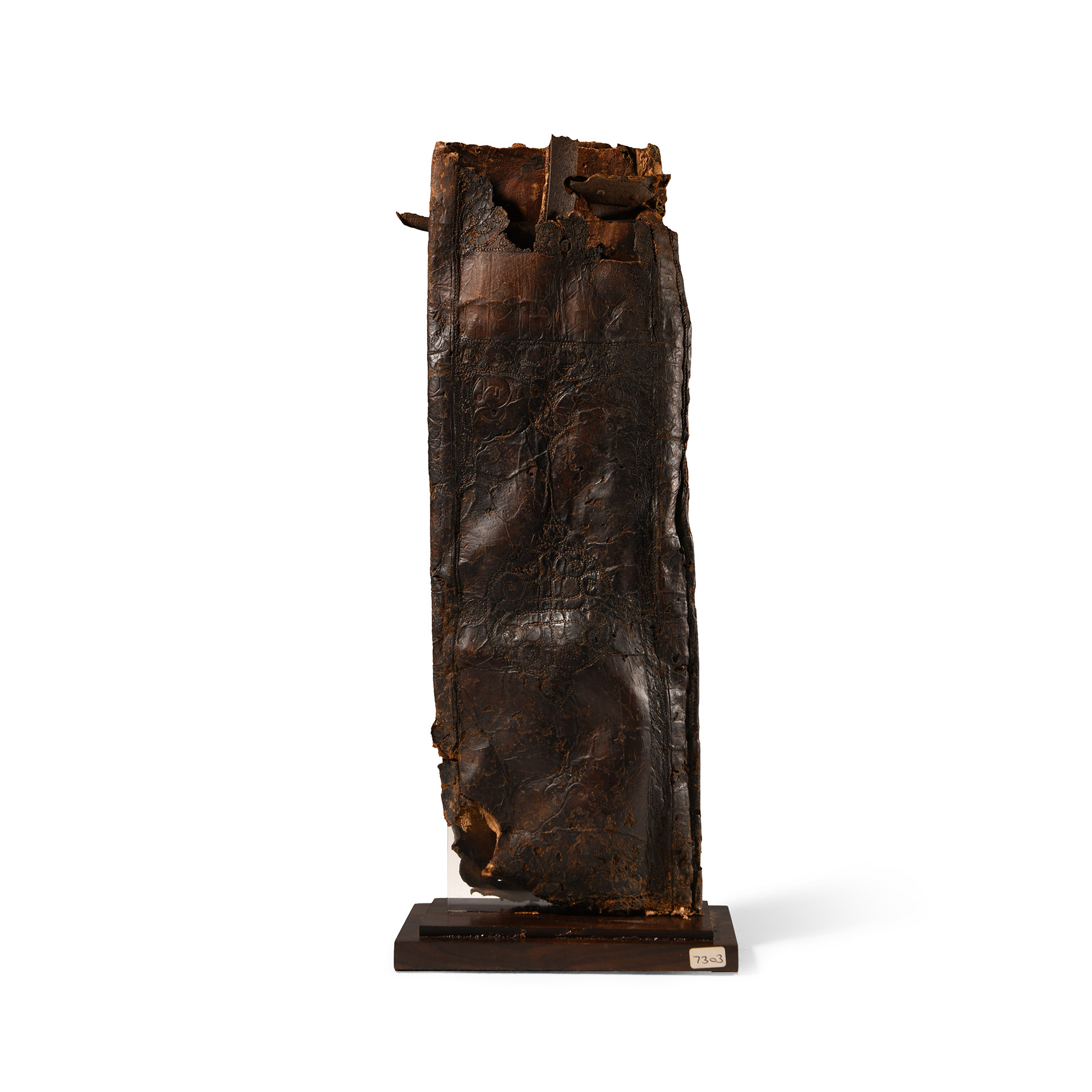
Ilkhanid Decorated Leather Quiver
13TH-14TH CENTURY A.D.
15 3/8 in. (498 grams total, 39.5 cm high).
Rectangular hide case with saddle-stitched edge, knotted attachment thong to reverse; obverse with panels of low-relief moulded tendril and geometric ornament with decorative stitching; mounted on a custom-made stand. [No Reserve]
ProvenanceEx Yacob's Gallery, London W1, 2000.
From a private UK collection.
Ex central London gallery.
TimeLine Auctions follows a vetting process to ensure the authenticity and legality of all items, reinforcing our commitment to integrity and responsible trading. Each antiquity, antique, and coin lot undergoes thorough examination by a vetting committee of at least ten external specialists, professional trade association members, scientists, and archaeologists: Our Vetting Process
AUCTIONS:
TimeLine is a leading auction house specialising in antiquities, ancient art, collectables, natural history, coins, medals, and books. Our auctions offer museums, collectors, historians, and enthusiasts the opportunity to acquire unique and historically significant pieces.
-
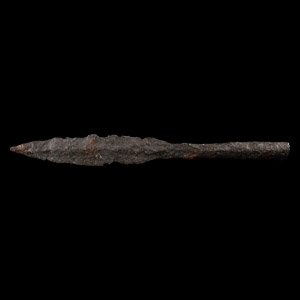
Anglo-Saxon 'Norfolk' Iron Socketted Spearhead
6th-7th century A.D.Sold for (Inc. bp): £172
With lentoid-section lanceolate blade, tapering circular socket with forge-welded split. 134 grams, 25.3 cm
Found Norfolk, UK, in the 1970s. Gary Edwards, York, UK. Private collection, Preston, UK. Accompanied by a certificate of authenticity and receipt from Gary Edwards, no.SN12480.
The spearhead belongs to the C2 group of the Swanton's classification, by far the commonest leaf-shaped blade found in Anglo-Saxon graves in 6th and 7th centuries A.D. These spears have their broadest part in the lower half, and are lentoid in section. Length varies between 20 and 35 cm. -
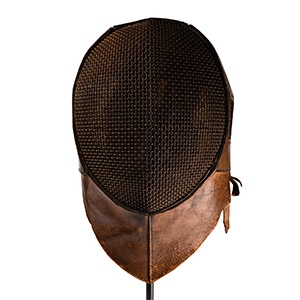
British Leather Fencing Helmet
Circa 1890-1920s A.D.Sold for (Inc. bp): £234
By Lillywhite Frowd Co of London, fitted with neck fringe, stamped buckled securing strap and wire mesh face and ear panels, padded lining internally marked 'broad arrow-over-67' so likely a military issue. 2.0 kg, 39 cm
Acquired from Manfred Schotten Antiques, 2016. The Kusmirek Collection, UK. Accompanied by a copy of Manfred Schotten invoice and listing.
Although masks/helmets of this general form are typically associated with sword fencing, this example is of very heavy construction so possibly for use in protecting while training with a heavier weapon than a foil or epee. -
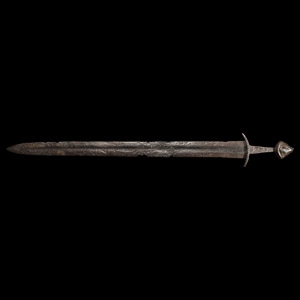
Viking Age Iron Sword with Cocked Hat Type Pommel
10th century A.D.Sold for (Inc. bp): £5,720
Petersen Type L variant with double-edged pattern-welded blade (waving pattern) showing evidence of being employed, tapering fullers and hefty tang; boat-shaped lower guard, cocked hat pommel with traces of silver inlay; some restoration. 996 grams, 90 cm
From the private collection of a London gentleman, from his grandfather's collection formed before the early 1970s. Accompanied by an academic report by Dr Raffaele D’Amato. This lot has been checked against the Interpol Database of stolen works of art and is accompanied by search certificate number no.11816-206858.
This sword shows evidence of beautiful pattern-welding. The great curvature of the hilt, stronger than any other type of Viking swords, characterises the typology of L swords. This is clearly visible on the specimens from Dolven and Nedre (Stokke) published by Petersen (1919, figs.94-95).
