
Loading, please wait...
LOT 1405
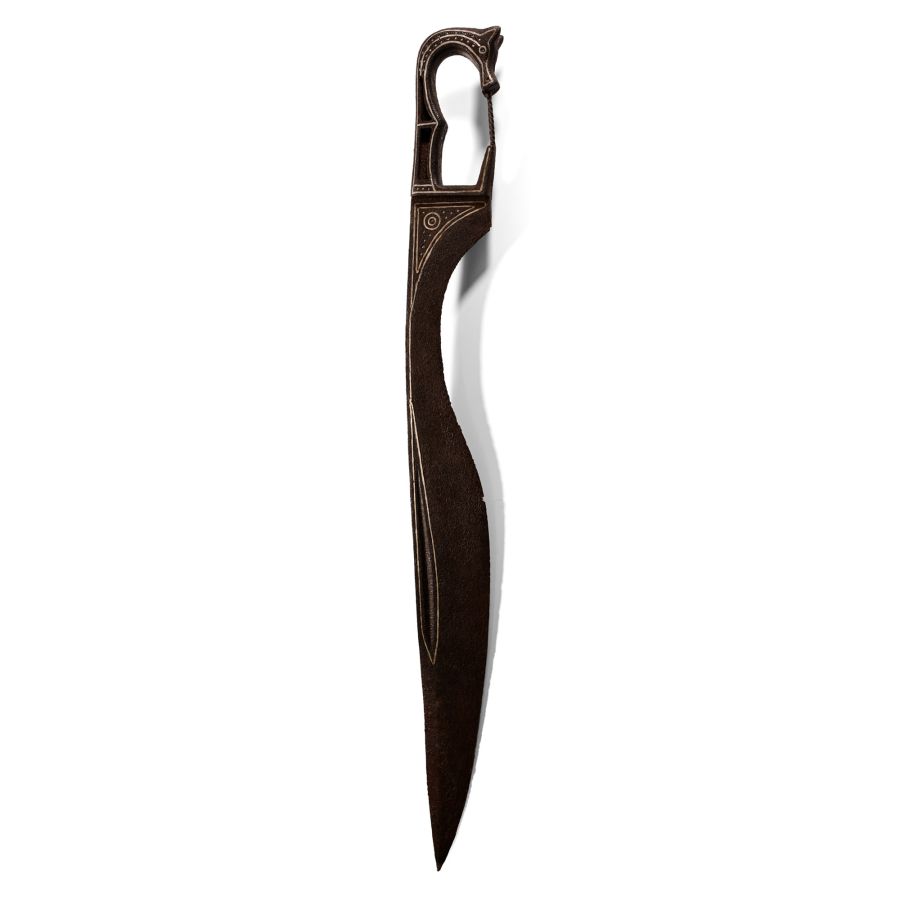
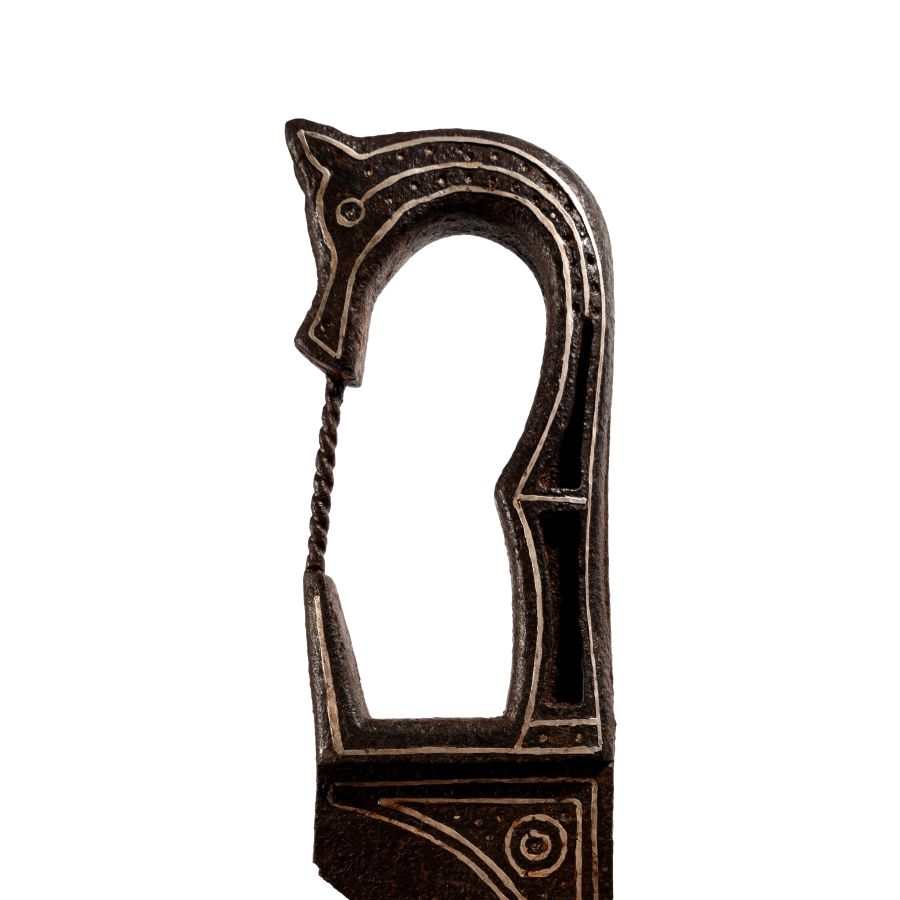
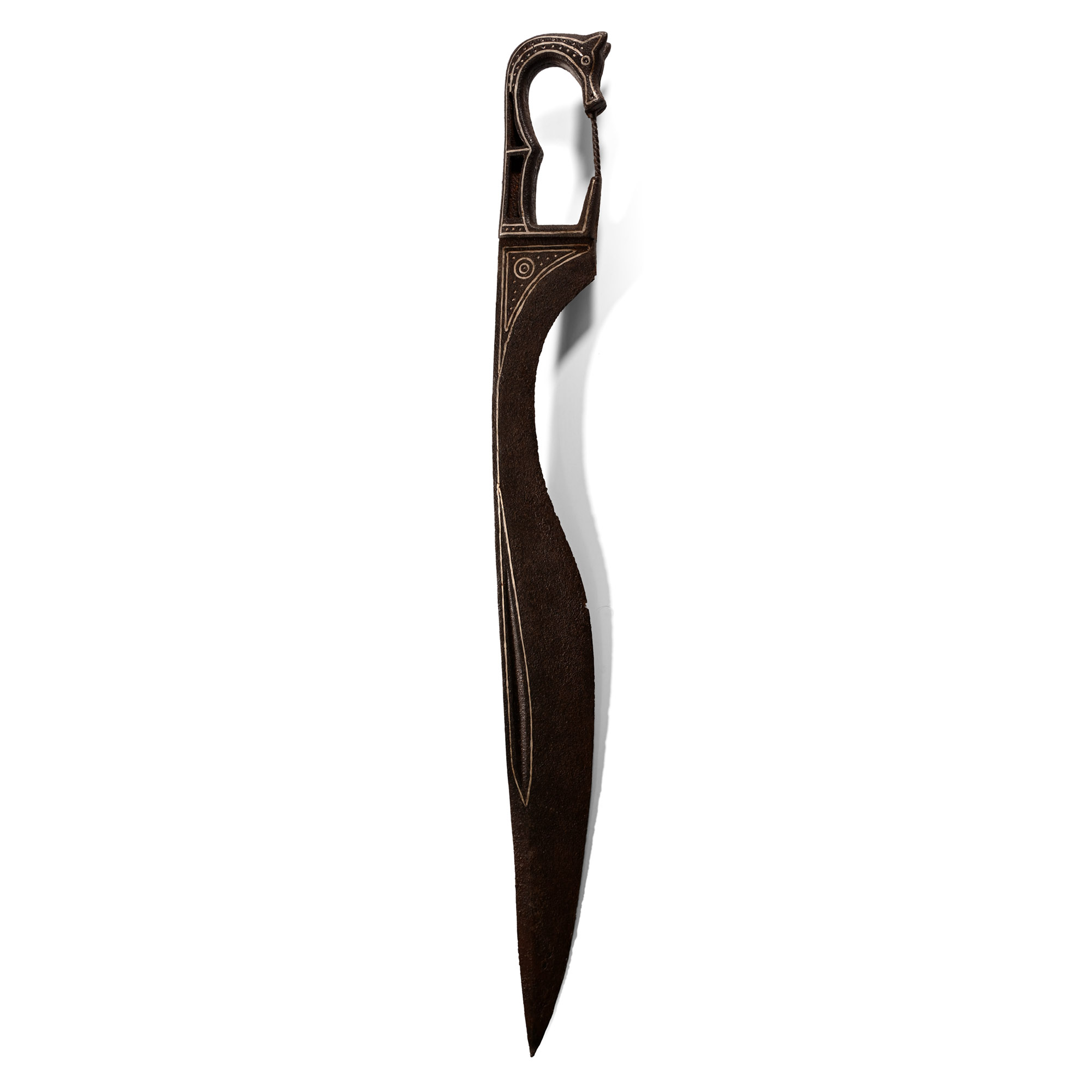
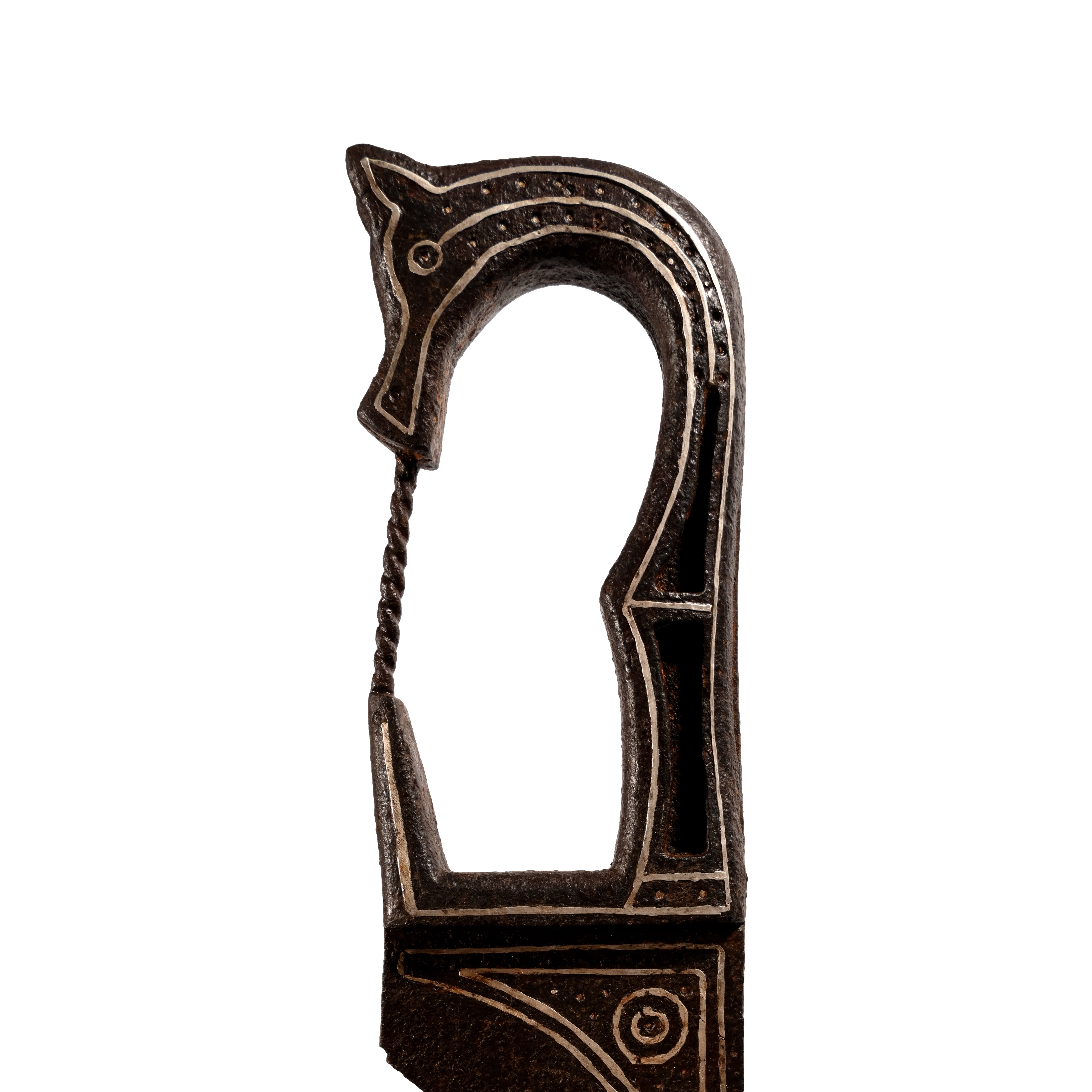
Ibero-Celtic Style Iron Falcata with Inlaid Decoration
20TH CENTURY A.D.
22 3/4 in. (771 grams, 57.7 cm).
A single-edged machaira sword of falcata typology, the hilt formed as a gracefully curving horse's head and neck, the blade with deep grooves, inlaid with geometric ornaments on the hilt and blade.
ProvenanceEx White Collection, England, 1970s.
The Bonnhauser Collection, Zurich, 2003.
This lot is accompanied by an illustrated lot declaration signed by the Head of the Antiquities Department, Dr Raffaele D'Amato.
For originals see Quesada Sanz, F., El armamento Ibérico, Madrid, 1991; Quesada Sanz, F., Arma y símbolo: la falcata Ibérica, Alicante, 1992; Quesada Sanz, F., 'Patterns of interaction, Celtic and Iberian weapons in Iron Age Spain', in Celtic connections, volume 2, papers from the Tenth International Congress of Celtic Studies, Edinburgh, 1995, Edinburg, 2005.
FootnotesSince the 5th-4th century BC, the Iberian warriors armed themselves with round shields and single-edged swords (falcatas), gradually adopting the appearance of hoplite armies and the Etruscan version of the machaira. The latter type of sword was duly transformed into a completely new type, with a different size, shape and function, the falcata, which was already in use in the Iberian area by c. 490 BC. This falcata, a type of curved, one-edged sword of supposedly Greek origin, is generally accepted by the scholars as the 'national' weapon of the Iberians, usually suspended on the left side of the warrior, inside a sheath to which sometimes was attached a short knife. It was a terrible cut-and-thrust sword, with an average blade length of 45 cm.
CONDITIONTimeLine Auctions follows a vetting process to ensure the authenticity and legality of all items, reinforcing our commitment to integrity and responsible trading. Each antiquity, antique, and coin lot undergoes thorough examination by a vetting committee of at least ten external specialists, professional trade association members, scientists, and archaeologists: Our Vetting Process
AUCTIONS:
TimeLine is a leading auction house specialising in antiquities, ancient art, collectables, natural history, coins, medals, and books. Our auctions offer museums, collectors, historians, and enthusiasts the opportunity to acquire unique and historically significant pieces.
LOT 1405
Ibero-Celtic Style Iron Falcata with Inlaid Decoration
Estimate £700 - 900€810 - 1,040 (for guidance only)$950 - 1,220 (for guidance only)
-
.jpg)
Luristan Bronze Arrowhead Group
13th-6th century B.C.Sold for (Inc. bp): £182
Including barbed-and tanged, leaf-shaped, lozengiform and other types. 232 grams total, 41-91 mm
Acquired 1980-2015. Ex Abelita family collection. This lot is accompanied by an illustrated lot declaration signed by the Head of the Antiquities Department, Dr Raffaele D’Amato. This lot is accompanied by an illustrated lot declaration signed by the Head of the Antiquities Department, Dr Raffaele D'Amato. -
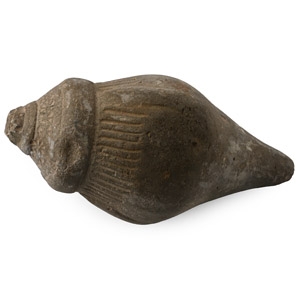
Turco-Mongol 'Greek Fire' Ceramic Fire Bomb or Hand Grenade
9th-11th century A.D.Sold for (Inc. bp): £72
Hollow vessel with piriform body, raised lugs on the shoulder with hatched banding in between the lugs, decorative band of rosettes beneath the domed mouth; intended to be filled with explosive liquid and a wick, and used as a hand grenade. 452 grams, 16 cm
From an important specialist collection, London, UK, 1990s onwards. This lot is accompanied by an illustrated lot declaration signed by the Head of the Antiquities Department, Dr Raffaele D'Amato. -
.jpg)
Luristan Bronze Sword
Late 2nd millennium B.C.Sold for (Inc. bp): £520
Later hilt with mushroom-shaped pommel, openwork grip with 'chain'-shaped pattern, crescentic guard, long sloping blade with rectangular-section mid-ridge. 1.05 kg, 55.2 cm
Acquired 1980-2015. Ex Abelita family collection. This lot is accompanied by an illustrated lot declaration signed by the Head of the Antiquities Department, Dr Raffaele D’Amato. This lot is accompanied by an illustrated lot declaration signed by the Head of the Antiquities Department, Dr Raffaele D'Amato.
These bronze swords were characterised by a solid-cast hilt with penannular guard, a grip equipped with raised shaped figures and a conical, hollow-cast mushroom pommel. The blade had a very pronounced shaped central midrib. In the complete specimens the hilt was usually cast with the blade.
