
Loading, please wait...
_900x900.jpg "Iberian Iron Dagger with Rivetted Hilt")
_200x200.jpg "Iberian Iron Dagger with Rivetted Hilt")
.jpg "Iberian Iron Dagger with Rivetted Hilt")
LOT 0270
Iberian Iron Dagger with Rivetted Hilt
2ND CENTURY B.C.
12 in. (235 grams, 30.6 cm).
A pugio military dagger with waisted leaf-shaped blade, rounded midrib, rectangular rivetted baluster, short grip with crescent pommel.
ProvenanceEx North American private collection, 1970s-1990s.
This lot is accompanied by an illustrated lot declaration signed by the Head of the Antiquities Department, Dr Raffaele D’Amato.
See Bishop, M.C. & Coulston, J.C.N., Roman military equipment, from the Punic wars to the fall of Rome, London, 1993; Bishop M. C. & Coulston J.C.N., Roman military equipment from the Punic Wars to the fall of Rome, London, 2006; for identical specimen cf. Casprini, F., Saliola, M., Pugio gladius brevis est, storia e tecnologia del pugnale da guerra romano, Roma, 2012, p.103 no.1.
FootnotesThe pugio appeared as a side weapon of the Roman legionary in the 2nd century B.C. However, its full diffusion within the Roman army begun with Caesar and Augustus, where it appeared as the reserve weapon for the heavy infantryman. The present specimen belongs to the Celtiberian tribes who fought against the Roman army in the 2nd century B.C., but represents one of the first prototypes adopted from the Iberians by the Roman legionaries.
CONDITIONTimeLine Auctions follows a vetting process to ensure the authenticity and legality of all items, reinforcing our commitment to integrity and responsible trading. Each antiquity, antique, and coin lot undergoes thorough examination by a vetting committee of at least ten external specialists, professional trade association members, scientists, and archaeologists: Our Vetting Process
AUCTIONS:
TimeLine is a leading auction house specialising in antiquities, ancient art, collectables, natural history, coins, medals, and books. Our auctions offer museums, collectors, historians, and enthusiasts the opportunity to acquire unique and historically significant pieces.
-
.jpg)
Marlik Bronze Spearhead
14th-10th century B.C.Estimate: £200 - 300 (+bp*)
Opening Bid: £100
With rounded shoulders and square-section mid-rib running to the tip; short tang. 280 grams, 38.5 cm
Acquired 1980-2015. Ex Abelita family collection. This lot is accompanied by an illustrated lot declaration signed by the Head of the Antiquities Department, Dr Raffaele D’Amato.
The blade belongs to the type VI of Marlik spearheads according to the Khorasani classification, with a long blade and a short tang, slightly rounded shoulders and pronounced midrib. Such spearheads have been excavated from the Marlik Royal Cemetery by Dr Negahban in Tomb 15, Trench XIII G. -
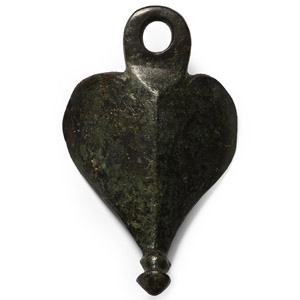
Roman Horse Harness Phalera
1st-4th century A.D.Estimate: £100 - 140 (+bp*)
Opening Bid: £50
Of carinated profile with pierced lug above and knop finial. 97 grams, 95 mm
Ex German art market, 2000s. Acquired from an EU collector living in London. From the collection of Surrey, UK, gentleman. This lot is accompanied by an illustrated lot declaration signed by the Head of the Antiquities Department, Dr Raffaele D’Amato. -
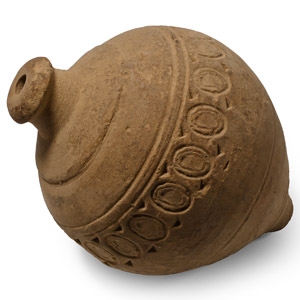
Byzantine 'Greek Fire' Ceramic Fire Bomb or Hand Grenade
9th-11th century A.D.Sold for (Inc. bp): £124
A piriform missile decorated with a band of annulets and chevrons, domed filler hole, intended to be filled with explosive liquid and wick, used as a hand grenade. 406 grams, 12.2 cm
From an important specialist collection, London, UK, 1990s onwards. Accompanied by an academic paper by military specialist Dr Raffaele D'Amato, dated 15 July 2019 and titled 'Eastern Roman Empire - Greek Fire Bomb or Hand Grenade (μεσαίον kακάβιον) 9th-11th century AD'. This lot is accompanied by an illustrated lot declaration signed by the Head of the Antiquities Department, Dr Raffaele D’Amato.
