
Loading, please wait...
LOT 0281
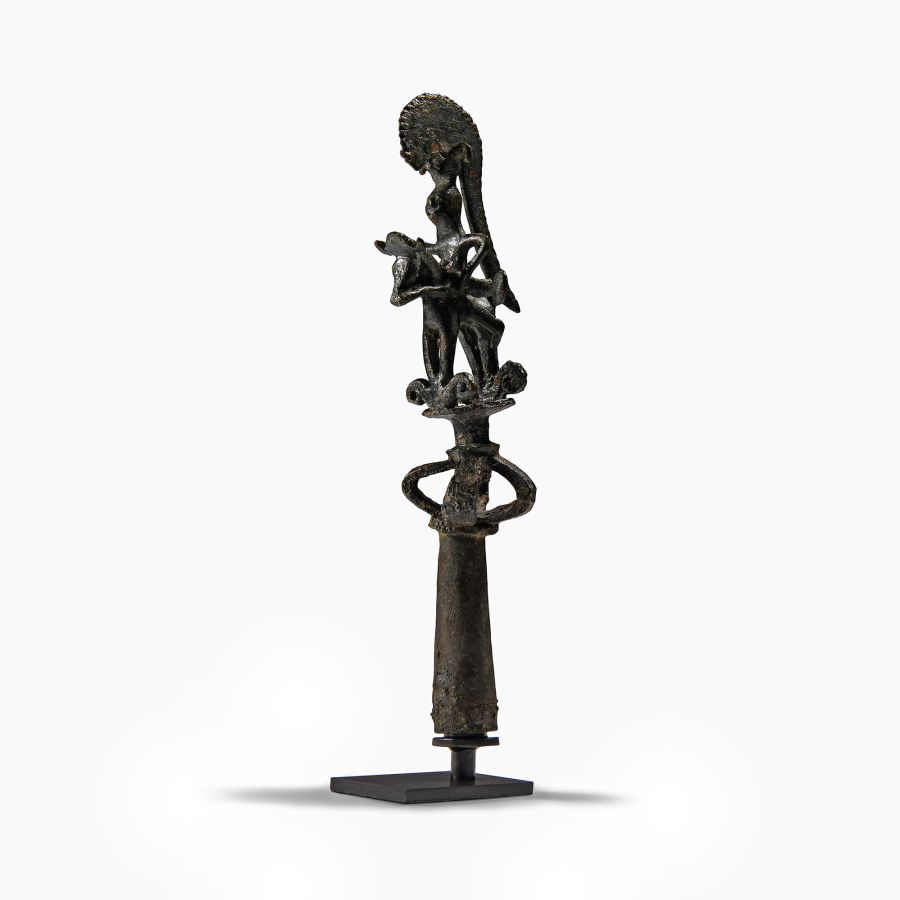
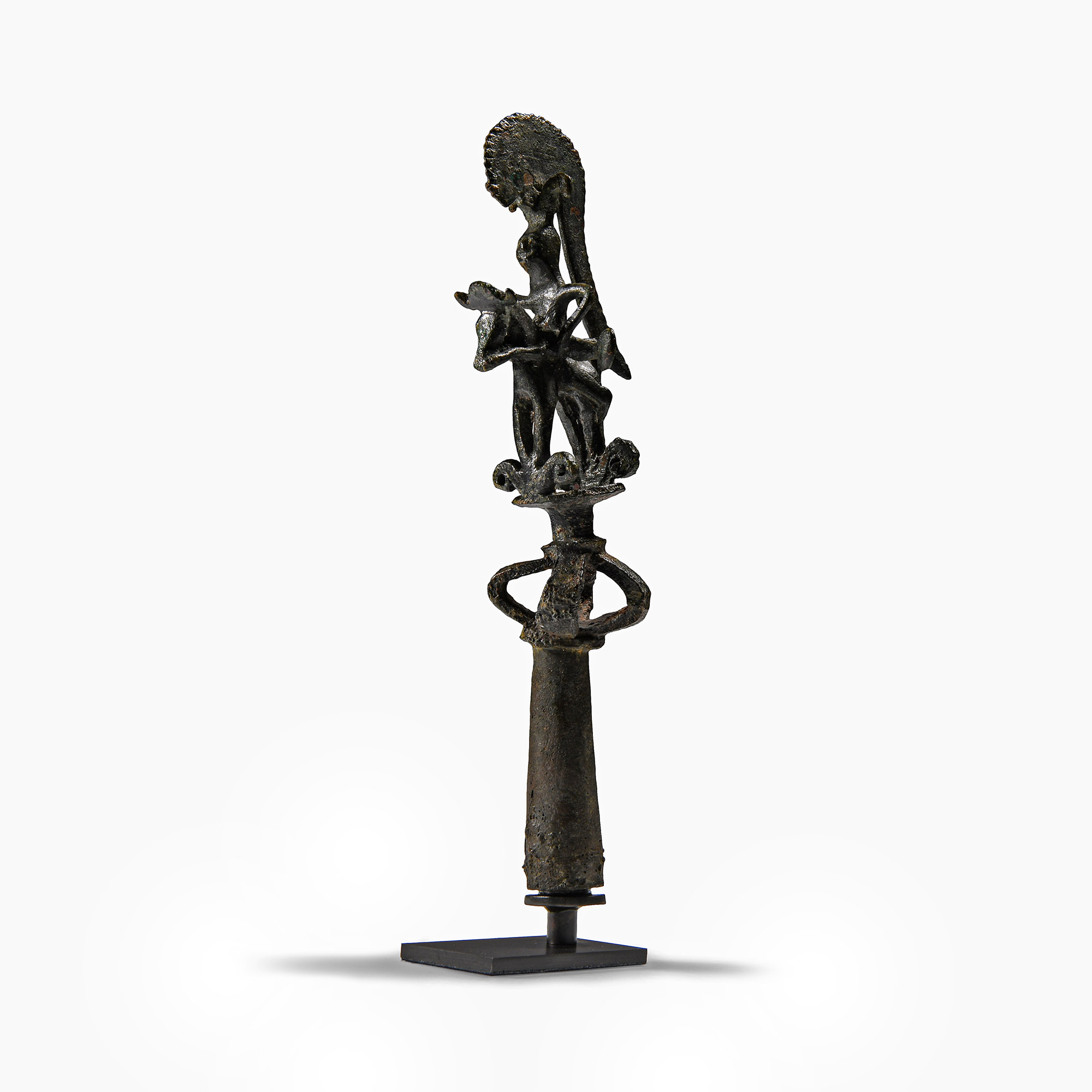
Iberian Celtic 'Axel Guttman' Bronze Warrior Finial
5TH-4TH CENTURY B.C.
7 1/8 in. (152 grams total, 18.2 cm high including stand).
With slightly tapering socket and openwork bulb above, discoid platform supporting a mounted warrior modelled in the round; horse with long vertical tail and horizontal reins, bowed legs and scrolls at the hooves; warrior astride the horse with legs bent and feet to the rear, helmet with lateral horns and large swept crest with notched edge; arms bent to show the warrior in the act of drawing his falcata sword from the scabbard worn across his midriff; mounted on a custom-made stand.
ProvenanceEx Axel Guttmann collection.
Accompanied by a copy of an old photograph showing this item on display in a display cabinet within the Guttmann Museum.
Cf. 'Warrior of Moixent' Iberian bronze figurine in the Museo de Prehistoria de Valencia, inventory no.2899.
FootnotesThe horseman's pose with his legs bent and feet held towards the rear would have been necessary before the introduction of stirrups in the early medieval period. The horse appears to sport a disc between its ears, possibly part of the bridle.
CONDITIONTimeLine Auctions follows a vetting process to ensure the authenticity and legality of all items, reinforcing our commitment to integrity and responsible trading. Each antiquity, antique, and coin lot undergoes thorough examination by a vetting committee of at least ten external specialists, professional trade association members, scientists, and archaeologists: Our Vetting Process
AUCTIONS:
TimeLine is a leading auction house specialising in antiquities, ancient art, collectables, natural history, coins, medals, and books. Our auctions offer museums, collectors, historians, and enthusiasts the opportunity to acquire unique and historically significant pieces.
-

Published Iron Age 'Vale' Bronze Cross Brooch
4th-1st century B.C.Sold for (Inc. bp): £85
Complete with swivel bar and pin to reverse; the cruciform body composed of four bulbous arms with concave reverses and domed centre; Type 2Bb2. 17.1 grams, 23 mm
Found Berkshire, UK. Accompanied by a copy of the British Museum's Portable Antiquities Scheme (PAS) report no.BERK-4EFFC6.
Designated 'a find of note' by the PAS and 'potential for inclusion in Britannia'. The PAS record also states: 'The style of the brooch suggests an Iron Age date but it is a very unusual style of brooch and no comparisons could be found in any of Hattatt's publications. There are two similar brooches recorded on the database; BUC-ED2437 is very similar, and WAW-DD1642 is also a related type. In this record, it is noted that the brooch style shares decorative similarities to the hangers from a chatelaine/distributor from Giubiasco, Switzerland (Jope, E.M. 2000 Early Celtic Art in the British Isles Clarendon Press Oxford, p. 285 No. 225 h).' The production of brooches began in around the 5th century B.C. This 'Vale' type has only been recognised as a regional type relatively recently. -

Iron Age Celtic Bronze La Tène Fibula
Circa 1st century B.C.-1st century A.D.Sold for (Inc. bp): £59
With sprung pin and lateral flange forming the catch. 3.37 grams, 57 mm
Acquired on the UK art market. Property of a Ruislip, UK, gentleman, by inheritance. -

Celtic Iron Age Bronze Terret Post and Slider Group
1st century B.C.Sold for (Inc. bp): £78
One terret post comprising a slightly domed rectangular plate and projecting arm with domed terminal, suspension arm below; an eye-shaped slider with punched ring-and-dot motif to centre, suspension arm to reverse. 68 grams total, 32-51 mm
Acquired on the UK market, 1990s. Property of a retired academic.
