
Loading, please wait...
_900x900.jpg "Iberian Bronze Statuette")
_200x200.jpg "Iberian Bronze Statuette")
.jpg "Iberian Bronze Statuette")
LOT 0626
Iberian Bronze Statuette
4TH-2ND CENTURY B.C.
4 in. (77.8 grams total, 10 cm including stand).
Standing with arms held straight at the sides, short hair with neck-ring to rear, short-sleeved tunic with pleats to centre-front and rear, wide belt; perhaps a monumental fitting; gas permeation to rear right leg; mounted on a custom-made stand.
ProvenancePrivate collection, Paris, France, assembled in the 1950s-1960s.
with Tessier-Sarrou & Associés, Paris, 2015.
European private collection.
Accompanied by a copy of an Art Loss Register certificate, no.S00107108.
Accompanied by a copy of French cultural export passport no.167803.
This lot has been checked against the Interpol Database of stolen works of art and is accompanied by a search certificate number no.12651-234613.
See Mitten, D.G. & Doeringer, S.F., Master Bronzes of the Classical World, New York, 1968, pp.51-52, figs.33, 34, for type.
CONDITIONTimeLine Auctions follows a vetting process to ensure the authenticity and legality of all items, reinforcing our commitment to integrity and responsible trading. Each antiquity, antique, and coin lot undergoes thorough examination by a vetting committee of at least ten external specialists, professional trade association members, scientists, and archaeologists: Our Vetting Process
AUCTIONS:
TimeLine is a leading auction house specialising in antiquities, ancient art, collectables, natural history, coins, medals, and books. Our auctions offer museums, collectors, historians, and enthusiasts the opportunity to acquire unique and historically significant pieces.
LOT 0626
Iberian Bronze Statuette
Estimate £3,000 - 4,000€3,480 - 4,640 (for guidance only)$4,050 - 5,400 (for guidance only)
-
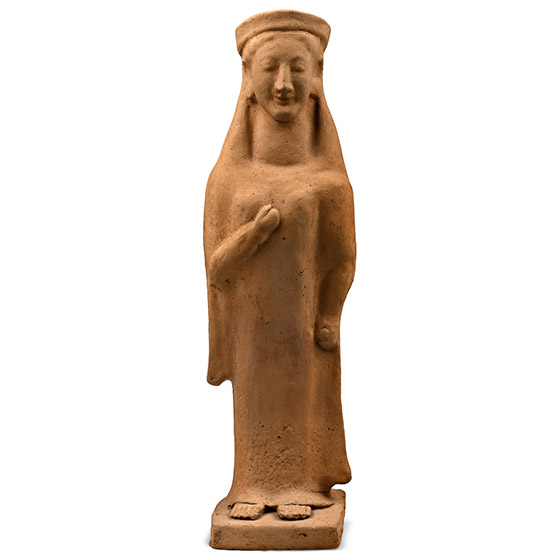
Large Greek Terracotta Figure of a Kore
6th century B.C.Estimate: £5,000 - 7,000 (‡+bp*)
Opening Bid: £2,778
Hollow-formed with scaphoid headdress, long hair hanging behind the shoulders, heavy peplos dress extending to the floor with splayed hem and feet visible beneath; left hand held straight at the thigh, right hand in a fist between the breasts; mounted on a custom-made stand. 6.7 kg total, 57 cm including stand
Swiss private collection, assembled in the 1970s-1980s. with Galerie Serodine, Ascona, Switzerland, 1993. Collection of Dr E.N., Zug, acquired in 1995. This lot has been checked against the Interpol Database of stolen works of art and is accompanied by a search certificate number no.12858-241755. -
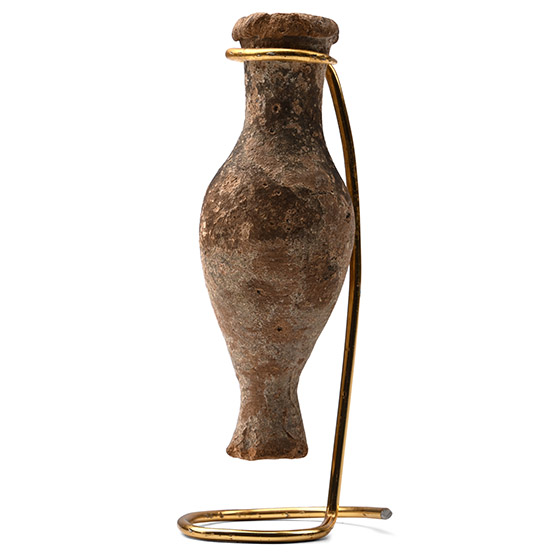
Greek Terracotta Spindle Flask
Hellenistic, late 2nd-1st century B.C.Sold for (Inc. bp): £78
With a narrow neck and carinated mouth, developing to a biconical body and flared foot; mounted on a custom-made stand. 24 grams total, 80 mm high, 93 mm including stand
From a Scottish gentleman’s collection, Glasgow, formed from the early 2000s. -
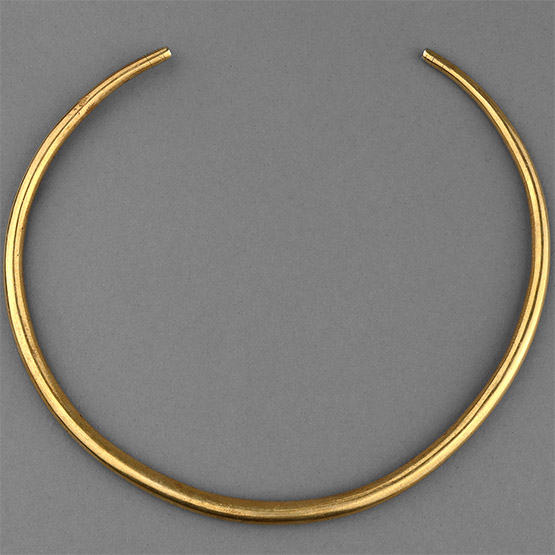
Scythian Electrum Torc
7th-5th century B.C.Sold for (Inc. bp): £14,300
Formed as a simple penannular hoop from a single piece of electrum, tapering towards the terminals. 169 grams, 16.5 cm diameter
Ex Jack Ogden, 1990s. Accompanied by an expertise from Striptwist Ltd, a London-based company run by historical precious metal specialist Dr Jack Ogden, reference number [191101]. This lot has been checked against the Interpol Database of stolen works of art and is accompanied by search certificate number no.13106-248042.
Portable X-ray fluorescence (XRF) analysis confirms the alloy to be electrum, with an average composition of approximately 62% gold, 34% silver, and 3% copper. The purity and metal ratios are consistent with ancient manufacture. The restrained form, lacking figural ornament, is characteristic of early Scythian metalwork and suggests a date prior to the 5th century BC.
