
Loading, please wait...
LOT 0815
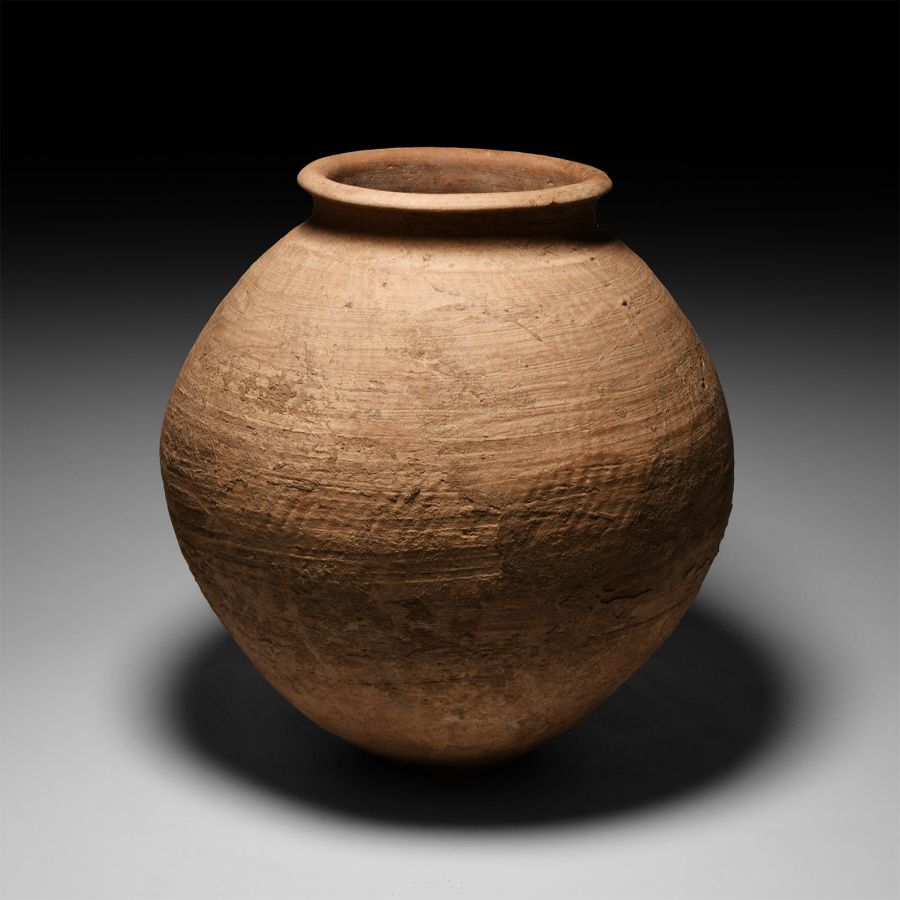
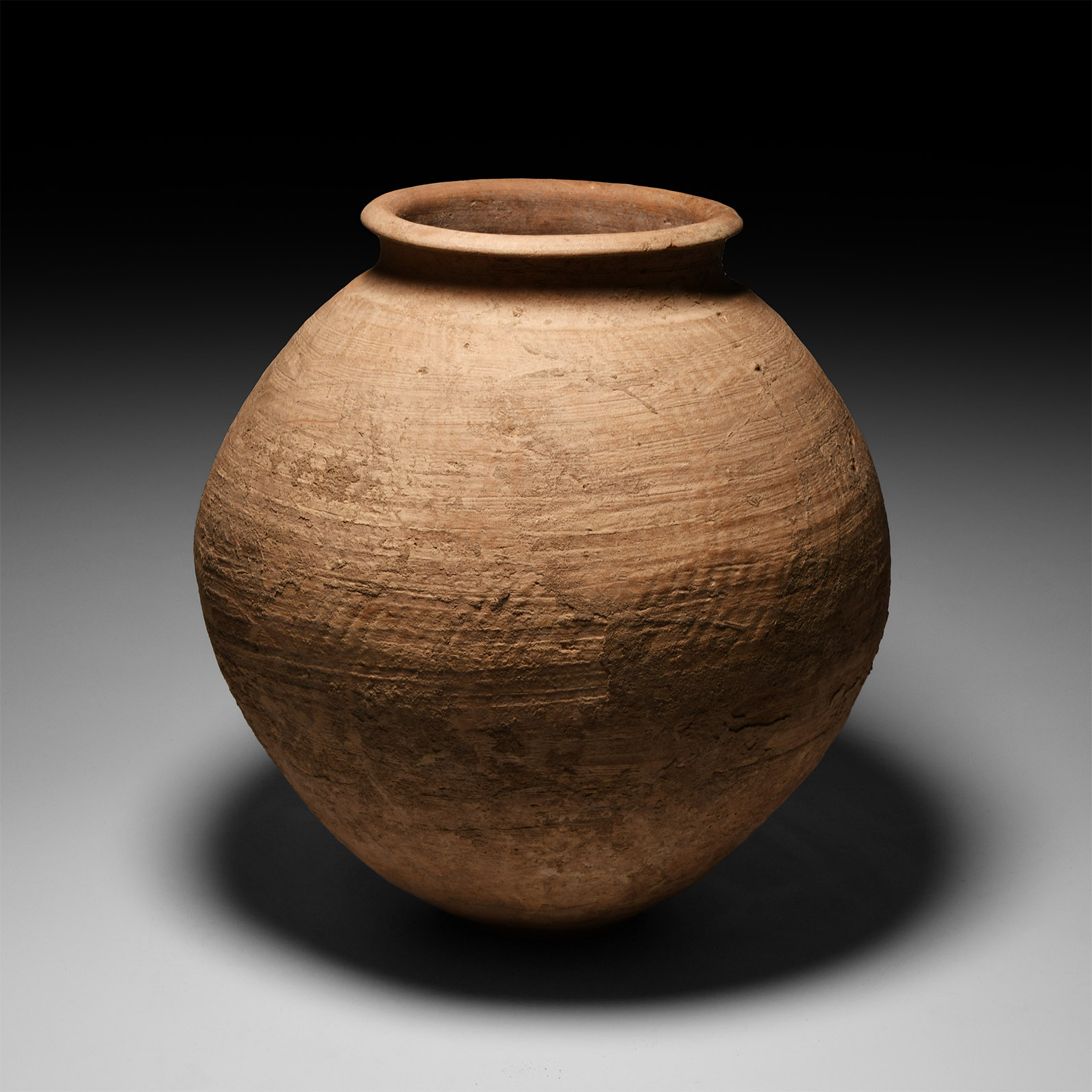
Holy Land Terracotta Jar
1ST MILLENNIUM B.C.
10 7/8 in. (2.2 kg, 27.5 cm high).
A piriform ceramic jar with short neck and chamfered rim.
ProvenanceAcquired before 2000.
Property of a London, UK, gentleman.
Property of an Essex, UK, gentleman.
TimeLine Auctions follows a vetting process to ensure the authenticity and legality of all items, reinforcing our commitment to integrity and responsible trading. Each antiquity, antique, and coin lot undergoes thorough examination by a vetting committee of at least ten external specialists, professional trade association members, scientists, and archaeologists: Our Vetting Process
AUCTIONS:
TimeLine is a leading auction house specialising in antiquities, ancient art, collectables, natural history, coins, medals, and books. Our auctions offer museums, collectors, historians, and enthusiasts the opportunity to acquire unique and historically significant pieces.
-
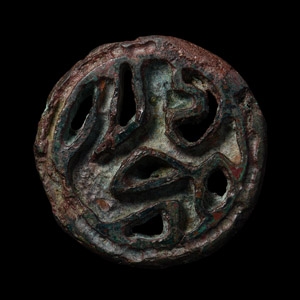
Central Asian Seal Pendant with Monkey
23rd-20th century B.C.Sold for (Inc. bp): £78
A bronze stamp seal featuring an openwork stylised monkey design; suspension loop to reverse; accompanied by a typed and signed scholarly note by W.G. Lambert, the late Professor of Assyriology at the University of Birmingham, 1970-1993, which states: '...This is round, with flat face and flat back, on which there is a small loop for suspension. The design consists of a depiction within a plain outer band. It shows a sitting monkey with tail up and front paws raised, perhaps holding something. This comes from west central Asia and dates to c.2300-2000 B.C. There is some wear and damage to the outer edge of the seal, but the design remains clear. The metal has been conserved.' 10 grams, 33 mm
1980s-early 1990s collection, UK. Accompanied by an original typed and signed scholarly note issued by the late Professor W.G. Lambert. -
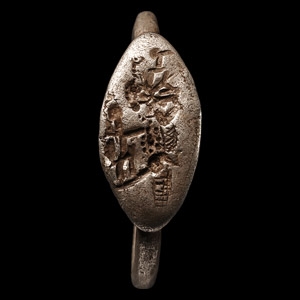
Achaemenid Silver Ring with Warriors
7th-4th century B.C.Estimate: £200 - 300 (+bp*)
Opening Bid: £110
A silver finger ring with scaphoid bezel, incuse image of an armoured warrior with shield and spear, a horseman and a hatched gate or wall. 4.12 grams, 25.84 mm overall, 21.41 mm internal diameter (approximate size British V, USA 10 1/2, Europe 23.77, Japan 22)
Acquired 1980-2015. Ex Abelita family collection. -
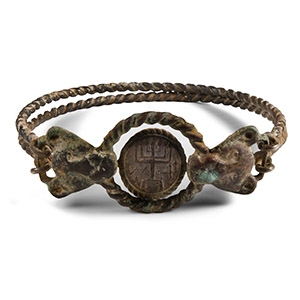
Western Asiatic Silver Bracelet with Lion Head Terminals Holding a Menorah
Circa 2nd-3rd century A.D.Estimate: £800 - 1,000 (+bp*)
Opening Bid: £400
An uncleaned silver bracelet composed of two decoratively twisted hoops, terminals formed as two facing lion (or lioness) heads supporting the bezel, a twisted roundel, in their mouths, central bifacial swivel plaque displaying a menorah flanked by letters 'W-T' on both faces; articulate join between hoops and animal heads. 40 grams, 73 mm wide
Acquired before 1988. From the collection of a deceased collector.
