
Loading, please wait...


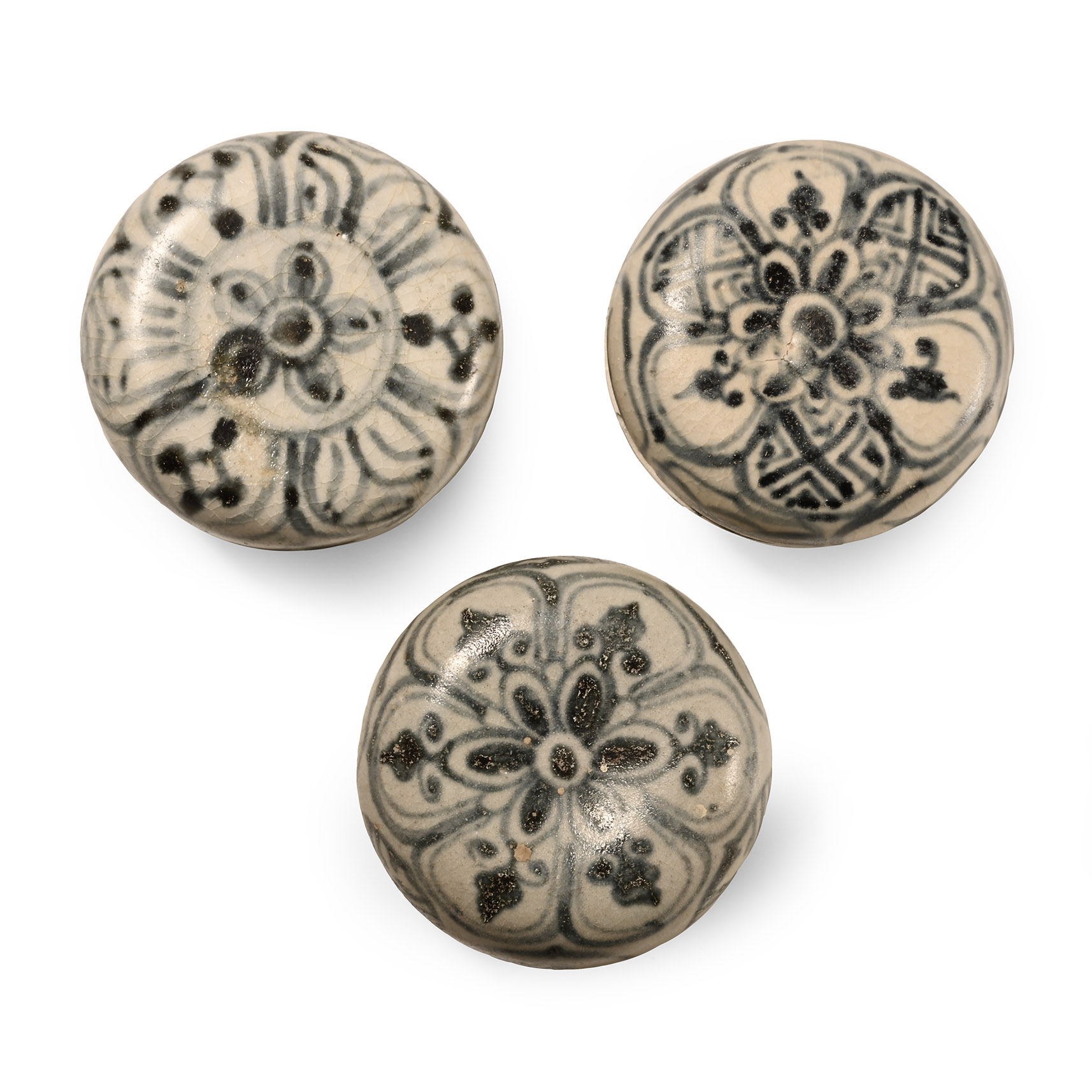
LOT 2123
Hoi An Cargo Shipwreck Glazed Blue and White Lidded Box Collection
15TH CENTURY A.D.
(362 grams total, 65-67 mm).
Comprising three powder boxes with painted rosette to the lid, geometric panels to the sidewall. [3, No Reserve]
ProvenanceEx Butterfield and Butterfield auction with official Hoi An Hoard labels.
Accompanied by an illustrated information sheet about the Hoi An shipwreck.
Comprising three powder boxes with painted flower to the lid.
FootnotesIn the mid 15th century a freighting junk loaded with fine Vietnamese pottery sank in an area of the South China Sea called the 'Dragon’s Embrace.' This vessel is part of the shipwreck cargo recovered off the coast of Vietnam at Hoi An. The ceramics themselves were probably made in the area of Chu Dau.
CONDITIONTimeLine Auctions follows a vetting process to ensure the authenticity and legality of all items, reinforcing our commitment to integrity and responsible trading. Each antiquity, antique, and coin lot undergoes thorough examination by a vetting committee of at least ten external specialists, professional trade association members, scientists, and archaeologists: Our Vetting Process
AUCTIONS:
TimeLine is a leading auction house specialising in antiquities, ancient art, collectables, natural history, coins, medals, and books. Our auctions offer museums, collectors, historians, and enthusiasts the opportunity to acquire unique and historically significant pieces.
LOT 2123
Hoi An Cargo Shipwreck Glazed Blue and White Lidded Box Collection
Sold for (Inc. bp): £143
-
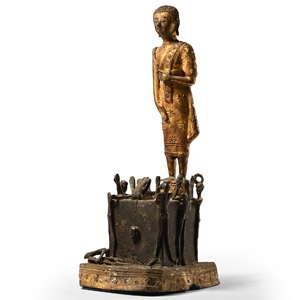
Large South East Asian Gilt Bronze Statue on Base
20th century A.D.Sold for (Inc. bp): £195
Hollow-formed idol comprising a rectangular base with beaded bands supporting a cuboid block with applied figure to each corner and two sides, each with elbows resting on the upper surface and hands pressed together; forward ledge of the base with supine figure; rear of block with large figure in dhoti with left hand placed across the midriff; some gilding remaining. 1.6 kg, 27.5 cm
From a collection acquired on the UK art market from various auction houses and collections mostly before 2000. From an important Cambridgeshire estate; thence by descent. -
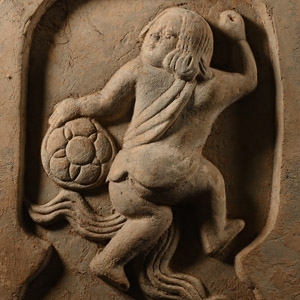
Chinese Song Terracotta Tile with Armoured Warrior
Song Dynasty, 960-1279 A.D. or laterSold for (Inc. bp): £117
With arched recess, high-relief figure wearing a cuirass with right arm bent and hand clenched in a fist, left hand supporting a shield with mandorla motif. 3.7 kg, 29 cm
From a West Country, UK, collection, 1990s. -
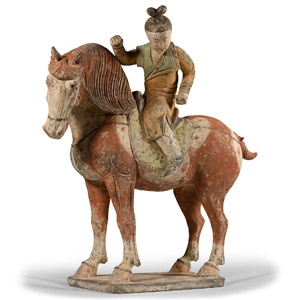
Chinese Red Terracotta Horse and Rider
Tang Dynasty, 618-907 A.D.Estimate: £2,000 - 3,000 (+bp*)
Opening Bid: £1,000
Modelled in the round in static pose on a rectangular base, the rider bent forward with right arm raised; both hands pierced to accept reins (absent). 6 kg, 41 cm high
From a West Country, UK, collection, 1990s. Accompanied by thermoluminescence analysis report no.03C26042024 from Laboratory Kotalla. This lot has been checked against the Interpol Database of stolen works of art and is accompanied by a search certificate number no.12452-226139.
