
Loading, please wait...


LOT 1301
Hittite Stone Bead Necklace String
OLD TESTAMENT PERIOD, CIRCA 1000 B.C.
38 1/8 in. (39.6 grams, 97 cm).
Restrung group of mainly small cylindrical beads with polished surface. [No Reserve]
ProvenanceFrom the private collection of Mr Brian Edwards, New Malden, Surrey, UK, formed from the late 1970s-early 1980s; thence by descent.
CONDITIONTimeLine Auctions follows a vetting process to ensure the authenticity and legality of all items, reinforcing our commitment to integrity and responsible trading. Each antiquity, antique, and coin lot undergoes thorough examination by a vetting committee of at least ten external specialists, professional trade association members, scientists, and archaeologists: Our Vetting Process
AUCTIONS:
TimeLine is a leading auction house specialising in antiquities, ancient art, collectables, natural history, coins, medals, and books. Our auctions offer museums, collectors, historians, and enthusiasts the opportunity to acquire unique and historically significant pieces.
-
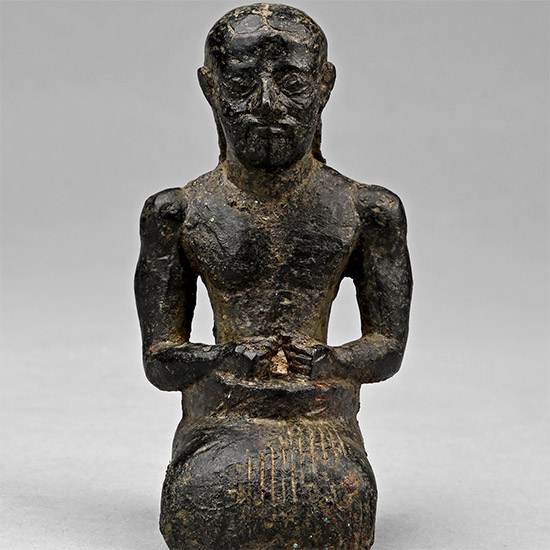
Western Asiatic Bronze Statuette of a Kneeling Priest
Late 3rd millennium B.C.Sold for (Inc. bp): £5,720
Modelled as a kneeling priest wearing a knee-length kilt, the long hair combed back from the face and extending down the back, arms bent, and fists clenched, resting on the belt, recessed to the underside. 359 grams, 83 mm
Ex London family collection, since the 1970s. Accompanied by a report of metallurgical analytical results, written by Metallurgist Dr Brian Gilmour of the Research Laboratory for Archaeology and the History of Art, University of Oxford. This lot has been checked against the Interpol Database of stolen works of art and is accompanied by search certificate number no.13313-258236.
This powerful figure was probably lost-wax cast in arsenical copper, as were many Near Eastern bronzes of the 3rd millennium. He is muscular with broad shoulders, a strong chest and a well-toned, rippling abdomen. The pleated long garment is typical of the Mesopotamian men. Very interesting is his praying gesture, which is typical of the statuette of Ur culture. -
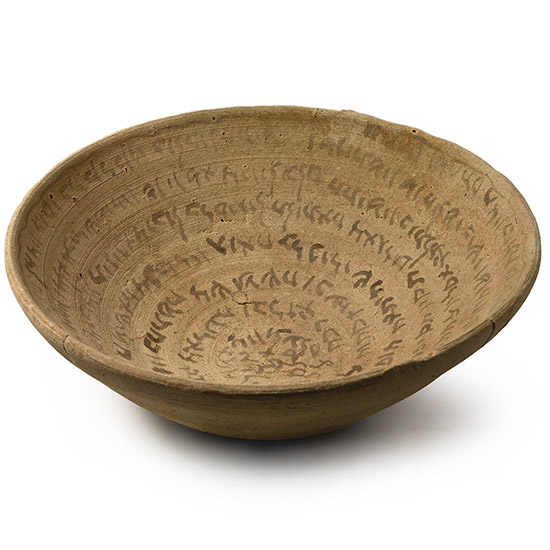
Aramaic Terracotta Magical Incantation Bowl
Circa 4th-8th century A.D.Sold for (Inc. bp): £975
Flat-based bowl, inscribed in spiral from the bottom inner wall to the rim with Aramaic text. 360 grams, 17.6 cm
Private collection, 1980s. UK private collection before 2000. Acquired on the UK art market. Private collection, London, UK
Aramaic incantation bowls are particular to the Sasanian period and have been found in the regions of modern Iraq. These simple ceramic bowls, also known as magic bowls, each contain an Aramaic inscription, written in ink, which spirals from the centre. The bowls seem to have played an important part in domestic life. For example, during excavation in Nippur in 1889, one or more incantation bowls were found in each house together with domestic artefacts, most often in doorways or under floorboards in the corner of rooms. The bowls are predominantly apotropaic, and the inscriptions tend to protect their owners from misfortunes such as childbirth, illness and evil spirits. -
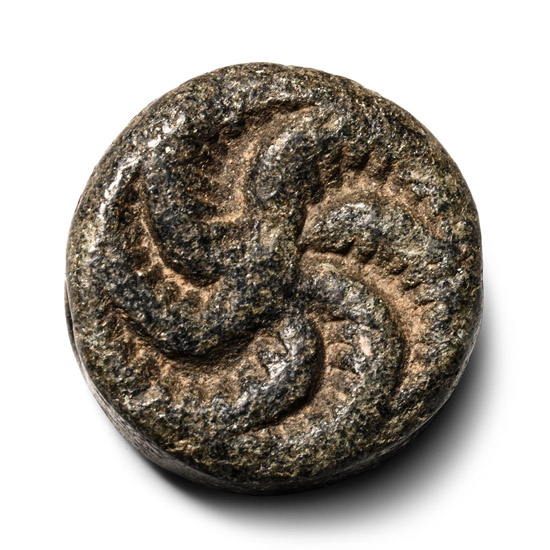
West Central Asian Green Stone Stamp Seal with Eight-Pointed Star Whorl
Circa 2000-1000 B.C.Sold for (Inc. bp): £72
Bifacial stamp seal, accompanied by an old scholarly note, typed and signed by W.G. Lambert, late Professor of Assyriology, University of Birmingham, 1970-1993, which states: 'Bifacial Stamp Seal of Green Stone, 18.5 x 8mm. The one side shows a spiralling device with notched curving arms. The other side shows an eight-pointed star with filling motifs between the arms. The seal is pierced at the widest point. This comes from west-central Asia and dates to c. 2500-2000 B.C. The side with the spiral was original with the seal, but the design on the other side may be a little later, perhaps c. 2000-1000 B.C. Similar designs to the spiral have been found on seals coming from the southeast Karakum desert.' 4.78 grams, 18 mm
Acquired in the late 1980s-early 1990s. Ex property of a West London businessman. Academically researched and catalogued by the late Professor Lambert in the early 1990s. Accompanied by a copy of a scholarly report, numbered 2009, typed and signed by Professor Wilfrid George Lambert.
