
Loading, please wait...


LOT 0203
Hittite Bronze Standard Finial with Animal
CIRCA 13TH-10TH CENTURY B.C.
6 3/4 in. (12 1/4 in.) (405 grams, 17 cm (922 grams total, 31 cm including stand)).
With a central bar with a semi-circle on either side, surmounted by a flat platform with a stag with large, elaborate horns, standing behind a doe; accompanied by a custom-made display stand.
ProvenanceFrom a private collection, since 1989.
Ex West London, UK collection.
TimeLine Auctions follows a vetting process to ensure the authenticity and legality of all items, reinforcing our commitment to integrity and responsible trading. Each antiquity, antique, and coin lot undergoes thorough examination by a vetting committee of at least ten external specialists, professional trade association members, scientists, and archaeologists: Our Vetting Process
AUCTIONS:
TimeLine is a leading auction house specialising in antiquities, ancient art, collectables, natural history, coins, medals, and books. Our auctions offer museums, collectors, historians, and enthusiasts the opportunity to acquire unique and historically significant pieces.
-
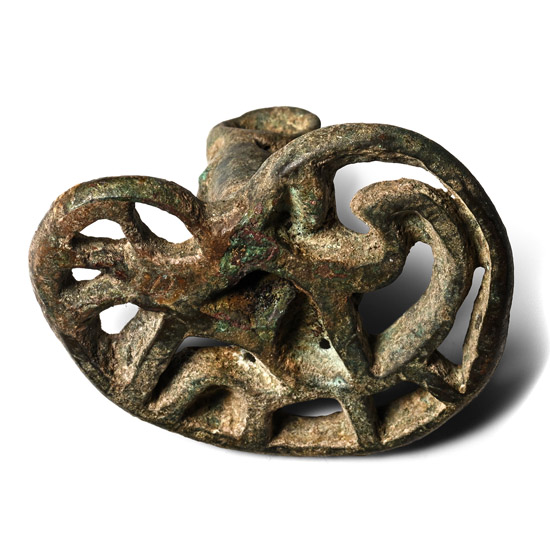
Large West Central Asian Bronze Ear-Shaped Seal Matrix
Circa 2300-2000 B.C.Estimate: £100 - 140 (+bp*)
Opening Bid: £50
Comprising an openwork ear-shaped body and a tall looped handle on the reverse. 42.7 grams, 51 mm
Acquired in the late 1980s-early 1990s. Ex property of a West London businessman. Academically researched and catalogued by the late Professor Lambert in the early 1990s. -

Large West Central Asian Bronze Scalloped Seal Matrix with Thunderbolt Cross
Circa 2300-2000 B.C.Estimate: £80 - 100 (+bp*)
Opening Bid: £40
Round openwork body with loop on the reverse, accompanied by an old scholarly note, typed and signed by W.G. Lambert, late Professor of Assyriology, University of Birmingham, 1970-1993, which states: 'Stamp Seal of Bronze, 45 x 45 x 15 mm. This is roughly round, with flat face and flat back and with scalloped edges. A handle of inverted V-shape is mounted on the back. The design consists of an outer scalloped band joined to the centre with straight arms with thickened ends which meet in the middle, but divided into two pairs. This comes from west central Asia and dates to c. 2300-2000 B.C. It is dented, and has some incrustation on the surface, which could be removed. Generally it is in good condition.' 28.4 grams, 46 mm
Acquired in the late 1980s-early 1990s. Ex property of a West London businessman. Academically researched and catalogued by the late Professor Lambert in the early 1990s. Accompanied by a copy of a scholarly report, numbered R-507, typed and signed by Professor Wilfrid George Lambert. -

Uzbek Double-Sided Pringi Tunic
20th century A.D.Sold for (Inc. bp): £26
Reversible type in olive green with bands of floral and geometric embroidered designs, and plain brown cloth. 1.8 kg, 1.18 m long
Private collection, UK.
