
Loading, please wait...
LOT 0082
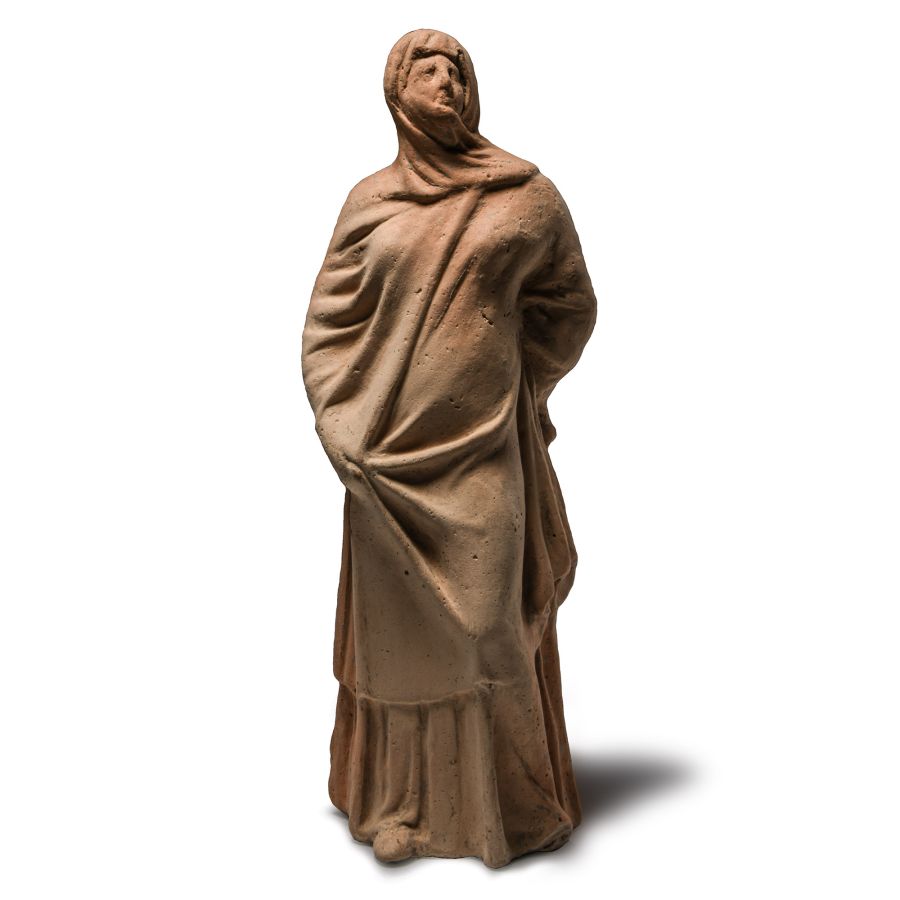
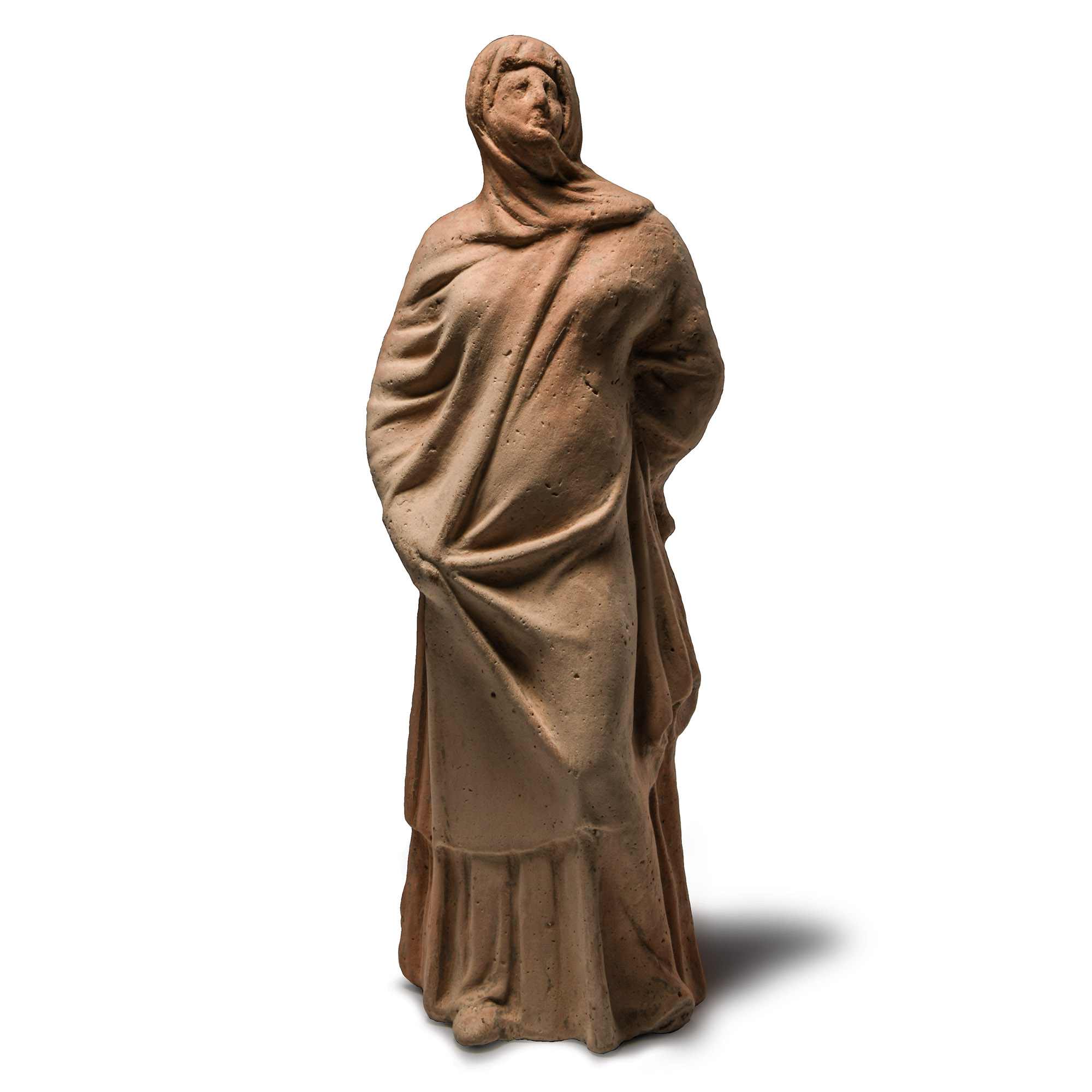
Hellenistic Terracotta Figure of a Veiled Woman
3RD-2ND CENTURY B.C.
8 5/8 in. (384 grams, 22 cm high).
Hollow-formed Tanagra type depicting a standing female wearing a floor-length robe, veil and mantle; the right arm holding the mantle, one foot protruding; a circular opening to the reverse.
ProvenanceAcquired early 1990s.
Ex private American collection; thence by descent.
Private Swiss collection since 1998.
Cf. similar figure in the British Museum under accession number 1874,1110.11.
CONDITIONTimeLine Auctions follows a vetting process to ensure the authenticity and legality of all items, reinforcing our commitment to integrity and responsible trading. Each antiquity, antique, and coin lot undergoes thorough examination by a vetting committee of at least ten external specialists, professional trade association members, scientists, and archaeologists: Our Vetting Process
AUCTIONS:
TimeLine is a leading auction house specialising in antiquities, ancient art, collectables, natural history, coins, medals, and books. Our auctions offer museums, collectors, historians, and enthusiasts the opportunity to acquire unique and historically significant pieces.
LOT 0082
Hellenistic Terracotta Figure of a Veiled Woman
Estimate £1,000 - 1,400€1,160 - 1,620 (for guidance only)$1,350 - 1,890 (for guidance only)
-
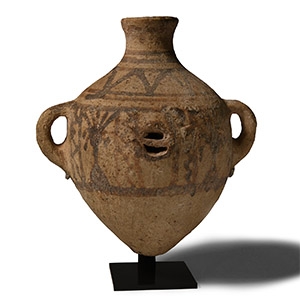
Cypriot Ceramic Jug
650-600 B.C.Sold for (Inc. bp): £663
Of piriform profile with lateral loop handles below the broad shoulder, short neck with flared mouth; bands of painted geometric ornament to the shoulder and equator; circular vent to one face and similar to the reverse with horizontal bar; old collector's labels '8.', 'No.357' and 'Chypre'; mounted on a custom-made display stand. 96 grams, 14 cm high (393 grams total, 15.5 cm including stand)
Collection of Louis-Gabriel Bellon (1819-1899), Saint-Nicolas-lez-Arras and Rouen; thence by descent. with Millon & Associes Auctions, Paris, 6th December 2021, lot 6. -
.jpg)
Cypriot Terracotta Figurine
6th-5th century B.C.Sold for (Inc. bp): £780
Modelled in the half-round, the figure wearing a conical hood with open front, detailed facial features and ribbed beard, left arm bent, right arm drawn across the body in the folds of a mantle, vertical border to the left chest; mounted on a custom-made stand. 48 grams, 83 mm (69 grams total, 10.9 cm high including stand)
Ex Julien Gréau (1810–1895) who was an omnivorous French collector with a predilection for antiquities. Collection of Louis-Gabriel Bellon (1819-1899), Saint-Nicolas-lez-Arras and Rouen, thence by descent. with Millon & Associes Auctions, Paris, 6th December 2021, lot 41 [Part]. Accompanied by a copy of Collection J. Gréau, Terres Cuites Grecques, by H. Hoffmann, 1891, where this piece is published. -
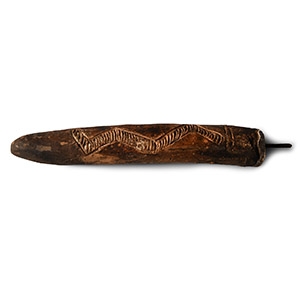
Cypriot Terracotta Votive Horn
2100-1850 B.C.Sold for (Inc. bp): £221
Tapering round-section votive with reserved zigzag bands of dense linear hatching; modern mounting pin. 71 grams, 13.5 cm
From the celebrated personal collection of art formed by the famous anthropologist, artist, and television presenter Desmond Morris. with Christie’s, South Kensington, 14 May 2002, lot 19 (part).
