Loading, please wait...

Hellenistic Silver Decorated Bowl Hellenistic Silver Decorated Bowl Hellenistic Silver Decorated Bowl
Use mousewheel to zoom in and out, click to enlarge
Details

LOT 0074

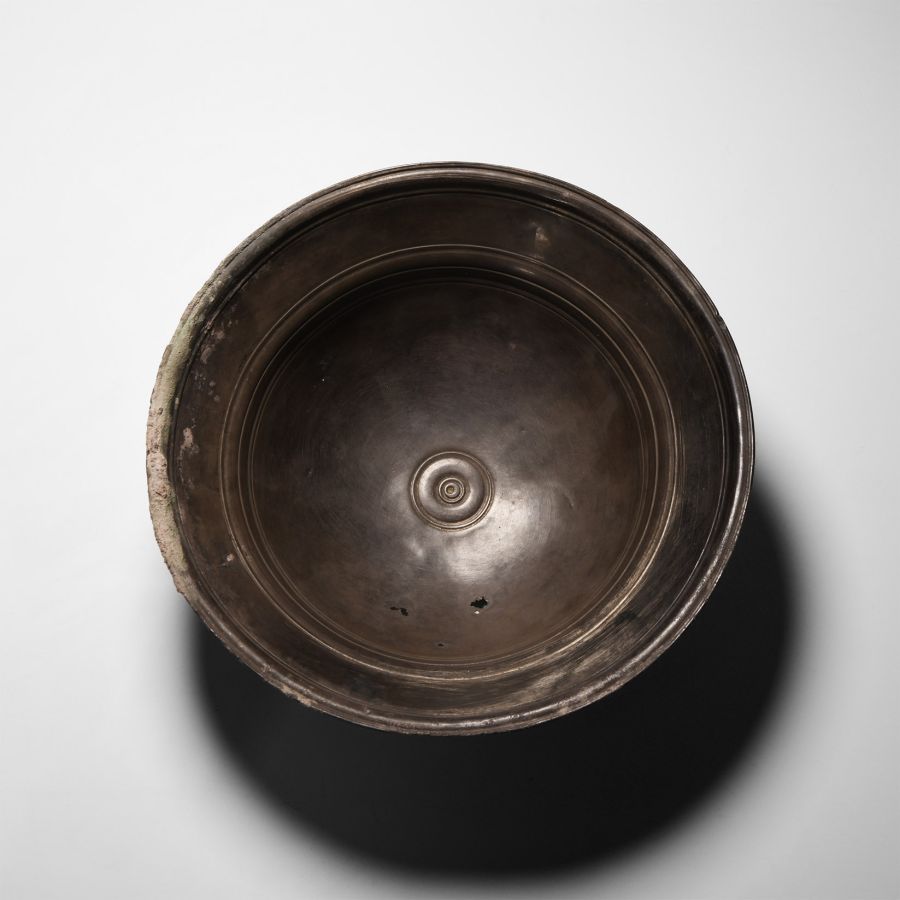
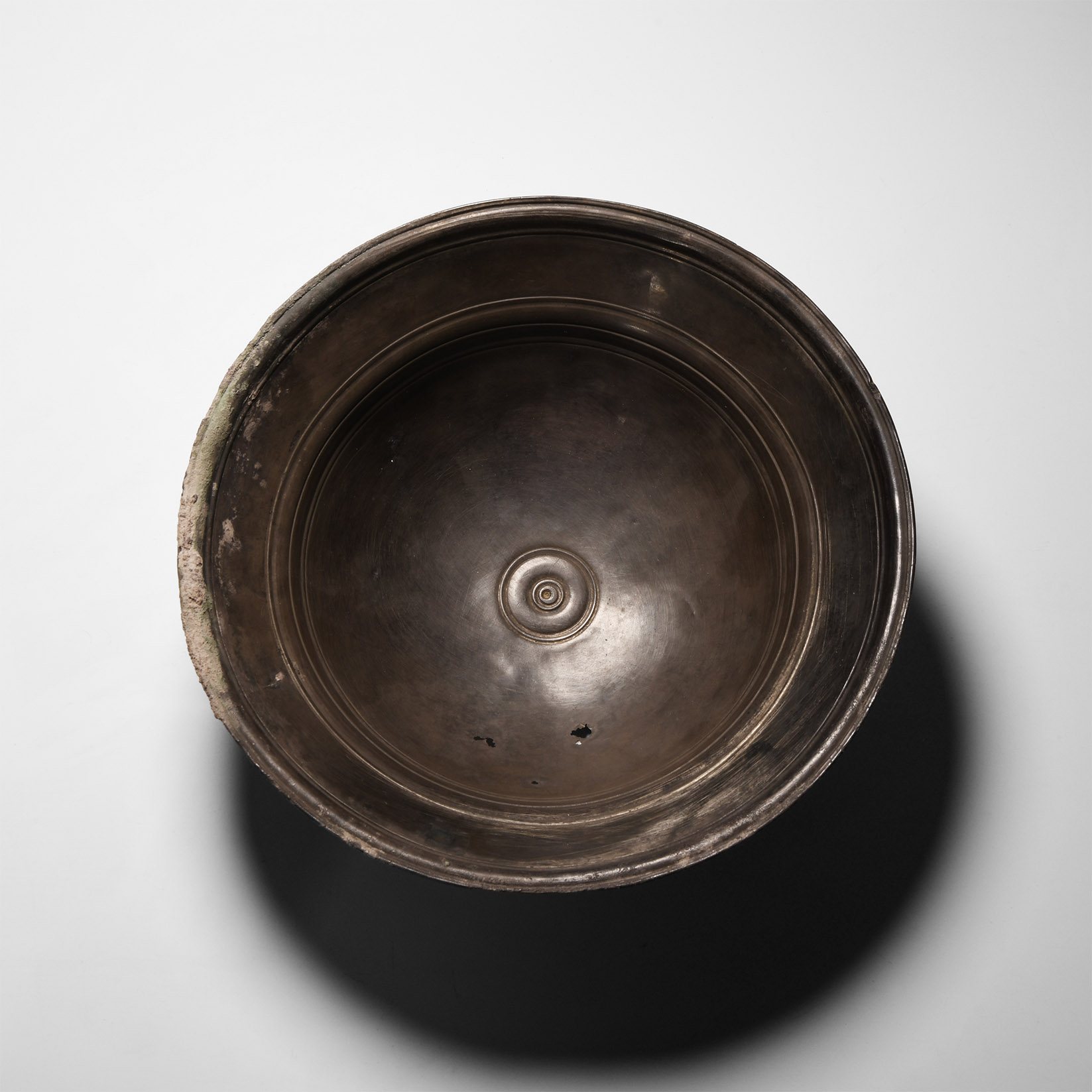
Hellenistic Silver Decorated Bowl

3RD CENTURY B.C.-1ST CENTURY A.D.

7 7/8 in. (437 grams, 20 cm wide).

A squat sheet-silver bowl with carinated profile, rolled rim, raised circumferential bands to the inner face and centre.

Provenance

Private Swiss collection, acquired 1999.
Ex Surena collection, London, UK.
Private European collection.

This lot has been checked against the Interpol Database of stolen works of art and is accompanied by search certificate no.11617-199030.

Literature

Cf. bowl of similar type in the British Museum, London, under accession number 134304.

CONDITION
VETTING:

TimeLine Auctions follows a vetting process to ensure the authenticity and legality of all items, reinforcing our commitment to integrity and responsible trading. Each antiquity, antique, and coin lot undergoes thorough examination by a vetting committee of at least ten external specialists, professional trade association members, scientists, and archaeologists: Our Vetting Process


AUCTIONS:

TimeLine is a leading auction house specialising in antiquities, ancient art, collectables, natural history, coins, medals, and books. Our auctions offer museums, collectors, historians, and enthusiasts the opportunity to acquire unique and historically significant pieces.

LOT 0074

Hellenistic Silver Decorated Bowl

Estimate £4,000 - 6,000€4,640 - 6,960 (for guidance only)$5,400 - 8,100 (for guidance only)

Print page

RELATED LOTS
  • Greek Silver Wine Strainer
    Greek Silver Wine Strainer
    4th-3rd century B.C.

    Estimate: £20,000 - 30,000 (‡+bp*)

    Opening Bid: £10,000

    A high-quality silver wine strainer composed of a shallow bowl and broad flange rim, two integral scalloped handles with scrolled flourishes, tapering to a loop handle with swan head terminals with incised eye and beak detailing, perforated whirl within roundel to interior base; accompanied by a custom-made display stand. 160 grams, 22.2 cm wide (526 grams total including stand)


    Ex private South German collection, 1980s. with Christie's, New York, 8 June 2012, lot 86. Accompanied by an academic report by Dr Raffaele D’Amato. This lot has been checked against the Interpol Database of stolen works of art and is accompanied by search certificate number no.11578-198980.

    Elaborate silver strainers, such as this present example, were used at symposia and festive occasions for the purpose of preventing the dregs of wine from entering the wine cup. This and other related silver utensils became popular in the later 4th and 3rd century B.C. These highly decorated wine strainers were fitted with dual handles forming loops in the shape of twisting animals, here a swan. Usually they took the form of a shallow dish complete with four rings of perforations in the centre in order to drain the wine. Strainers of this type were used to separate out sediments which could be found in the thick Greek wine. Examples similar to this one have been found in royal tombs in northern Greece, as well as the tomb of a monarch in Sudan.

    Lot Details

  • Large Greek Apulian Platter with Eros
    Large Greek Apulian Platter with Eros
    4th century B.C.

    Estimate: £5,000 - 7,000 (+bp*)

    Opening Bid: £2,500

    A broad ceramic patera with raised rim and stepped foot, two strap handles to the rim each flanked by two domed studs; rim with reserved wave pattern band, studs with starburst motif; painted central scene with outer foliate bands and reserved wave pattern framing the tondo displaying Eros in flight with wings spread, holding a red cloth over an inverted shield; some repainting. 2.76 kg, 41 cm wide

    Fine condition.

    French collection, 1990s-early 2000s. Formerly in Patrick Declerck Auction, Douai, France, 2014, lot 72. From an important Paris gallery, France. Ex private Parisian collection. Accompanied by an original thermoluminescence analysis report no.N122j42 from Oxford Authentication. This lot has been checked against the Interpol Database of stolen works of art and is accompanied by search certificate no.11616-196567.

    Lot Details

  • Large Greek Hydria with Egg-and-Dart Motifs
    Large Greek Hydria with Egg-and-Dart Motifs
    Early 5th century B.C.

    Sold for (Inc. bp): £9,525

    A spectacular bronze hydria composed of a tapering body, broad shoulder and waisted neck, the everted rim decorated with egg-and-dart motifs, three round-section handles and tiered, ogival foot; professionally restored. 4.7 kg, 39.5 cm

    Fine condition, professionally restored. A spectacular display piece.

    Acquired circa 1989-1990. Private collection of N.A., Niedersachsen. Accompanied by an original French cultural passport number 226773 dated 3 June 2021. Accompanied by an academic report by Dr Raffaele D'Amato. This lot has been checked against the Interpol Database of stolen works of art and is accompanied by search certificate no.11306-190969.

    Whilst such vessels were originally produced for holding water, hydriai were often re-purposed. From the 5th century B.C. onwards, they also had a funerary function, used in the cult of the dead and the underworld. Appearing as grave deposits, they were sometimes used as funerary urns, receptacles for the ashes of the deceased (see the MET hydria from Galaxidi, found with the bones still inside). Hydriai were also commonly associated with rituals relating to the cults of the gods. They have been found in temples and public buildings and have been recorded as prizes in athletic games. It has also been suggested that the more lavish examples were gifted to brides.

    Lot Details

Stay up-to-date with the latest from TimeLine Auctions by joining our mailing list