
Loading, please wait...
_900x900.jpg "Hellenistic Pale Green Glass Bowl")
_200x200.jpg "Hellenistic Pale Green Glass Bowl")
_900x900.jpg "Hellenistic Pale Green Glass Bowl")
_200x200.jpg "Hellenistic Pale Green Glass Bowl")
.jpg "Hellenistic Pale Green Glass Bowl")
.jpg "Hellenistic Pale Green Glass Bowl")
LOT 0080
Hellenistic Pale Green Glass Bowl
CIRCA MID 2ND-EARLY 1ST CENTURY B.C.
6 1/8 in. (375 grams, 15.7 cm).
Conical bowl with three horizontal grooves cut to the inner rim, a pair of concentric circles to the underside; remains of iridescence.
ProvenanceDr Jutaro Kawabe, Nagoya, Japan, his collection formed in the 1960s-1970s.
with Hoshigaoka Gallery until the late 1990s.
Private collection, London, UK.
This lot has been checked against the Interpol Database of stolen works of art and is accompanied by a search certificate number no.12828-241335.
This lot has been cleared against the Art Loss Register database, and is accompanied by an illustrated lot declaration signed by the Head of the Antiquities Department, Dr Raffaele D'Amato.
Cf. a deep bowl in the Hermitage Collection, St Petersburg, likewise formed from semi-translucent greenish glass, with three deep wheel-cut grooves on the interior below the rim and further concentric polished lines encircling the exterior near the base in Kunina, N., Ancient Glass in the Hermitage Collection, St Petersburg, 1997, p.257, no. 50; for a colourless example, see The Metropolitan Museum of Art, New York, acc. no. 81.10.243. and 57.11.6.
FootnotesKunina notes that this form imitates metallic prototypes of the late Hellenistic period.
CONDITIONTimeLine Auctions follows a vetting process to ensure the authenticity and legality of all items, reinforcing our commitment to integrity and responsible trading. Each antiquity, antique, and coin lot undergoes thorough examination by a vetting committee of at least ten external specialists, professional trade association members, scientists, and archaeologists: Our Vetting Process
AUCTIONS:
TimeLine is a leading auction house specialising in antiquities, ancient art, collectables, natural history, coins, medals, and books. Our auctions offer museums, collectors, historians, and enthusiasts the opportunity to acquire unique and historically significant pieces.
LOT 0080
Hellenistic Pale Green Glass Bowl
Estimate £4,000 - 6,000€4,640 - 6,960 (for guidance only)$5,400 - 8,100 (for guidance only)
-
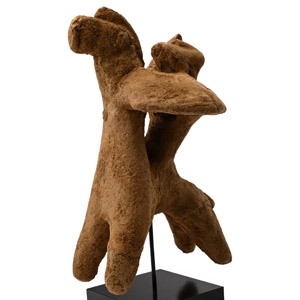
Archaic Greek Terracotta Figure of Mounted Warrior with Shield
7th-5th century B.C.Sold for (Inc. bp): £169
The horse with an elongated neck and stylised features; mounted by a bearded rider gazing towards the sky, holding a shield in his left hand and a sword(?) in his right hand; mounted on a custom-made display stand. 286 grams total, 15 cm high including stand
Acquired before 1990. From an old German collection. From the private collection of John Meredith, acquired since the 1990s; thence by descent. This lot is accompanied by an illustrated lot declaration signed by the Head of the Antiquities Department, Dr Raffaele D'Amato.
Terracotta figurines of horse and rider were common grave offerings in Boeotia, northwest of Attica, particularly during the 6th century B.C. Representations of warriors on horseback were already widespread in the Geometric Period, and widely used in Cyprus, during this period. -
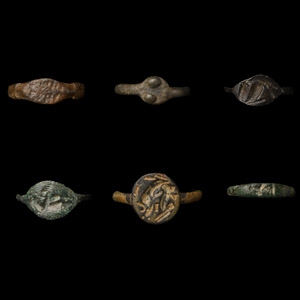
Greek and Other Bronze Ring Collection
4th century B.C.-2nd century A.D.Sold for (Inc. bp): £104
Including discoid, scaphoid, pelletted and other bezel types. 10.12 grams total, 18-24 mm
Ex London, UK, gentleman 1980-1990s. This lot is accompanied by an illustrated lot declaration signed by the Head of the Antiquities Department, Dr Raffaele D'Amato. -
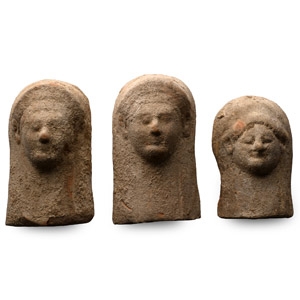
Greek Terracotta Female Protome Group
Early 5th century B.C.Sold for (Inc. bp): £286
Each tongue-shaped in plan and hollow to the reverse, female bust in high-relief with palla head-covering. 408 grams total, 9.5-11.6 cm
with H.A.C., Basel, prior 1999. This lot is accompanied by an illustrated lot declaration signed by the Head of the Antiquities Department, Dr Raffaele D'Amato.
