
Loading, please wait...

LOT 0096
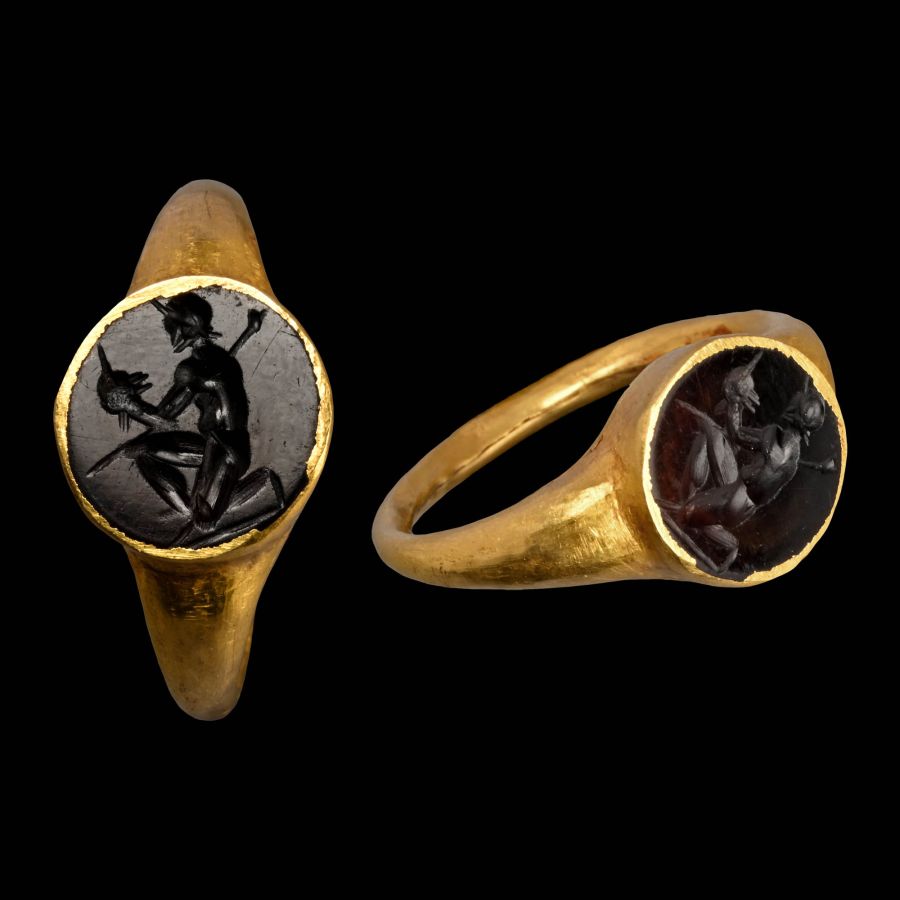
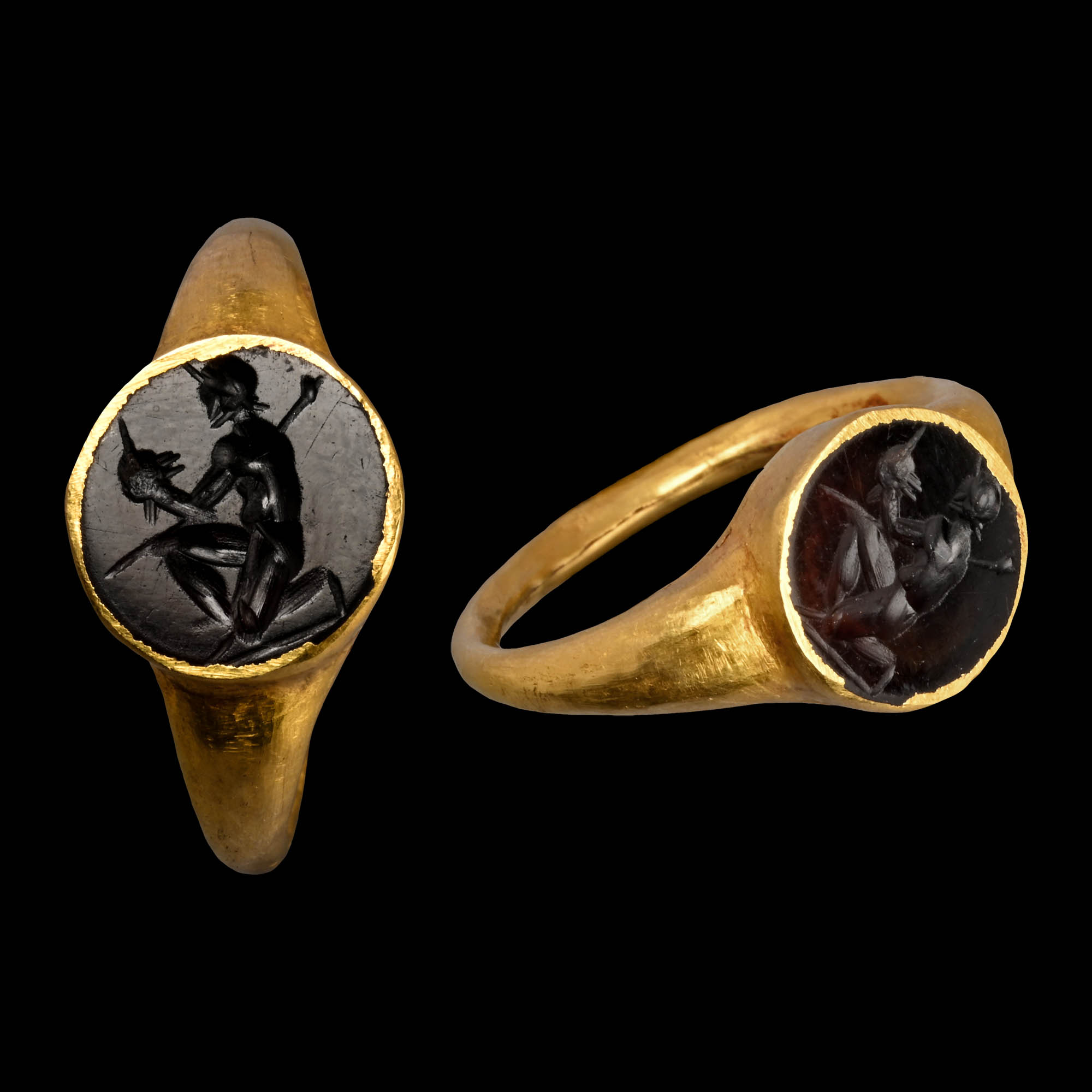
Hellenistic Gold Ring with Satyr Gemstone
2ND-1ST CENTURY B.C.
1 in. (2.91 grams, 23.57 mm overall, 19.25 mm internal diameter (approximate size British O 1/2 , USA 7 1/4, Europe 15.61, Japan 15)).
With hollow-form hoop widening towards the shoulders, raised bezel set with a round intaglio, engraved with an image of a satyr or kneeling nude warrior on a baseline, wearing a Boeotian-style helmet pushed back, holding a spear in one hand and an object in the other; a marriage.
ProvenanceFrom a private family collection formed since the early 19th century, thence by descent.
Property of a New Zealand legal professional.
Accompanied by an academic report by Dr Raffaele D’Amato.
This lot has been checked against the Interpol Database of stolen works of art and is accompanied by search certificate number no.12322-223716.
Cf. Marshall, F. M., Catalogue of the Finger Rings Greek, Etruscan and Roman in the Departments of Antiquities of the British Museum, London, 1968; Spier, J., Ancient Gems and Finger Rings, Malibu, 1992, figs.50, 112 (crouching warrior); Chadour, A.B., Rings. The Alice and Louis Koch Collection, volume I, Leeds, 1994, item 87, for type of ring; item 123, for the type of ring and the image of a crouching warrior; Boardman, J., Greek gems and finger rings, London, 2001, fig.213.
FootnotesThe scene possibly alludes to the incident in the Trojan Cycle where Achilles is wounded by an arrow in his heel, the only part of his body which was not impervious to injury.
CONDITIONTimeLine Auctions follows a vetting process to ensure the authenticity and legality of all items, reinforcing our commitment to integrity and responsible trading. Each antiquity, antique, and coin lot undergoes thorough examination by a vetting committee of at least ten external specialists, professional trade association members, scientists, and archaeologists: Our Vetting Process
AUCTIONS:
TimeLine is a leading auction house specialising in antiquities, ancient art, collectables, natural history, coins, medals, and books. Our auctions offer museums, collectors, historians, and enthusiasts the opportunity to acquire unique and historically significant pieces.
-
Cypriot and Other Vessel Group
2nd-1st millennium B.C.Sold for (Inc. bp): £98
Including ribbed vase, oinochoe and other types, some on a ceramic base. 896 grams total, 4.9-11.9 cm
From a collection acquired on the UK art market from various auction houses and collections mostly before 2000. From an important Cambridgeshire estate; thence by descent. -
Cypriot and Other Terracotta Figure Group
2nd-1st millennium B.C.Sold for (Inc. bp): £117
Comprising anthropomorphic, zoomorphic and theriomorphic ceramic figures in various poses, some on a ceramic base. 546 grams total, 6.1-10.5 cm
From a collection acquired on the UK art market from various auction houses and collections mostly before 2000. From an important Cambridgeshire estate; thence by descent. -
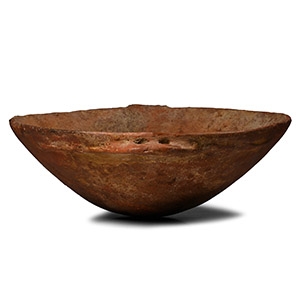
Very Large Red Burnished Ware Cooking Bowl
Early Bronze Age I-III, circa 2300-2000 B.C.Sold for (Inc. bp): £286
Broad shallow bowl with rounded underside, lateral tab to the rim and pierced ledge handle opposite. 2 kg, 37 cm wide
From a collection acquired on the UK art market from various auction houses and collections mostly before 2000. From an important Cambridgeshire estate; thence by descent.
