
Loading, please wait...
LOT 0103
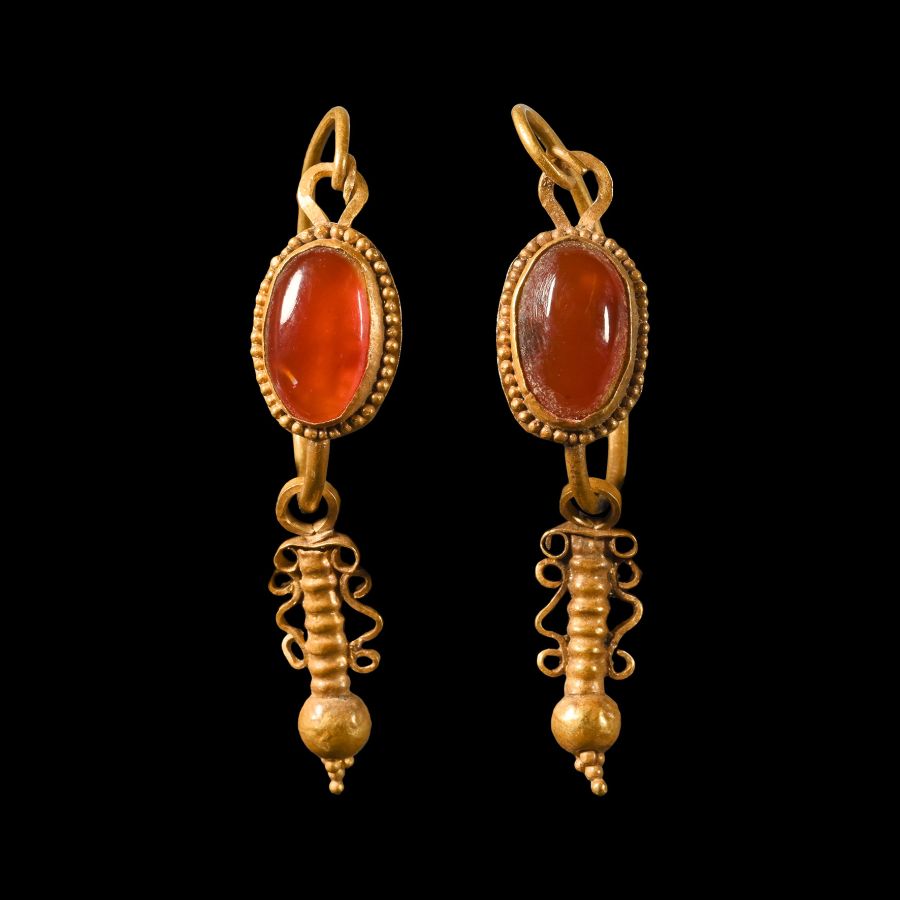
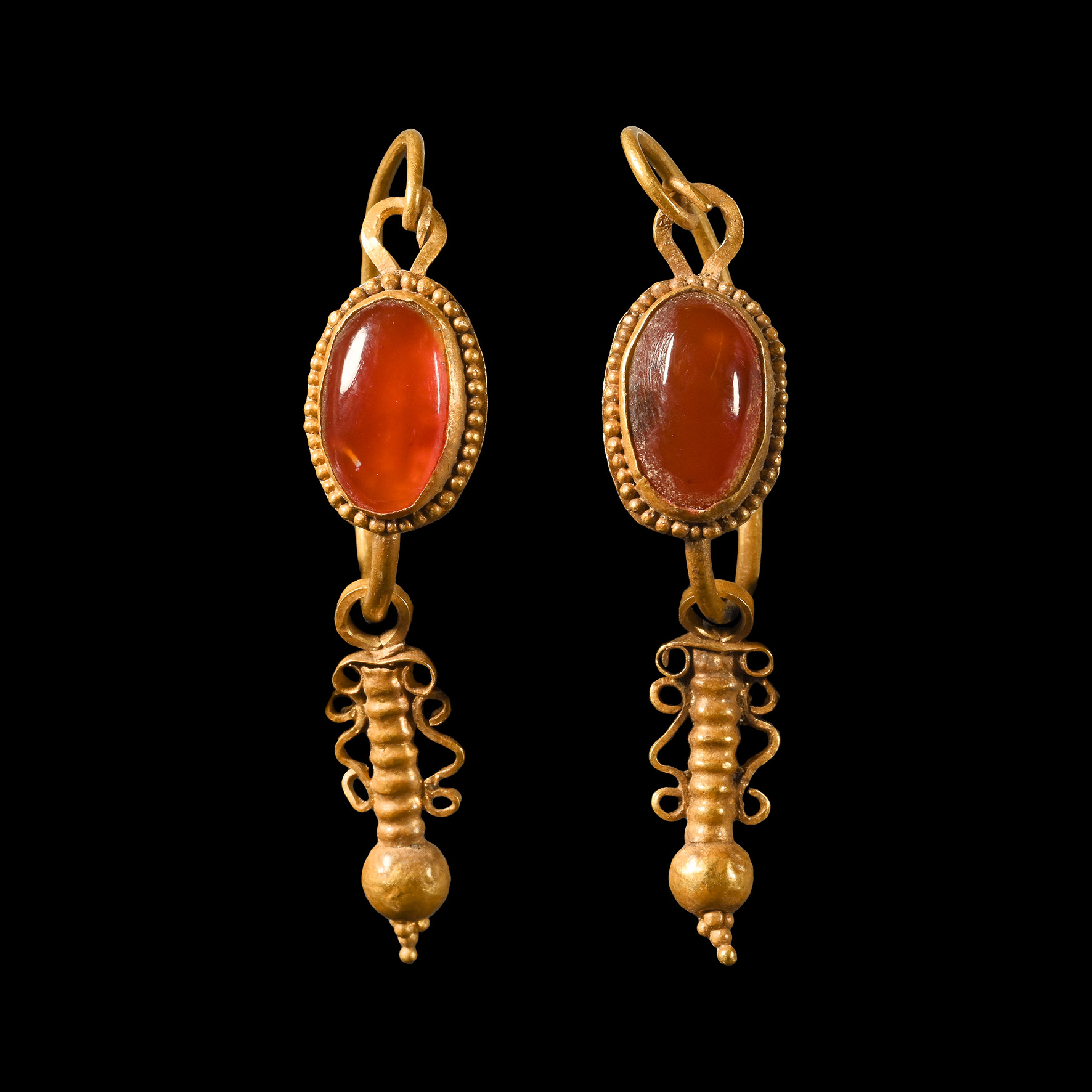
Hellenistic Gold Earrings with Gemstones
CIRCA 2ND-1ST CENTURY B.C.
1 1/2 in. (3.85 grams total, 40 mm each).
Matched pair of gold earrings, each wire hoop with hook-and-eye closure, ellipsoid shield with beaded rim and cell with carnelian cabochon, free-running dangle with filigree crocketting and granule cluster. [2]
ProvenanceFrom a collection of a London lady, acquired annually during 1990s-2000s.
LiteratureCf. Marshall, F.H., Catalogue of the Jewellery, Greek, Etruscan and Roman, in the Department of Antiquities, British Museum, London, 1911, pl.LII, items 2376, 2377, for type.
CONDITIONTimeLine Auctions follows a vetting process to ensure the authenticity and legality of all items, reinforcing our commitment to integrity and responsible trading. Each antiquity, antique, and coin lot undergoes thorough examination by a vetting committee of at least ten external specialists, professional trade association members, scientists, and archaeologists: Our Vetting Process
AUCTIONS:
TimeLine is a leading auction house specialising in antiquities, ancient art, collectables, natural history, coins, medals, and books. Our auctions offer museums, collectors, historians, and enthusiasts the opportunity to acquire unique and historically significant pieces.
LOT 0103
Hellenistic Gold Earrings with Gemstones
Estimate £1,200 - 1,700€1,390 - 1,970 (for guidance only)$1,620 - 2,300 (for guidance only)
-
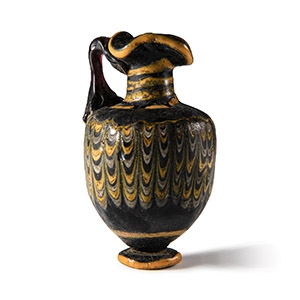
Greek Core-Formed Glass Juglet
Circa 4th-3rd century B.C.Sold for (Inc. bp): £1,170
Black glass with yellow dragged-trail detailing to the body, small disc foot; oinochoe-type pinched spout and applied strap handle to the rear; cracked and repaired. 67 grams, 74 mm high
Ex Korban Gallery, 1970s. Ex P. A., Hertfordshire, UK, specialist collection of Greek art, 1980-1990s. -
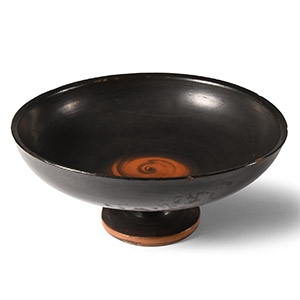
Greek Attic Black-Glazed Kylix
Circa 5th century B.C.Estimate: £400 - 600 (‡+bp*)
Opening Bid: £200
Without handles, composed of a D-section bowl with attractive whorl pattern to the centre, everted rim, spool-shaped stem and discoid foot; old label with '37' to the outside of the bowl; restored. 230 grams, 15.6 cm wide
Very fine condition.
Ex Louis-Gabriel Bellon (1819?-1899), France. Private collection, acquired on the French art market in 2009.
This Attic pottery type, developed towards the late 6th century B.C., made from a fine light tan clay with a semi-lustrous black gloss, except for the edge and underside of discoid foot. Usually this kind of handleless kylix evidences a shallow, segmental form body with the lip curving inward and being slightly offset on the exterior. A wide circle in black is usually visible on the underside of the foot. -
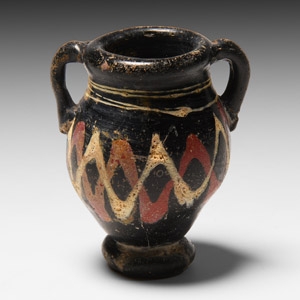
Greek Core-Formed Glass Amphora
Circa 3rd century B.C.Estimate: £500 - 700 (+bp*)
Opening Bid: £250
Miniature with piriform body, carinated rim, applied handles and discoid foot, with polychrome geometric motif to the equator. 45.2 grams, 47 mm high
Fine condition.
Paris collection, 1990s. From an important Paris gallery, France. Ex private Parisian collection.
