
Loading, please wait...
_900x900.jpg "Hellenistic Gold Amphora Pendant Inlaid with Gemstones")
_200x200.jpg "Hellenistic Gold Amphora Pendant Inlaid with Gemstones")
.jpg "Hellenistic Gold Amphora Pendant Inlaid with Gemstones")
LOT 0049
Hellenistic Gold Amphora Pendant Inlaid with Gemstones
2ND-1ST CENTURY B.C.
1 1/4 in. (1 7/8 in.) (6.96 grams, 33 mm (16 grams total, 49 mm including stand)).
A gold amphora-shaped pendant composed of strip-twist volute handles, spool-shaped neck, piriform body and plinth style foot, body decorated with deep geometric cells inlaid with vibrant lapis lazuli, turquoise and possibly glass paste; suspension loop over mouth; accompanied by a custom-made display stand.
Provenancewith Sotheby's, New York, 12 June 2001, lot 230 (US$10,000-$15,000).
Property of a London gentleman.
Accompanied by copies of the relevant Sotheby's catalogue pages.
TimeLine Auctions follows a vetting process to ensure the authenticity and legality of all items, reinforcing our commitment to integrity and responsible trading. Each antiquity, antique, and coin lot undergoes thorough examination by a vetting committee of at least ten external specialists, professional trade association members, scientists, and archaeologists: Our Vetting Process
AUCTIONS:
TimeLine is a leading auction house specialising in antiquities, ancient art, collectables, natural history, coins, medals, and books. Our auctions offer museums, collectors, historians, and enthusiasts the opportunity to acquire unique and historically significant pieces.
LOT 0049
Hellenistic Gold Amphora Pendant Inlaid with Gemstones
Sold for (Inc. bp): £1,430
-
.jpg)
Campanian Red-Figure Bail Amphora from a Cumae Workshop
330-300 B.C.Sold for (Inc. bp): £4,680
A ceramic red-figure bail amphora with round-section strap handle and pierced lug at the apex, tall waisted neck with vertical rib detailing, rounded shoulder with running wave pattern ornament, tapering body with figural designs of standing females wearing a himation and a stephane in red and white on black ground, one figure holding a thyrsus and the other an ear of corn, with accessories in the field; flared base; from a workshop in Cumae. 862 grams, 37 cm high
Ex collection H.& P. Payot, Clarens, by descent. Accompanied by an academic report by Dr Raffaele D’Amato. This lot has been checked against the Interpol Database of stolen works of art and is accompanied by search certificate number no.11577-199027. Accompanied by an original thermoluminescence analysis report no.QED2223/SG0-0105 from QED Laboratoire.
The bail amphora, named for the tall handle arching over the mouth, was a shape made primarily in Campania, where red-figure vases were produced at both Capua and Cumae in the 4th century B.C. The decoration offered a remarkable range of subjects associated not only with mythological images, but with representations of the local life, costumes and customs. The simple, single figure compositions decorating each side of this vase are also characteristic of the style, which tended to avoid complex mythological scenes often found on much larger vessels like volute craters, favouring representation of the daily life of south Italic people. -
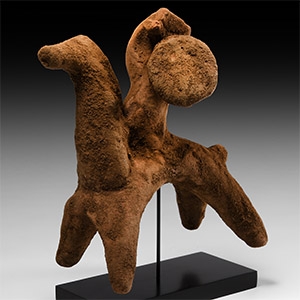
Archaic Greek Mounted Warrior with Shield
7th-5th century B.C.Sold for (Inc. bp): £338
A terracotta figure modelled in the round as a mounted warrior, the stylised horse modelled standing on stub legs, with a long neck and detailing to its eyes; the warrior holding a shield in his left hand, right hand and arm raised to eye level, wearing a crested helmet; restored and mounted on a custom-made display stand. 410 grams total, 16 cm high including stand
Acquired before 1990. From an old German collection.
Terracotta figurines of horse and rider were common grave offerings in Boeotia, northwest of Attica, particularly during the 6th century B.C. Representations of warriors on horseback were already widespread in the Geometric Period, and also widely employed in Cyprus in this same period. The image of our rider, although influenced by Cypriot designs, does not show typical Cypriot characteristics, and indeed his kausia cap suggests a northern Greek origin. -
.jpg)
Greek Attic Black-Glazed Kylix
Circa 5th century B.C.Estimate: £500 - 700 (‡+bp*)
Opening Bid: £250
A black-glazed kylix or stemmed cup created without handles, composed of a D-section bowl with attractive whorl pattern to the centre, everted rim, spool-shaped stem and discoid foot; old label with '37' to the outside of the bowl. 230 grams, 15.6 cm wide
Very fine condition.
Ex Louis-Gabriel Bellon (1819?-1899), France. Private collection, acquired on the French art market in 2009.
This Attic pottery type, developed towards the late 6th century B.C., made from a fine light tan clay with a semi-lustrous black gloss, except for the edge and underside of discoid foot. Usually this kind of handleless kylix evidences a shallow, segmental form body with the lip curving inward and being slightly offset on the exterior. A wide circle in black is usually visible on the underside of the foot.
