
Loading, please wait...
LOT 0090
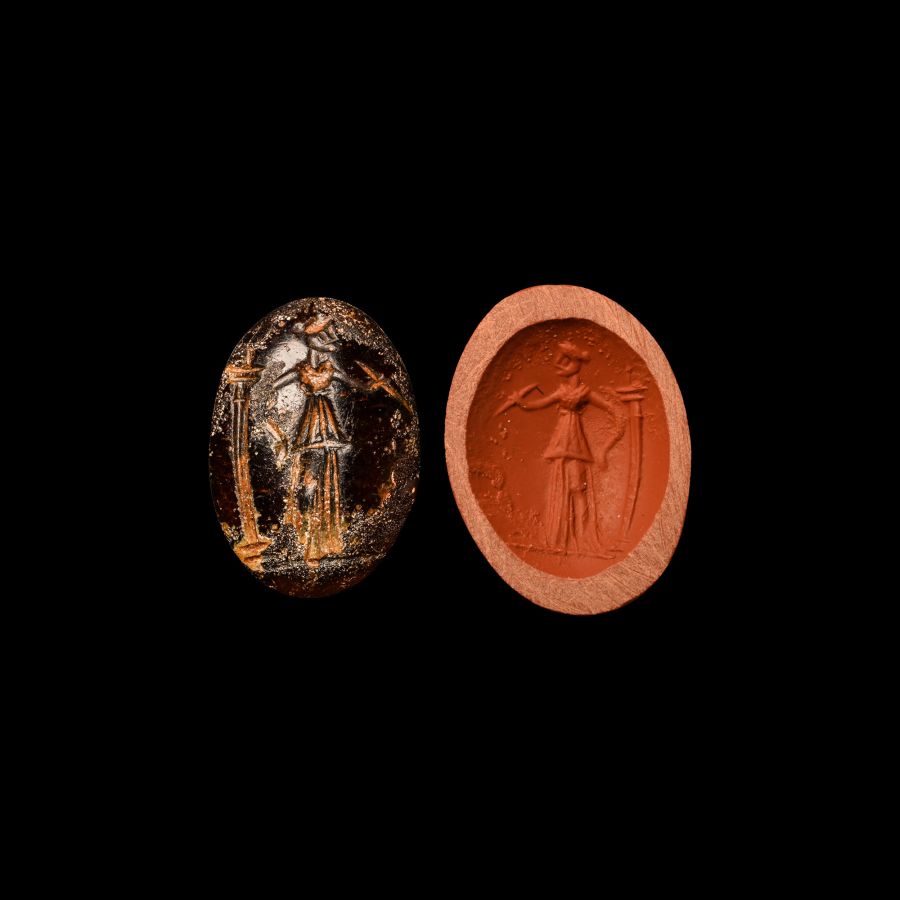
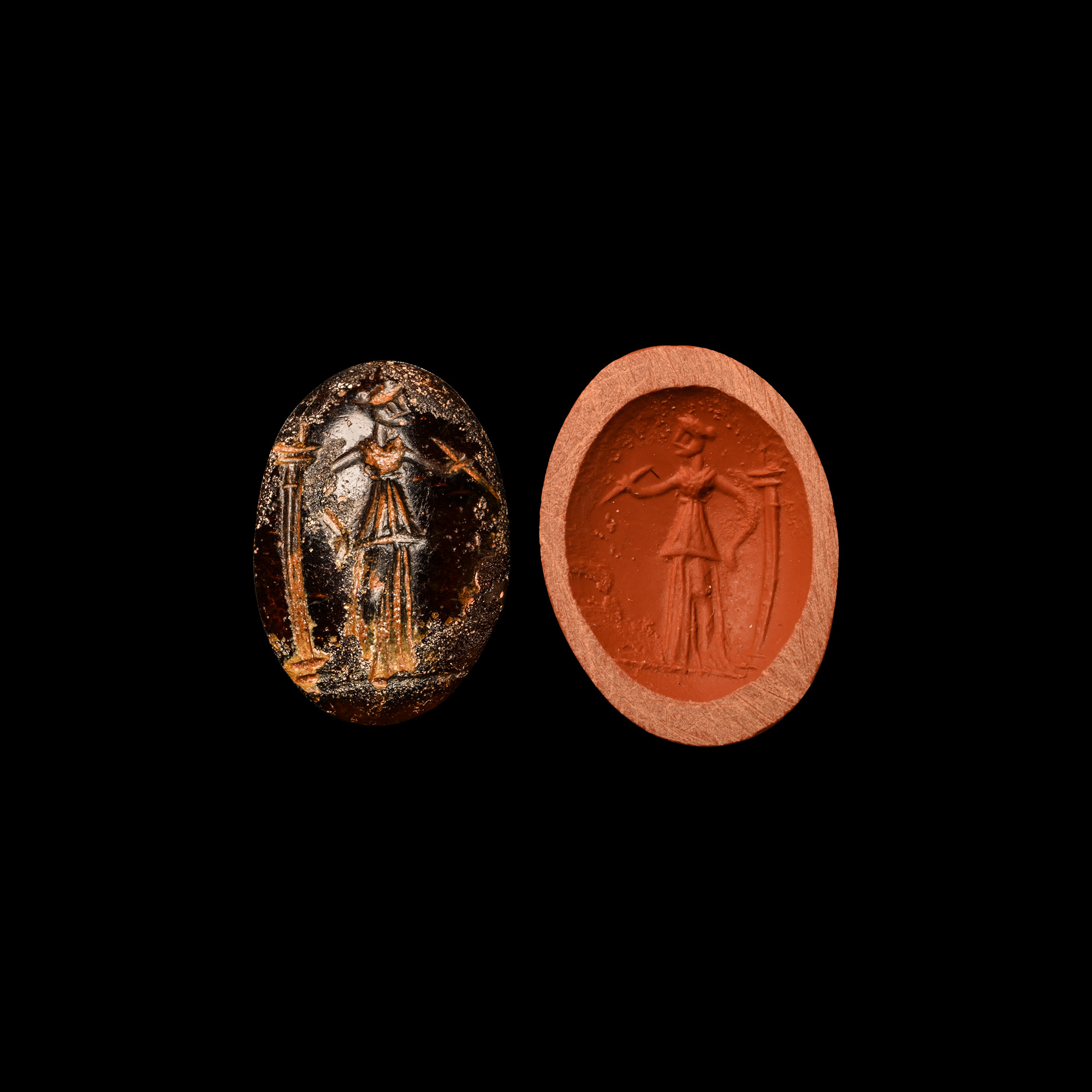
Hellenistic Glass Gem with Goddess
3RD-2ND CENTURY B.C.
7/8 in. (2.52 grams, 22 mm).
Engraved with a goddess (Aphrodite?), facing right, peplos around her hips, her left elbow resting on a column and her left hand behind her body; the right hand outstretched and holding a sceptre; a snake(?) before.
ProvenanceAcquired in the late 1980s-early 1990s.
Important North West London collection.
Cf. Amorai-Stark, S., ‘Roman Wheel-cut Engraving, Dyeing and Painting Microquartz Gemstones’ in Journal of Archaeological Science, 2003, 30, pp.227-238, pl.2, fig.1, for the type.
FootnotesIn the famous Greek myth of the Gorgon, Aphrodite, jealous of their beauty, placed a curse on Medusa and her sisters, transforming their hair into snakes and making their gaze turn anyone into stone.
CONDITIONTimeLine Auctions follows a vetting process to ensure the authenticity and legality of all items, reinforcing our commitment to integrity and responsible trading. Each antiquity, antique, and coin lot undergoes thorough examination by a vetting committee of at least ten external specialists, professional trade association members, scientists, and archaeologists: Our Vetting Process
AUCTIONS:
TimeLine is a leading auction house specialising in antiquities, ancient art, collectables, natural history, coins, medals, and books. Our auctions offer museums, collectors, historians, and enthusiasts the opportunity to acquire unique and historically significant pieces.
LOT 0090
Hellenistic Glass Gem with Goddess
Estimate £600 - 800€700 - 930 (for guidance only)$810 - 1,080 (for guidance only)
-
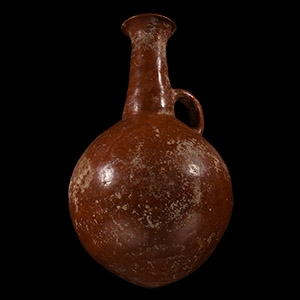
Cypriot Red Burnished Ware Pitcher
Bronze Age, 2300-1650 B.C.Sold for (Inc. bp): £2,340
With burnished surface, tall tapering neck and trumpet-shaped mouth, globular body, one loop handle at the shoulder. 3.4 kg, 42 cm high
From the collection of Dr Takey Crist, Jacksonville, North Carolina, acquired late 1980s. This lot has been checked against the Interpol Database of stolen works of art and is accompanied by search certificate number no.11854-207732. -
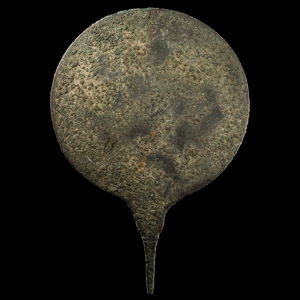
Greek Bronze Handled Mirror
5th century B.C.Estimate: £300 - 400 (‡+bp*)
Opening Bid: £150
The discoid head with waisted neck and tapering tang, slightly recessed to one face. 350 grams, 22 cm
Acquired in Europe before 1990. -
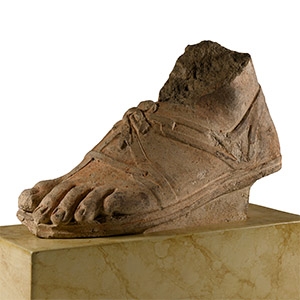
Life-Size Etruscan Terracotta Foot
Circa 200 B.C.Sold for (Inc. bp): £3,900
From a statue; left foot with detailed lacing to the sandal; integral wedge below to provide the correct angle for the foot and ankle. 3.1 kg total, 28 cm wide including stand
From the collection of Platon Hobson (29 January 1937-3 December 2022), local dealer and previously a costumier in the film industry.
