
Loading, please wait...
LOT 0073
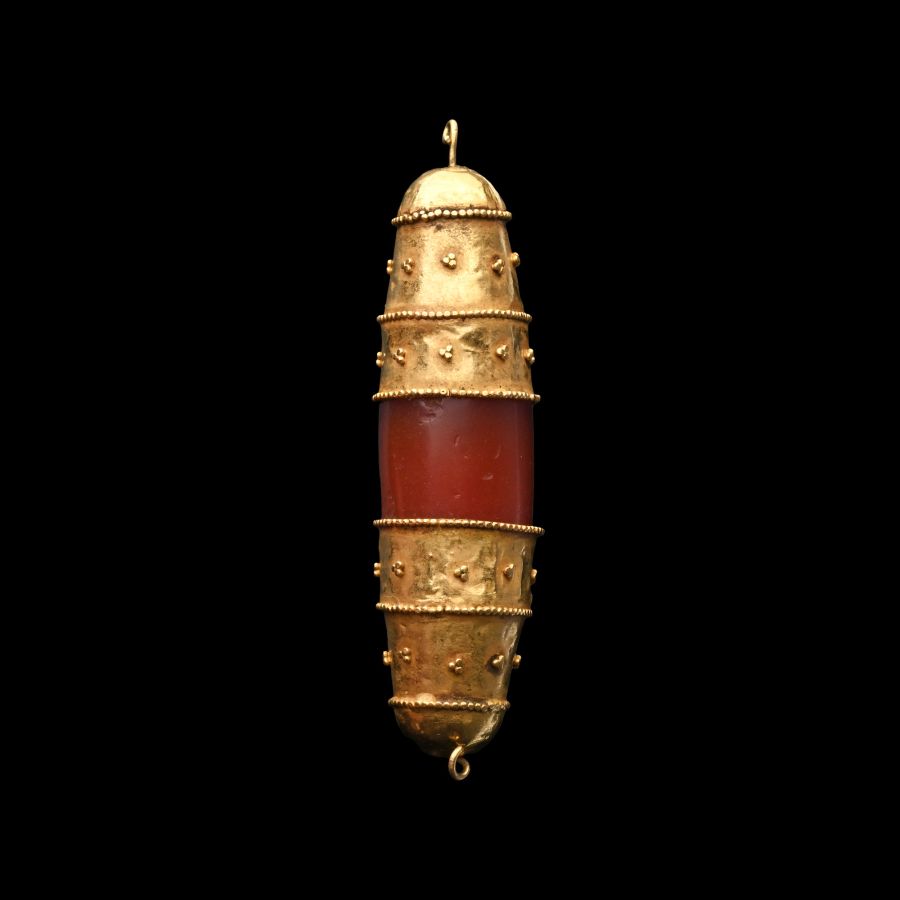
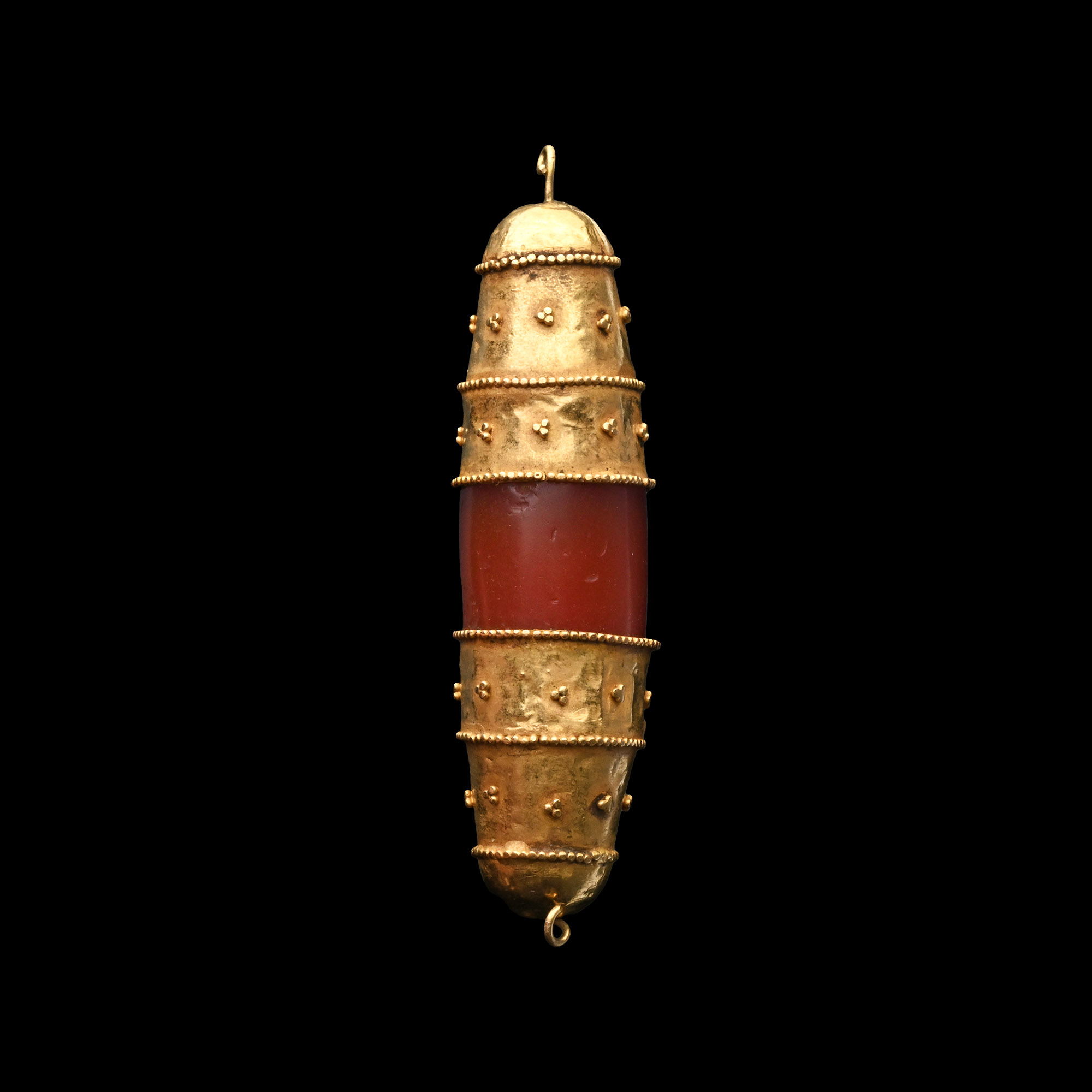
Hellenistic Carnelian Bead with Gold End Caps
1ST CENTURY B.C.-1ST CENTURY A.D.
2 3/8 in. (17.44 grams, 60 mm).
Columnar bead with sheet-gold cap to each end, each with beaded circlets and applied granule clusters, domed end with loop; possibly assembled.
ProvenanceAcquired in the mid 1980s-1990s.
Private collection, Switzerland, thence by descent.
Private collection, since the late 1990s.
Cf. a pair of gold disc and sphere-drop earrings of the Late Hellenistic Period in a similar style and decoration, in Ogden, J., Gold Jewellery in Ptolemaic, Roman and Byzantine Egypt, in two volumes, Volume 2 – figures, Durham, 1990, fig.268.
FootnotesThe very elaborate versions of earrings with large domes and pendants composed of clusters of hollow spheres and granulation are most typically Romano-Syrian, but they begin to be produced in the Late Hellenistic Age. They were diffused in the Levant, Egypt and on the frontier area between the Roman and the Arsacid Empire.
CONDITIONTimeLine Auctions follows a vetting process to ensure the authenticity and legality of all items, reinforcing our commitment to integrity and responsible trading. Each antiquity, antique, and coin lot undergoes thorough examination by a vetting committee of at least ten external specialists, professional trade association members, scientists, and archaeologists: Our Vetting Process
AUCTIONS:
TimeLine is a leading auction house specialising in antiquities, ancient art, collectables, natural history, coins, medals, and books. Our auctions offer museums, collectors, historians, and enthusiasts the opportunity to acquire unique and historically significant pieces.
LOT 0073
Hellenistic Carnelian Bead with Gold End Caps
Estimate £600 - 800€700 - 930 (for guidance only)$810 - 1,080 (for guidance only)
Opening Bid
£333 (EUR 387; USD 450) ‡+BP*
-
.jpg)
Etruscan Agate Talismanic Scarab
Late 4th-early 3rd century B.C.Estimate: £500 - 700 (+bp*)
Opening Bid: £250
Carved from banded orange agate and formed as a flattened scarab with a striated carapace, pierced for suspension. 3.53 grams, 18 mm
UK private collection, acquired on the English market in the 2000s.
The shape of an Etruscan scarab includes: (1) the scarab gem, where the engraving of the curved back of the stone more or less faithfully imitates the anatomical parts of the scarab beetle; (2) the scaraboid, which retains the overall shape of the scarab gem but with little or no engraving on the curved backside; and (3) the pseudo-scarab, which has an image carved in relief on its curved backside instead of a beetle. All three types have a flat, oval underside which carries an engraved miniature image (device) within a decorated border which is usually hatched. -
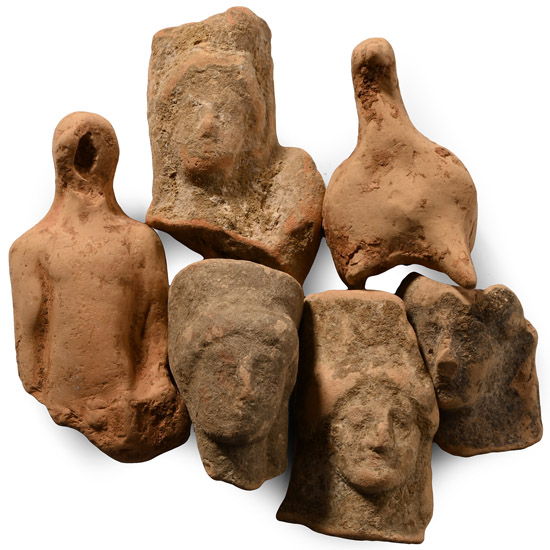
Greek Terracotta Head Collection
Circa 4th-2nd century B.C.Estimate: £60 - 80 (+bp*)
Opening Bid: £5
Comprising four head fragments, one fragment of the upper torso of a male, and a bird fragment. 116 grams total, 37-72 mm
From the collection of a Cambridge, UK, gentleman, by direct descent from his father, who acquired the items in London in circa 1960. -
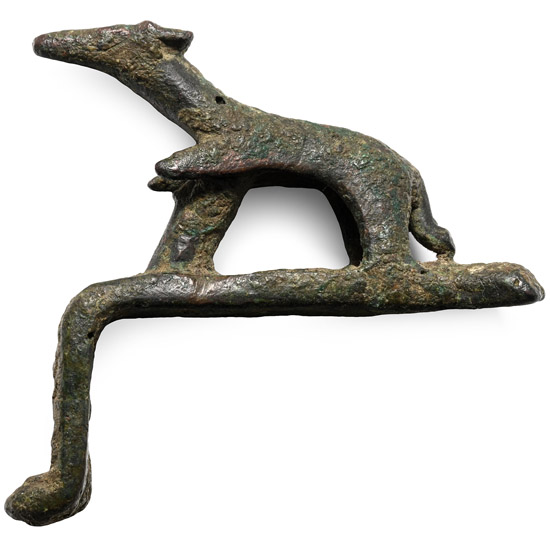
Greek Bronze Fitting with Fox
Circa 5th century B.C.Estimate: £150 - 200 (+bp*)
Opening Bid: £5
L-shaped bracket with a leaping fox, the beast with an elongated muzzle and swept-back ears. 46.7 grams, 62 mm
From the private coin collection of a West London, UK, gentleman, formed since the mid 1980s.
