Loading, please wait...
Details
LOT 0493
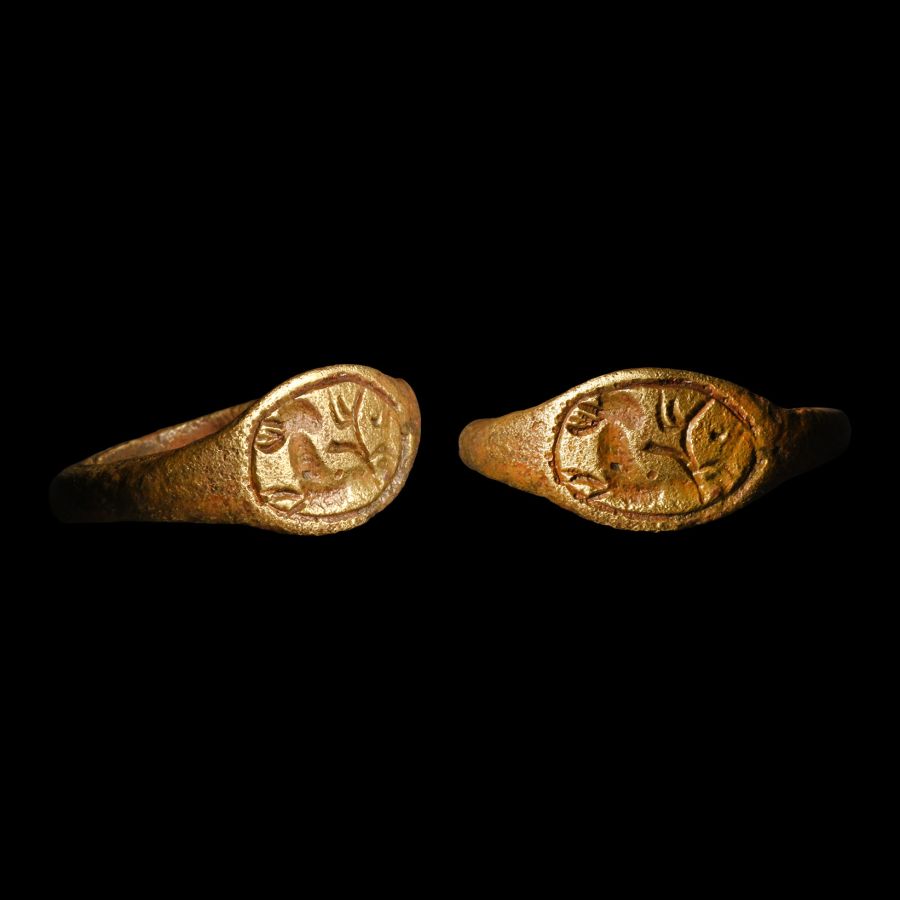
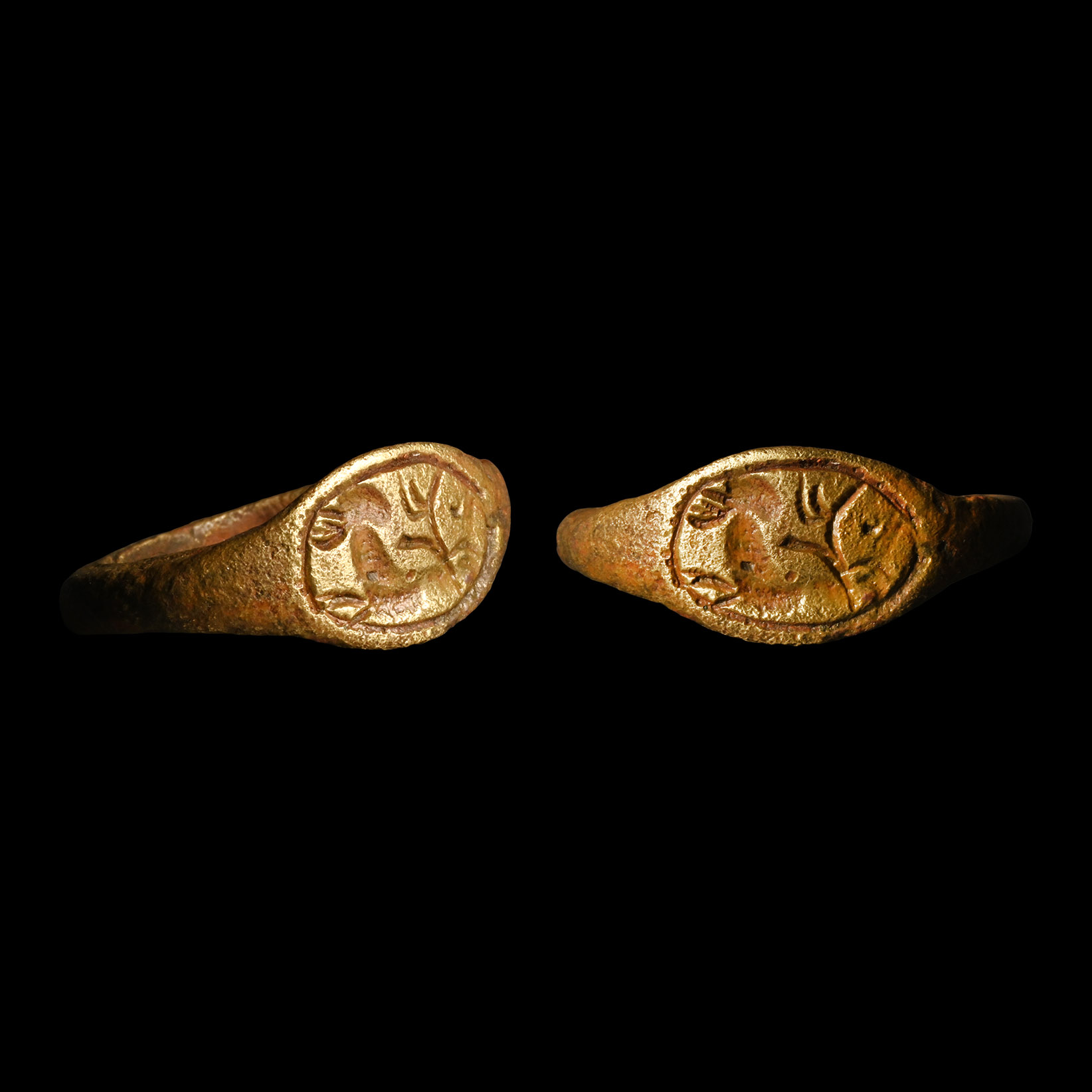
Hellenistic Bronze Ring with Stag
CIRCA 2ND-1ST CENTURY B.C.
1 in. (5.81 grams, 25.58 mm overall, 18.10 mm internal diameter (approximate size British P, USA 7 1/2, Europe 16.23, Japan 15)).
With square-section shoulders, ellipsoid bezel with incuse stag motif within a linear border. [No Reserve]
Provenance
Ex old English collection.
London art market, pre 2000.
Property of a London, UK, gentleman.
VETTING:
TimeLine Auctions follows a vetting process to ensure the authenticity and legality of all items, reinforcing our commitment to integrity and responsible trading. Each antiquity, antique, and coin lot undergoes thorough examination by a vetting committee of at least ten external specialists, professional trade association members, scientists, and archaeologists: Our Vetting Process
AUCTIONS:
TimeLine is a leading auction house specialising in antiquities, ancient art, collectables, natural history, coins, medals, and books. Our auctions offer museums, collectors, historians, and enthusiasts the opportunity to acquire unique and historically significant pieces.
RELATED LOTS
-
Greek Terracotta Venus and Triton Group
1st century B.C.Sold for (Inc. bp): £910
Both figures represented facing with bare chests, Aphrodite sitting next to the triton and holding himation over her head with her right hand, her right leg raised and the left extended, the lower part of her himation covering the lower half of her body; the lower part of Triton’s body covered by marine foliage, from which the long serpentine tail emerges on the opposite side next to Aphrodite's right leg; possibly from Asia Minor; repaired. 688 grams, 18 cm high
Ex French Sorbonne archaeology professor (deceased); 1960s-2000s. Accompanied by an original thermoluminescence analysis report no.QED2323/FG-0201 from the QED Laboratory, Marseille, France.
Many of the Smyrna and Myrina figures are feminine, the heads modelled in late Hellenistic style. The bodies are often either draped in Tanagra-style robes, or represented as figures of Aphrodite, draped, semi-nude or naked. The association with Triton is linked with the Greek myth of Aphrodite born from sea foam. -
Greek Red-Figure Hydria with Combat Scene Between Amazons and Greek or Trojan Heroes
4th century B.C.Sold for (Inc. bp): £7,800
The vessel with integral round-section upward-facing handles, a third, round-section handle placed vertically between shoulder and upper neck to rear; laurel sprigs to the neck with traces of gilding; combat scene with Amazons (and Trojans?) below, armed with short swords and crescent shields, most wearing an exomis leaving the shoulder and one breast uncovered; volute palmettes below both side-handles, a panel of tiered and swirling volutes to the rear, all on a band of egg-moulding, repeated around the rim; possibly Apulian or Campanian; restored. 3 kg, 46 cm high
Ex collection Woodyat, Rome, Italy, 1912. with Vente Genève, 24 & 25 June 1960. Private European collection. Accompanied by an academic report by Dr Raffaele D’Amato. This lot has been checked against the Interpol Database of stolen works of art and is accompanied by search certificate number no.11581-199028.
The mythological topic of this hydria is fascinating, representing a fight between Amazons and Greek or Trojan heroes (suggested by the central cavalryman wearing a Phrygian cap). During this period, Amazons were no longer represented as Persian or Scythian warriors, as in Attic red-figure ceramics, but depicted as athletic parthenoi and wearing chitons. Rather than oriental costume and armour, the Amazons wear a short exomis with a bare shoulder and breast (Patten, 2013, PI.VI, I, VI,2, 2 and 3). -
Greek Terracotta Protome Mask
Late 6th-early 5th century B.C.Sold for (Inc. bp): £182
Modelled as a female head with rounded oval face, slightly bulging eyes and pronounced chin, indistinct smiling mouth with thin lips, outline of ears; low straight polos with fastening hole. 133 grams, 10.5 cm
Acquired 1970s-1996. Property of a North American collector. London collection, 2016.
The figure belongs to a common type known from mainland Greece and the islands. The head clearly shows the so-called 'Archaic smile' visible on the dedicatory protomes of the same typology. They were terracotta votive offerings attached with a nail to the shrine of a goddess for ex-voto or to receive the grace of the represented goddess (Demeter?).