
Loading, please wait...
LOT 0062
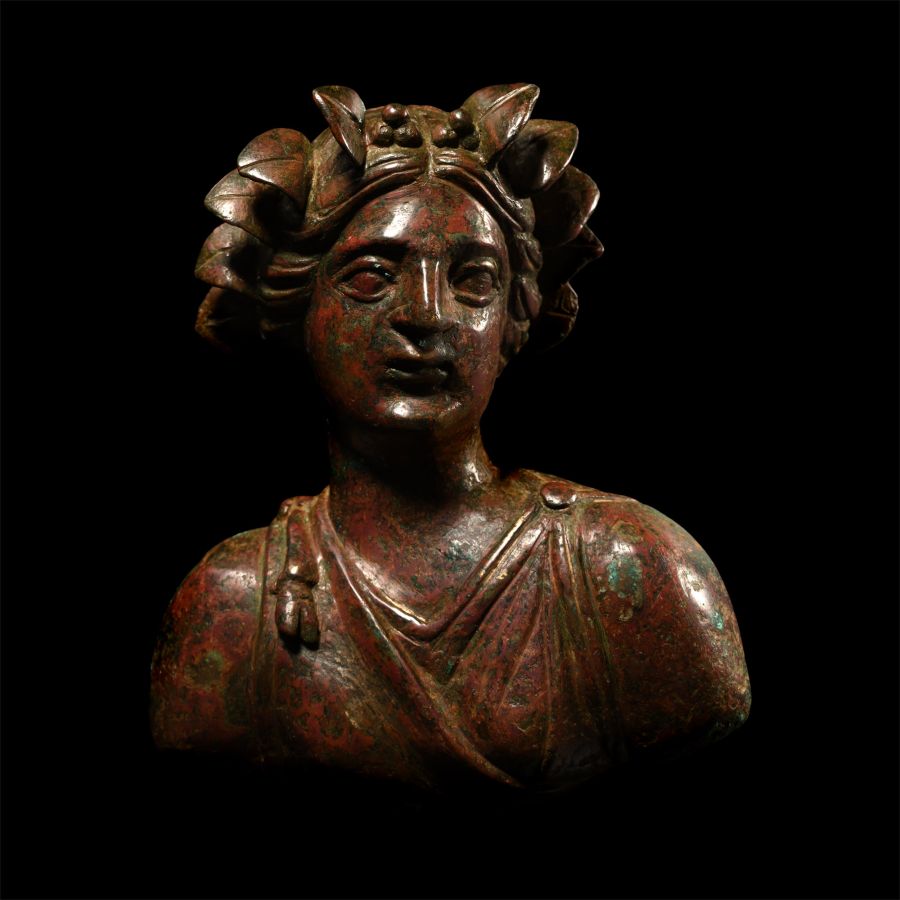
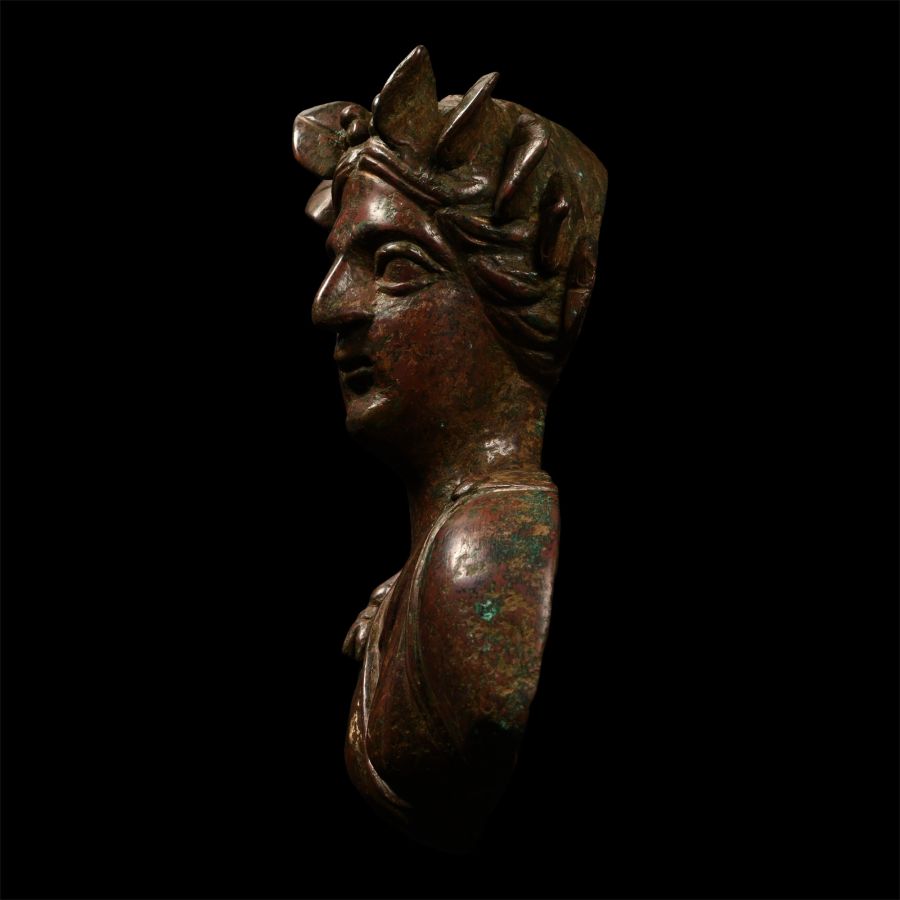
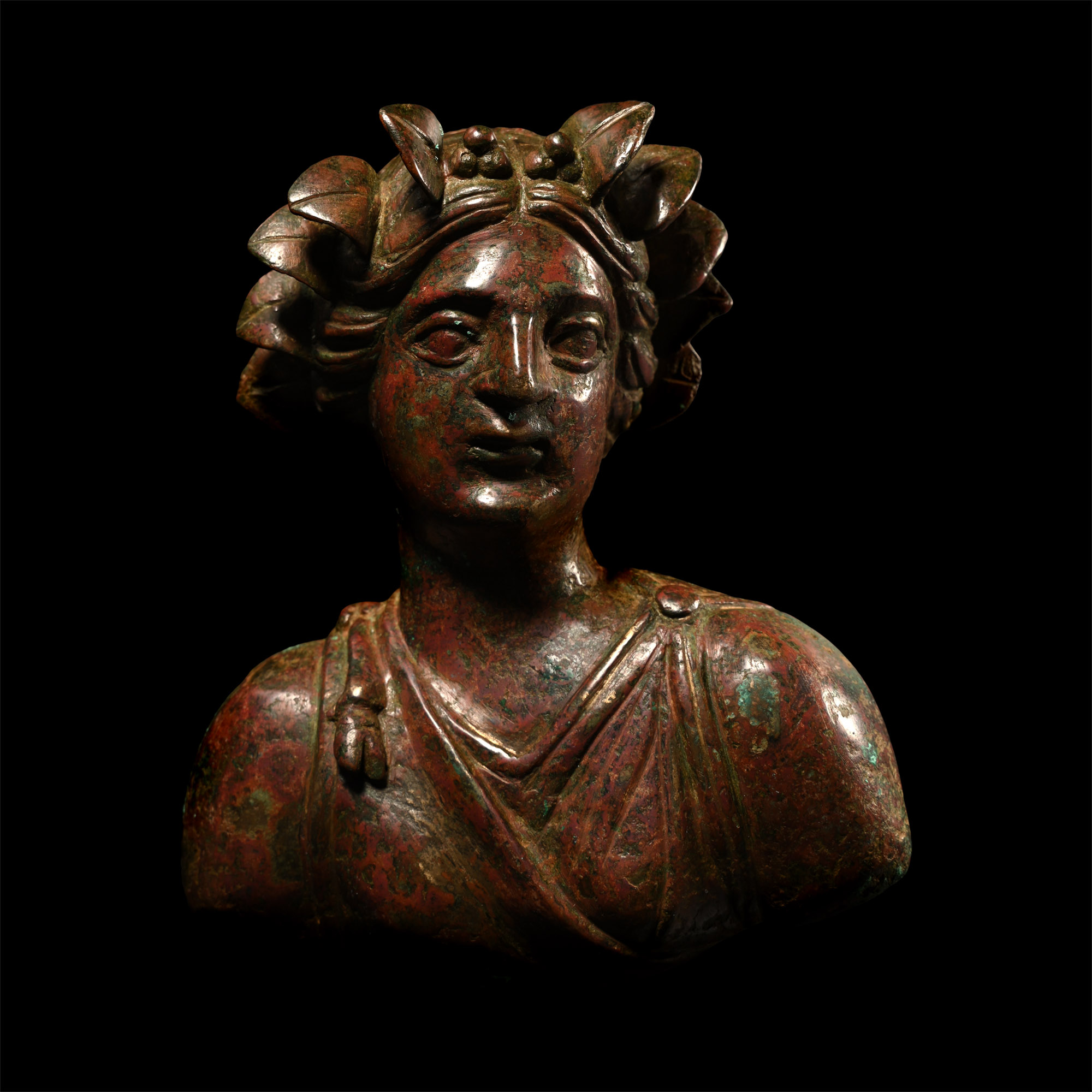
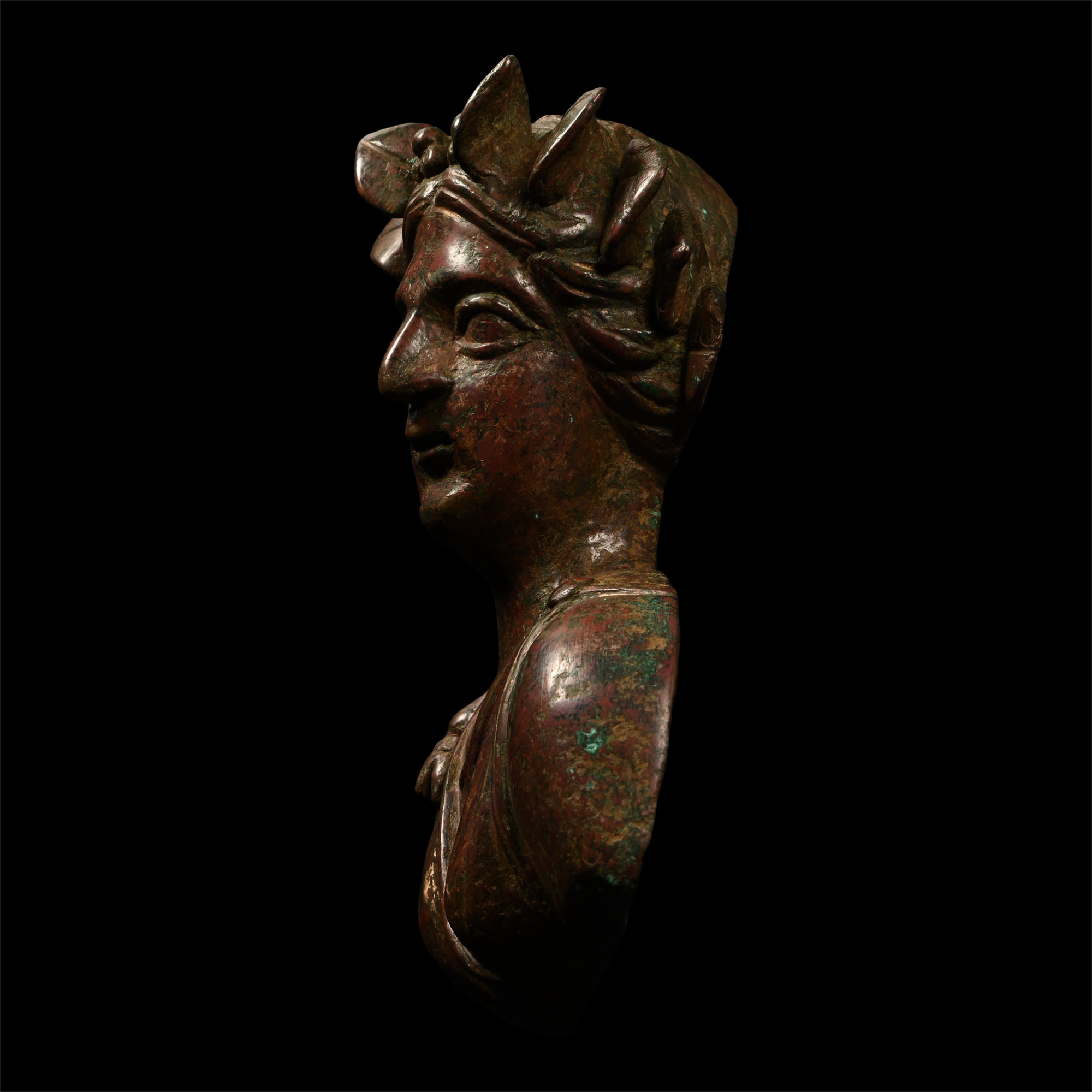
Hellenistic Bronze Protome of a Maenad
3RD-2ND CENTURY B.C.
5 1/2 in. (541 grams, 14 cm).
Modelled in the half-round as a maenad or Artemis, hollow to the reverse with diadem of ivy leaves with clusters of berries at the centre, exaggerated lentoid eyes, peplos dress secured at her left shoulder by a disc brooch and at her right with a cloven hoof.
ProvenanceAcquired before 1983.
Ex London gallery, 1990s.
This lot has been checked against the Interpol Database of stolen works of art and is accompanied by a search certificate number no.12519-231946.
This lot has been cleared against the Art Loss Register database, and is accompanied by an illustrated lot declaration signed by the Head of the Antiquities Department, Dr Raffaele D’Amato.
The Greek deity Artemis was the goddess of hunting, associated with wild animals and woodland as well as childbirth. She was often linked with folk magic and witchcraft due to her role as goddess of the moon. She was identified by the Romans with the goddess Diana. Artemis was born, with her twin brother Apollo, on the island of Delos, daughter of Zeus and Leto. Homer refers to her as Artemis Agrotera, Potnia Theron: "Artemis of the wildland, Mistress of Animals". Her best-known cult sites were on the island of Delos, in Attica at Brauron and Mounikhia, and in Sparta. She was often depicted in paintings and statues in a forest setting, carrying a bow and arrows, and accompanied by a deer. In Greek classical art, she is usually portrayed as a maiden huntress: young, tall and slim, clothed in a girl's short skirt, with hunting boots, a quiver, a bow and arrows. When portrayed as a moon goddess, Artemis wore a long robe and sometimes a veil covering her head. Her darker side is revealed in some vase paintings, where she is shown as the death-bringing goddess whose arrows fell young maidens and women, such as the daughters of Niobe. Artemis was also identified with the ancient mother goddess at Ephesus in modern-day Turkey and it was there that a huge temple was built in her honour, long recognised as one of the Seven Wonders of the World.
CONDITIONTimeLine Auctions follows a vetting process to ensure the authenticity and legality of all items, reinforcing our commitment to integrity and responsible trading. Each antiquity, antique, and coin lot undergoes thorough examination by a vetting committee of at least ten external specialists, professional trade association members, scientists, and archaeologists: Our Vetting Process
AUCTIONS:
TimeLine is a leading auction house specialising in antiquities, ancient art, collectables, natural history, coins, medals, and books. Our auctions offer museums, collectors, historians, and enthusiasts the opportunity to acquire unique and historically significant pieces.
-
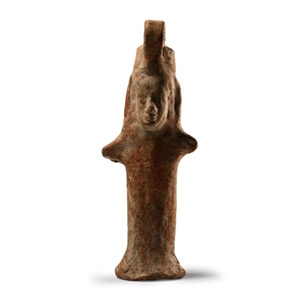
Greek Archaic Human-Faced Idol
Daedalic, 8th century B.C.Sold for (Inc. bp): £416
Modelled in the round mould-formed figure with D-shaped human face, stub arms and columnar body with flared base; exaggerated facial features, tall headdress and coiled loop above. 147 grams, 16.7 cm
German private collection, before 1997. Accompanied by a copy of an Art Loss Register certificate no.S00003188. This lot is accompanied by an illustrated lot declaration signed by the Head of the Antiquities Department, Dr Raffaele D’Amato. -
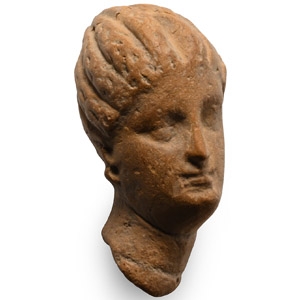
Greek Terracotta Head
Tarentine, 3rd-1st century B.C.Sold for (Inc. bp): £260
Female head moulded with a segmented conical cap, pierced ears visible beneath; the head slightly turned and tilted downwards on a slender neck. 22 grams, 49 mm
Acquired in the mid 1980s-1990s. Private collection, Switzerland, thence by descent. Private collection, since the late 1990s. This lot is accompanied by an illustrated lot declaration signed by the Head of the Antiquities Department, Dr Raffaele D’Amato. -
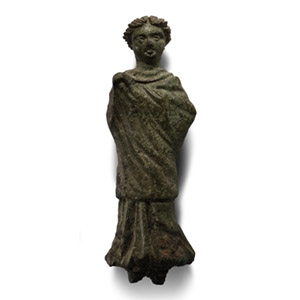
Etruscan Bronze Ceres Statuette
3rd-2nd century B.C.Estimate: £800 - 1,000 (‡+bp*)
Opening Bid: £400
Female with hair drawn up in a chignon, palla wrapped tightly around the upper body hiding the right arm bent with the hand at the shoulder, lower hem of robe flared; fixing lug to underside. 86 grams, 71 mm
Acquired in the mid 1980s-1990s. Private collection, Switzerland, thence by descent. Private collection, since the late 1990s. This lot is accompanied by an illustrated lot declaration signed by the Head of the Antiquities Department, Dr Raffaele D’Amato.
This is a figurine of a deity of difficult interpretation representing an ex-voto. This typology is widespread in the votive offerings of Etrusco-Roman sanctuaries, and by analogy with various statuettes could represent Ceres.
