
Loading, please wait...
LOT 0255
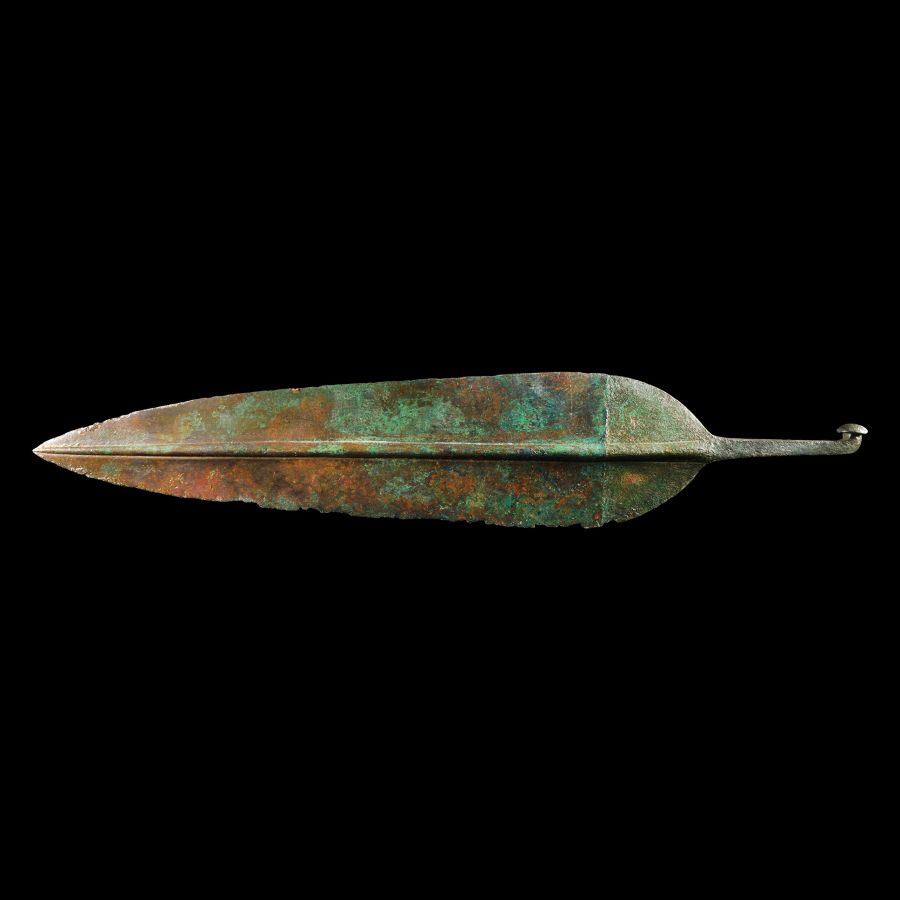
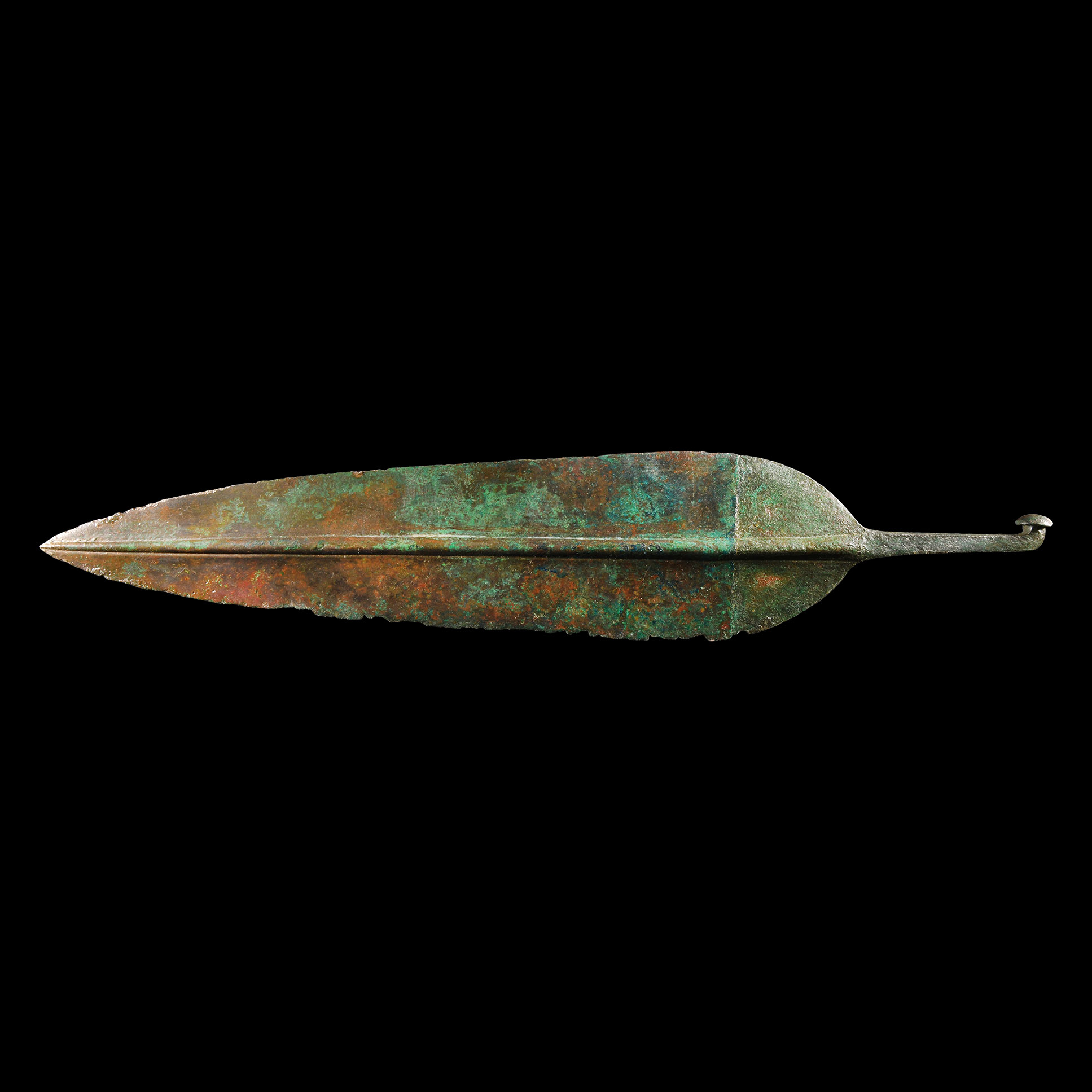
Heavy Western Asiatic Leaf-Shaped Spearhead
14TH-10TH CENTURY B.C.
18 1/4 in. (844 grams, 46.2 cm).
The leaf-shaped ovate blade with rounded, gently curved shoulders and raised midrib, flat rectangular-sectioned tang tapering to a sharply bent end with a fastening button.
ProvenanceAcquired 1980-2015.
Ex Abelita family collection.
See Khorasani, M.M., Arms and Armour from Iran. The Bronze Age to the End of the Qajar Period, Tübingen, 2006, s.cat.270, for type.
FootnotesSimilar spearheads were excavated in the Marlik Royal cemetery by Dr Negahban, see for example in tomb 47, Trench XXIIE. They were the evolution of a typology which began much earlier in Mesopotamia and the fertile crescent, the type 4 of the Stronach classification, with straight tang and square section, usually thickened at the base with a button tang. The foliate blade was wide and exaggerated in some specimens excavated at Marlik.
CONDITIONTimeLine Auctions follows a vetting process to ensure the authenticity and legality of all items, reinforcing our commitment to integrity and responsible trading. Each antiquity, antique, and coin lot undergoes thorough examination by a vetting committee of at least ten external specialists, professional trade association members, scientists, and archaeologists: Our Vetting Process
AUCTIONS:
TimeLine is a leading auction house specialising in antiquities, ancient art, collectables, natural history, coins, medals, and books. Our auctions offer museums, collectors, historians, and enthusiasts the opportunity to acquire unique and historically significant pieces.
LOT 0255
Heavy Western Asiatic Leaf-Shaped Spearhead
Estimate £600 - 800€700 - 930 (for guidance only)$810 - 1,080 (for guidance only)
-
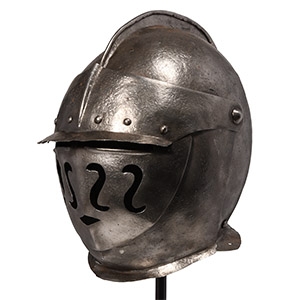
European Savoyard Burgonet
Circa 1620 A.D.Sold for (Inc. bp): £3,380
Comprising a full face shield with broad wavy bars and a small mouth opening, a wide hinged visor; the visor and the front section of the helmet secured by large hook-and-eye closures on the right-hand side; the crown with a tall ridge running from front to back, small collar for protecting the neck. 1.14 kg, 25 cm high
Acquired from Andrew Bennett in 2016. The Kusmirek Collection, UK. Accompanied by a copy of a payment confirmation from Andrew Bennett, dated 1st June 2016. Accompanied by an academic report by Dr Raffaele D'Amato. This lot has been checked against the Interpol Database of stolen works of art and is accompanied by search certificate number no. 11768-203986.
This variation of the burgonet helmet is thought to have originated in the Savoy region of southeast France, and was very popular with heavy cavalry (Reiters) serving with a variety of Continental armies of the period. The term Savoyard is a reference to a large number of these helmets that the Swiss captured from the troops of the Duke of Savoy during an unsuccessful assault on the city of Genoa in 1602. The undulated bars and the small mouth of the visor are all indicative of the Savoyard style. The hinges on the side allowed the front of the helmet as a whole to be lifted away from the rear, aiding the wearer to place it over his head. -
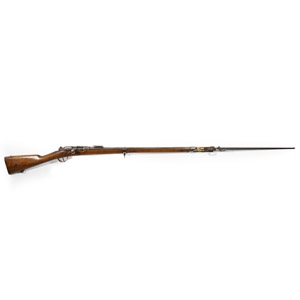
1866/74 Model Gras Rifle and Bayonet
Dated 1868 A.D.Estimate: £500 - 700 (+bp*)
Opening Bid: £250
Round rifled 90cm (35½") barrel of 11mm calibre with folding rear sight (without slide), bolt action with serial no.52431 to breech; fitted with full wood stock with steel butt cap, trigger guard, sling swivels and fore-end, steel cleaning rod; with correct Gras bayonet inscribed 'M[--] d'Armes de St Etienne 8bre 1878' to back and steel scabbard. 4.8 kg, 1.84 m
Acquired from Czerny's Auctions, Italy, 2019. The Kusmirek Collection, UK. Accompanied by a copy of Czerny's invoice and listing.
Sold as an exempt item under Section 58 (2) of the Firearms Act, 1968, to be held as a curiosity or ornament. No license required but buyer must be over 18 years of age. Overseas bidders should note that, due to UK regulations governing export of all firearms, overseas buyers will need to make arrangements for shipping this lot out of the UK directly, by air freight, with a specialist company or agent. -
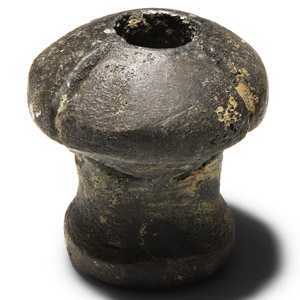
Urartu Bronze Mace or Sceptre Head
9th-8th century B.C.Sold for (Inc. bp): £208
With cylindrical head and narrow flanged base, the head divided in four petals. 490 grams, 60 mm
Acquired on the UK art market. Property of a Ruislip, UK, gentleman, by inheritance.
Assyrian and Urartian officers are identified by their weapons in the reliefs. It is not so easy to definitely identify cavalry officers on the palace reliefs of the Assyrian kings, but their identification is based mainly on the context they appear in, and on some insignia (mace, sceptre) they carry with them. Hence, the mace was not only a practical weapon, but also a command insignia.
