
Loading, please wait...
![Group of Three Hundred [300] Brown Calcite Specimens](https://timelineauctions.com/zoom_images/zoomthumb/2/5/256008_900x900.jpg "Group of Three Hundred [300] Brown Calcite Specimens")
![Group of Three Hundred [300] Brown Calcite Specimens](https://timelineauctions.com/zoom_images/zoommap/2/5/256008_200x200.jpg "Group of Three Hundred [300] Brown Calcite Specimens")
![Group of Three Hundred [300] Brown Calcite Specimens](https://timelineauctions.com/upload/images/items/256008.jpg "Group of Three Hundred [300] Brown Calcite Specimens")
LOT 2403
Group of Three Hundred [300] Brown Calcite Specimens
3/4 - 1 1/4 in. (1.66 kg total, 18-32 mm).
Comprising three hundred honey-coloured chunks of calcite displaying vitreous lustre. [300, No Reserve]
ProvenanceFrom Mexico.
Ex Mineral Imports, London, UK.
Gregory, Bottley & Lloyd (Gregory's), Harwich, UK.
TimeLine Auctions follows a vetting process to ensure the authenticity and legality of all items, reinforcing our commitment to integrity and responsible trading. Each antiquity, antique, and coin lot undergoes thorough examination by a vetting committee of at least ten external specialists, professional trade association members, scientists, and archaeologists: Our Vetting Process
AUCTIONS:
TimeLine is a leading auction house specialising in antiquities, ancient art, collectables, natural history, coins, medals, and books. Our auctions offer museums, collectors, historians, and enthusiasts the opportunity to acquire unique and historically significant pieces.
-
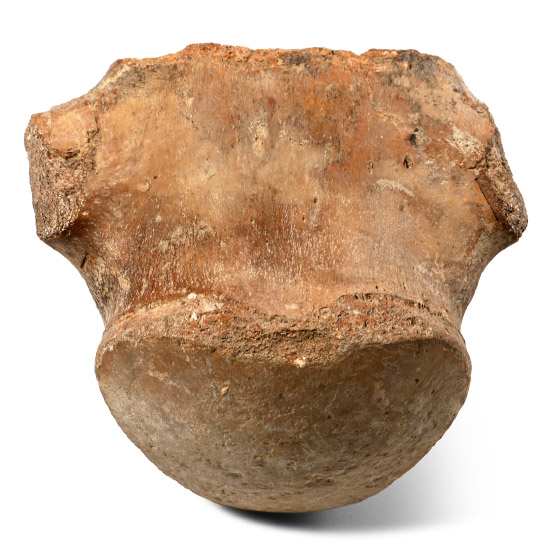
Fossil Tylosaurus Marine Dinosaur Vertebra
Late Cretaceous Period, circa 92-66 million years B.P.Sold for (Inc. bp): £52
The main body of a vertebra with two raised ridges underneath, likely a pygal or caudal vertebra; old inked collector's number 'VR26'. 622 grams, 96 mm
From near Harlan County Dam, Nebraska, USA. From the private collection of Kenneth Machin (1936-2020), Buckinghamshire, UK; his collection of antiquities and natural history was formed since 1948; thence by descent.
Tylosaurus was an apex marine predator during the Late Cretaceous period, and is classified in the superfamily Mosasauroidea. -
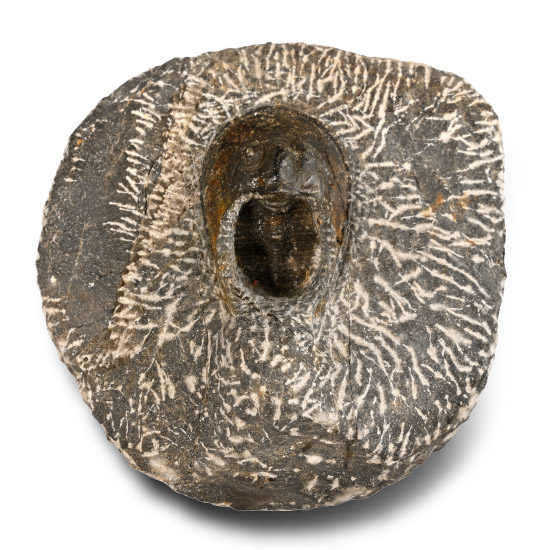
Fossil Harpes Trilobite in Matrix
Middle Devonian Period, circa 380 million years B.P.Sold for (Inc. bp): £26
With an ovate cephalon and an outer bilaminar brim extending posteriorly to long genal prolongations. 475 grams, 99 mm
From the private collection of Kenneth Machin (1936-2020), Buckinghamshire, UK; his collection of antiquities and natural history was formed since 1948; thence by descent. -
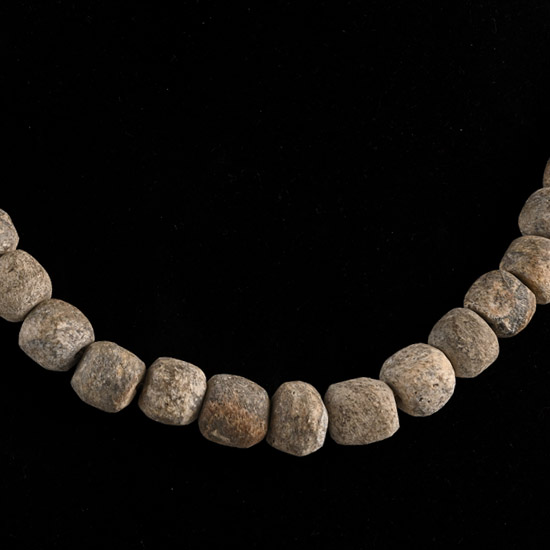
Woolly Mammoth Bone Bead Necklace String
Pleistocene Epoch, 2.6 million-11,700 years B.P.Sold for (Inc. bp): £52
Restrung, using recently polished oblate Mammuthus primigenius bone beads. 126 grams, 59 cm
From a UK collection formed in the early 2000s. Property of an Essex, UK, gentleman.
The mammoth lineage branched from the Asian elephant around 6 million years ago, and later on, the Woolly Mammoth, Mammuthus primigenius, evolved in eastern Siberia. Woolly mammoths, being slightly smaller than living African elephants, were foragers and ate grass, as well as small, nutritious flowering plants that flourished in the environment where they lived. They may also have used their curved tusks to dig through snow and eat plants that other foragers were unable to reach.
