
![Group of Six [6] AR Roman Denarii.](https://timelineauctions.com/upload/images/items/223265b.jpg "Group of Six [6] AR Roman Denarii.")
![Group of Six [6] AR Roman Denarii.](https://timelineauctions.com/upload/images/items/223265.jpg "Group of Six [6] AR Roman Denarii.")
LOT 3169
Group of Six [6] AR Roman Denarii. 1st century BC-2nd century AD.
Included five Roman Imperial and one Roman Republican Denarius. Fair to Near Very Fine.(15.95gr total, 16-19mm.). [No Reserve]
ProvenanceFrom a private Barnsley, UK, family collection.
TimeLine Auctions follows a vetting process to ensure the authenticity and legality of all items, reinforcing our commitment to integrity and responsible trading. Each antiquity, antique, and coin lot undergoes thorough examination by a vetting committee of at least ten external specialists, professional trade association members, scientists, and archaeologists: Our Vetting Process
AUCTIONS:
TimeLine is a leading auction house specialising in antiquities, ancient art, collectables, natural history, coins, medals, and books. Our auctions offer museums, collectors, historians, and enthusiasts the opportunity to acquire unique and historically significant pieces.
-
![Group of Six [6] Mixed Roman Coins.](https://timelineauctions.com/upload/images/items/small/225137-s.jpg)
Group of Six [6] Mixed Roman Coins. 1st century BC-3rd century AD.
Sold for (Inc. bp): £130
Various emperors. 17.25gr total.
Fine to Good Very Fine.
From the collection of a London antiquarian, formed since the 1980s. -
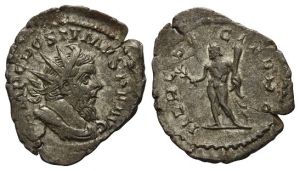
Postumus, Romano-Gallic Emperor AR Antoninianus. AD 260-269.
Sold for (Inc. bp): £20
Treveri mint; struck AD 262-263. IMP C POSTVMVS P F AVG, radiate, draped and cuirassed bust to right / HERC PACIFERO, Hercules standing to left, holding olive branch, club and lion skin. RIC V.2 67 (Lugdunum); RIC V.4 209; RSC 101a. 2.84gr, 25mm, 7h.
Good Very Fine.
Property of a North London, UK, gentleman. -
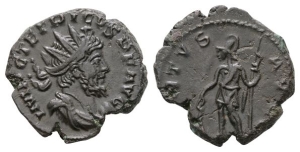
Tetricus I, Romano-Gallic Emperor BI Antoninianus. AD 271-274.
Sold for (Inc. bp): £20
Treveri mint; struck AD 273. IMP C TETRICVS P F AVG, radiate, draped and cuirassed bust to right, seen from rear / [VI]RTVS AVGG, Virtus standing facing, head to left, holding spear with left hand and leaning his right on shield set on ground. RIC V.2 148. 4.58gr, 21mm, 12h.
Extremely Fine.
From a London, UK, collection, 1990s.
