
Loading, please wait...


LOT 1951
Greek Wooden Polychrome Mount Athos Annunciation Plaque
19TH CENTURY A.D.
4 5/8 in. (44.2 grams, 11.7 cm).
Rectangular openwork plaque showing the Archangel Gabriel appearing to the Virgin Mary within an architectural arch.
ProvenanceAcquired on the European art market.
CONDITIONTimeLine Auctions follows a vetting process to ensure the authenticity and legality of all items, reinforcing our commitment to integrity and responsible trading. Each antiquity, antique, and coin lot undergoes thorough examination by a vetting committee of at least ten external specialists, professional trade association members, scientists, and archaeologists: Our Vetting Process
AUCTIONS:
TimeLine is a leading auction house specialising in antiquities, ancient art, collectables, natural history, coins, medals, and books. Our auctions offer museums, collectors, historians, and enthusiasts the opportunity to acquire unique and historically significant pieces.
LOT 1951
Greek Wooden Polychrome Mount Athos Annunciation Plaque
Estimate £200 - 300€230 - 350 (for guidance only)$270 - 410 (for guidance only)
-
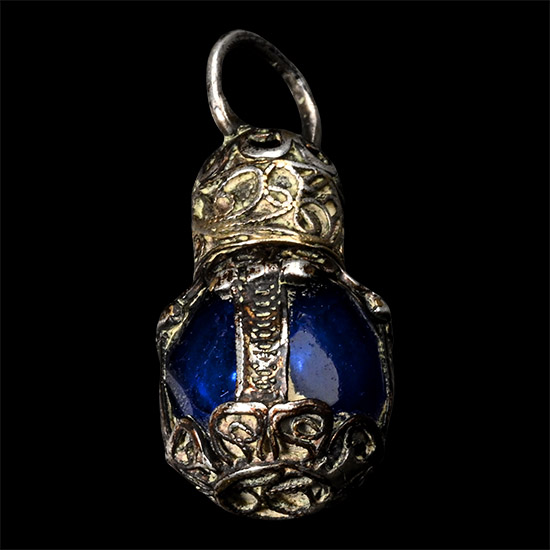
Miniature Blue Glass Scent Bottle with Silver Filigree Mounts
England, 17th century A.D.Estimate: £400 - 600 (+bp*)
Opening Bid: £200
Of facetted deep blue glass, enclosed within an elegant silver filigree cage mount retaining traces of its original gilding; the domed screw-cap similarly decorated with scrolling filigree ornament and fitted with a suspension loop, indicating that it was intended to be worn on a chain or ribbon, with an original clear glass stopper. 4.62 grams, 28 mm
Acquired on the European art market.
Delicate in scale yet refined in execution, the bottle is a characteristic example of late 17th-century English personal luxury wares. -
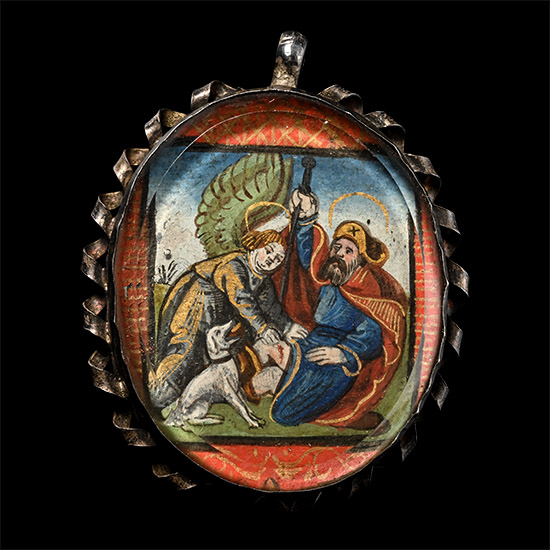
Silver Illuminated Miniature Pendant
France, 16th century A.D.Sold for (Inc. bp): £1,950
The glazed silver pendant containing illuminated miniatures on each side, one side depicting Saint Roch and the other Saint Matthew; Saint Roch shown seated on the ground while an angel is attending his bubonic plague sore on his thigh, and a white dog at his feet; Saint Matthew on the other side depicted writing the Gospel with a young attendant holding a book beside him; the frame with a fixed bale to the top and the sides adorned with a twisted silver wire decoration. 36.2 grams, 58 mm
Acquired on the European art market.
Saint Roch (c. 1348–1379) is a Catholic saint, revered as the patron of plague victims, dogs, and the sick. Born in Montpellier, France, he devoted his life to caring for those suffering from the plague. According to legend, he contracted the disease himself but was miraculously healed with the help of a dog that brought him food and licked his wounds. He is often depicted with a pilgrim’s staff, a dog by his side, and a wound on his leg. His feast day is celebrated on August 16. Saint Matthew was one of the twelve apostles of Jesus and the traditional author of the Gospel of Matthew. Before following Jesus, he was a tax collector, known as Levi. He is considered the patron saint of accountants, bankers, and tax collectors. His gospel emphasises Jesus as the Messiah and the fulfilment of Old Testament prophecies. According to tradition, he preached in various regions, including Ethiopia and Persia, before being martyred. His feast day is celebrated on September 21. -
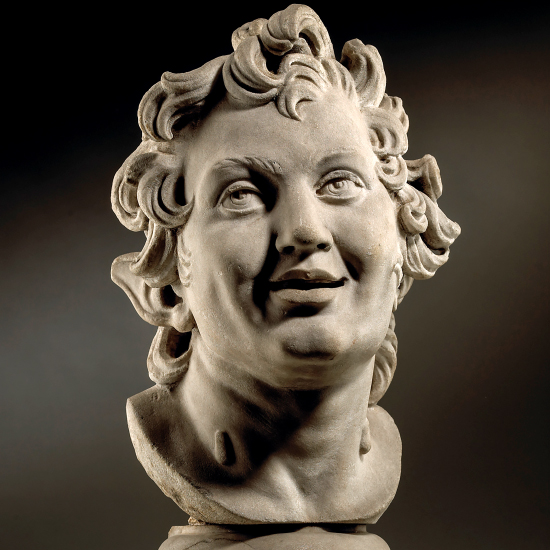
Life-Size Stone Head of a Centaur
18th century A.D.Sold for (Inc. bp): £3,640
Carved in the round bust depicting a faun or centaur with a youthful face; the hair falling in exuberant curls over the goat-like ears, the mouth parted in laughter, the eyes set beneath a stern brow; on an integral pedestal base with repair to reverse. 21.4 kg, 45 cm high
Private collection, UK. This lot has been checked against the Interpol Database of stolen works of art and is accompanied by search certificate number no.13392-259012.
Monumental marble centaurs were excavated together at Hadrian's Villa in December 1736. Pope Clement XIII secured them for the Capitoline Museum, where they remain to this day. Bronze reproductions of the famous centaurs were very much in vogue amongst the Grand Tour travellers of the 18th century.
