
Loading, please wait...
LOT 0081
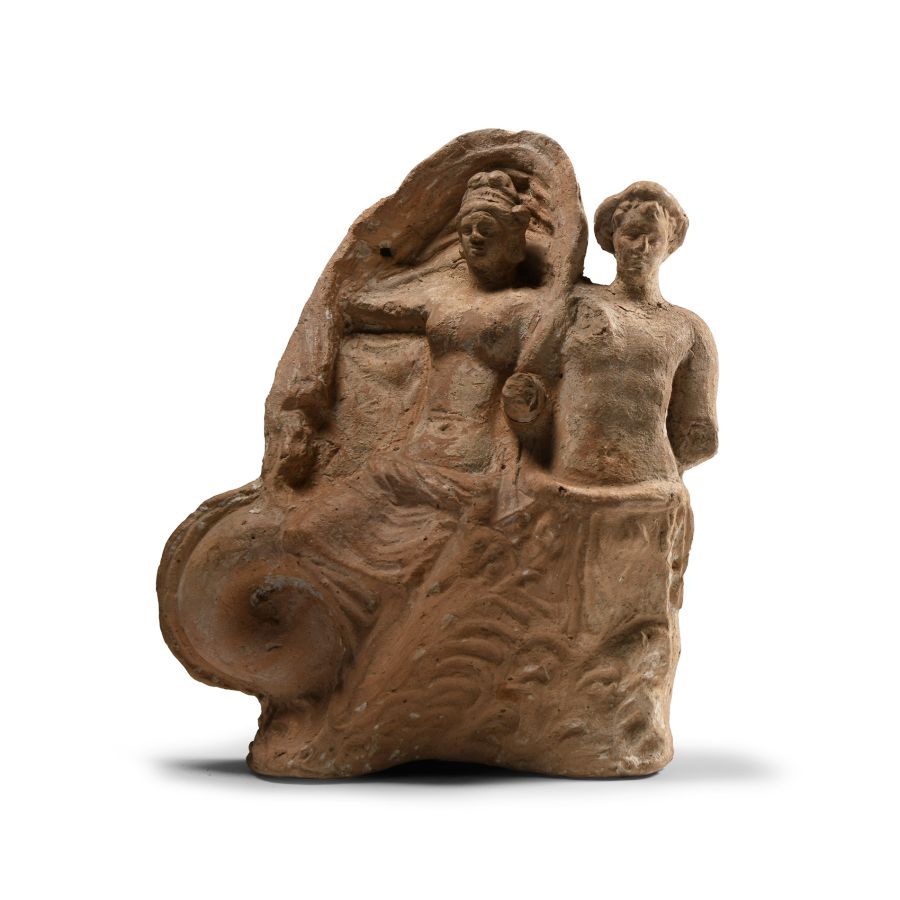
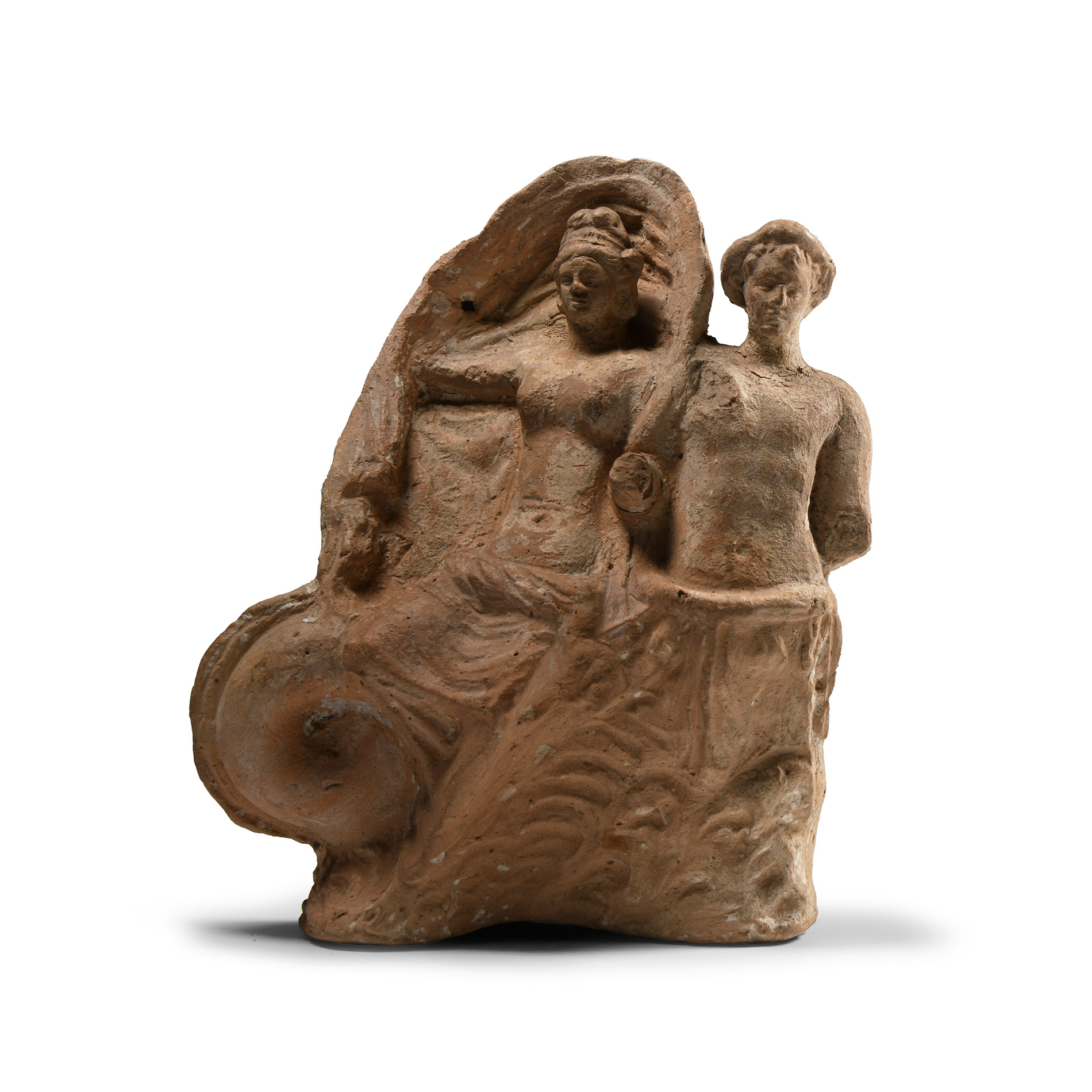
Greek Terracotta Venus and Triton Group
1ST CENTURY B.C.
7 1/8 in. (688 grams, 18 cm high).
Both figures represented facing with bare chests, Aphrodite sitting next to the triton and holding himation over her head with her right hand, her right leg raised and the left extended, the lower part of her himation covering the lower half of her body; the lower part of Triton’s body covered by marine foliage, from which the long serpentine tail emerges on the opposite side next to Aphrodite's right leg; possibly from Asia Minor; repaired.
ProvenanceEx French Sorbonne archaeology professor (deceased); 1960s-2000s.
Accompanied by an original thermoluminescence analysis report no.QED2323/FG-0201 from the QED Laboratory, Marseille, France.
Cf. Higgins, R.A., Greek Terracottas, London, 1967, pl. 55C, for a similar terracotta in Myrina style, representing Eros and Psyche; pl.52B, for a similar head of Aphrodite.
FootnotesMany of the Smyrna and Myrina figures are feminine, the heads modelled in late Hellenistic style. The bodies are often either draped in Tanagra-style robes, or represented as figures of Aphrodite, draped, semi-nude or naked. The association with Triton is linked with the Greek myth of Aphrodite born from sea foam.
CONDITIONTimeLine Auctions follows a vetting process to ensure the authenticity and legality of all items, reinforcing our commitment to integrity and responsible trading. Each antiquity, antique, and coin lot undergoes thorough examination by a vetting committee of at least ten external specialists, professional trade association members, scientists, and archaeologists: Our Vetting Process
AUCTIONS:
TimeLine is a leading auction house specialising in antiquities, ancient art, collectables, natural history, coins, medals, and books. Our auctions offer museums, collectors, historians, and enthusiasts the opportunity to acquire unique and historically significant pieces.
-
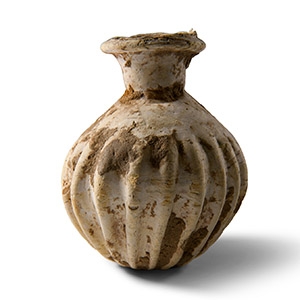
Greek Cream Frit Ribbed Bottle
4th-2nd century B.C.Estimate: £120 - 170 (‡+bp*)
Opening Bid: £60
Opaque with vertical ribbing around the globular body, trumpet-style neck and mouth with rolled rim. 76 grams, 73 mm high
Acquired early 1990s. Ex private American collection; thence by descent. Private collection since 1998. -
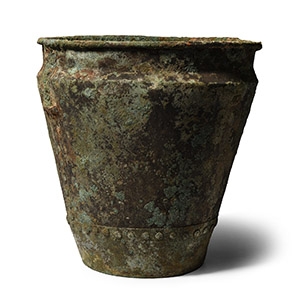
Greek Bronze Situla
5th-4th century B.C.Sold for (Inc. bp): £520
Tall vessel with dished underside, elegant carination at the shoulder, rolled rim; lateral vertical seams each covered by an applied rivetted strip, with remains of handle below the shoulder. 1.56 kg, 26 cm high
Ex Axel Guttmann Collection of Ancient Arms and Armour, Germany [1944-2001], AG 490. This lot has been checked against the Interpol Database of stolen works of art and is accompanied by search certificate no.11953-210857. -
.jpg)
Hellenistic Cut-Glass Skyphos
1st century B.C.-1st century A.D.Sold for (Inc. bp): £5,850
Drum-shaped frosted glass vessel on a low basal ring, lateral loop handles each with and angled spur below and fish-tail plaque above; 247 grams, 18 cm wide
Acquired in the 1980s. with Christopher Sheppard, London, UK. Acquired from the above in 2007. This lot has been checked against the Interpol Database of stolen works of art and is accompanied by search certificate no.11954-210906.
