
Loading, please wait...


LOT 0496
Greek Terracotta Toy Skyphos
CORINTHIAN, CIRCA 600 B.C.
1 5/8 in. (4.46 grams, 40 mm).
Miniature skyphos with loop handles to the rim, painted horizontal bands to sidewall and vertical slashes; supplied with old collector's record card. [No Reserve]
ProvenanceFrom the collection of the late Bernard C. Pickard, Hampshire, UK, the owner of Bernard C. Pickard Antiquities, which closed in 1987, he had been collecting since the mid 1950s.
FootnotesBernard Pickard was a close friend of Richard Hattatt, the renowned author of several books on ancient brooches. Hattatt acknowledges in his first book, Ancient & Romano-British Brooches, published in 1982, that Mr Pickard first aroused his interest in brooches and inspired him in writing his books during his retirement. Mr Pickard also wrote the foreword to the section on Roman animal brooches, op. cit. p.158-160.
CONDITIONTimeLine Auctions follows a vetting process to ensure the authenticity and legality of all items, reinforcing our commitment to integrity and responsible trading. Each antiquity, antique, and coin lot undergoes thorough examination by a vetting committee of at least ten external specialists, professional trade association members, scientists, and archaeologists: Our Vetting Process
AUCTIONS:
TimeLine is a leading auction house specialising in antiquities, ancient art, collectables, natural history, coins, medals, and books. Our auctions offer museums, collectors, historians, and enthusiasts the opportunity to acquire unique and historically significant pieces.
-
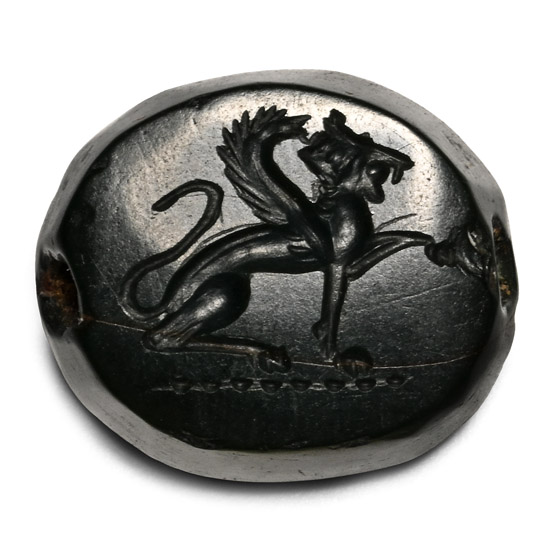
Eastern Greek Scaraboid Gemstone with Gryphon
4th-2nd century B.C. or laterSold for (Inc. bp): £650
Scaraboid type with incuse design to the underside of a winged gryphon with one foreleg raised; supplied with a museum-quality impression. 1.24 grams, 13 mm
From the private collection of a European gentleman (1942-2024), formed since the 1970s. -
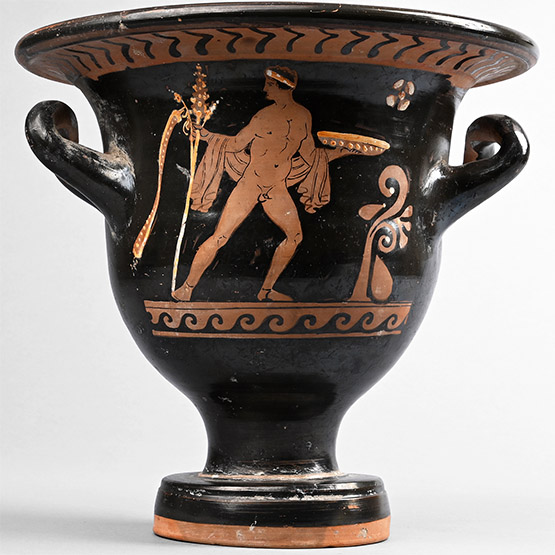
Greek Red-Figure Bell Krater Belonging to the Chevron Group
Apulia, 4th century B.C.Sold for (Inc. bp): £3,120
With reserved herringbone band beneath the rim, wave pattern to be the baseline; Side A: young man with thyrsus and pendant streamer holding a phiale, a loose mantle draped from the elbows; Side B: head of a lady of fashion with white accents to her stephane and hair drawn up in a chignon, a volute and window before her. 1.11 kg, 23.2 cm wide
Acquired on the art market between the late 1990s and mid-2000s. Estate of the late Barry Paul Buxton (1944-2024), Oakham, Rutland. Acquired on the UK art market, 2025. Accompanied by an academic report by Dr Raffaele D'Amato. This lot has been checked against the Interpol Database of stolen works of art and is accompanied by search certificate no.13071-249285.
Bell kraters were commonly used in regions of ancient Italy for mixing and serving wine during communal gatherings, thanks to their wide shape and flared mouth. These vessels also served as artistic expressions, reflecting the cultural tastes of the time. The Chevron Group is the conventional name for a group of ancient Apulian red-figure vase painters who were active in Southern Italy between approximately 335-310 B.C. They are named for their distinctive use of a band of chevron patterns to encircle the rims of the small kraters (mixing vessels) they decorated. -
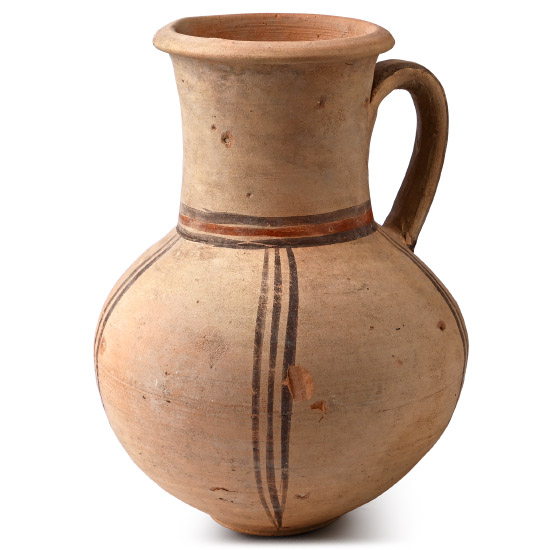
Large Eastern Mediterranean Painted Terracotta Pitcher
1st millennium B.C.Sold for (Inc. bp): £1,105
With a wide mouth, everted rim, and elongated, cylindrical neck, bulbous body with painted polychrome bands, a strap handle with painted linear decoration. 1.03 kg, 22.5 cm
From a 1980s UK collection. Acquired on the UK art market in the early 2000s. Property of a London, UK, antiquarian.
