
Loading, please wait...
LOT 0513
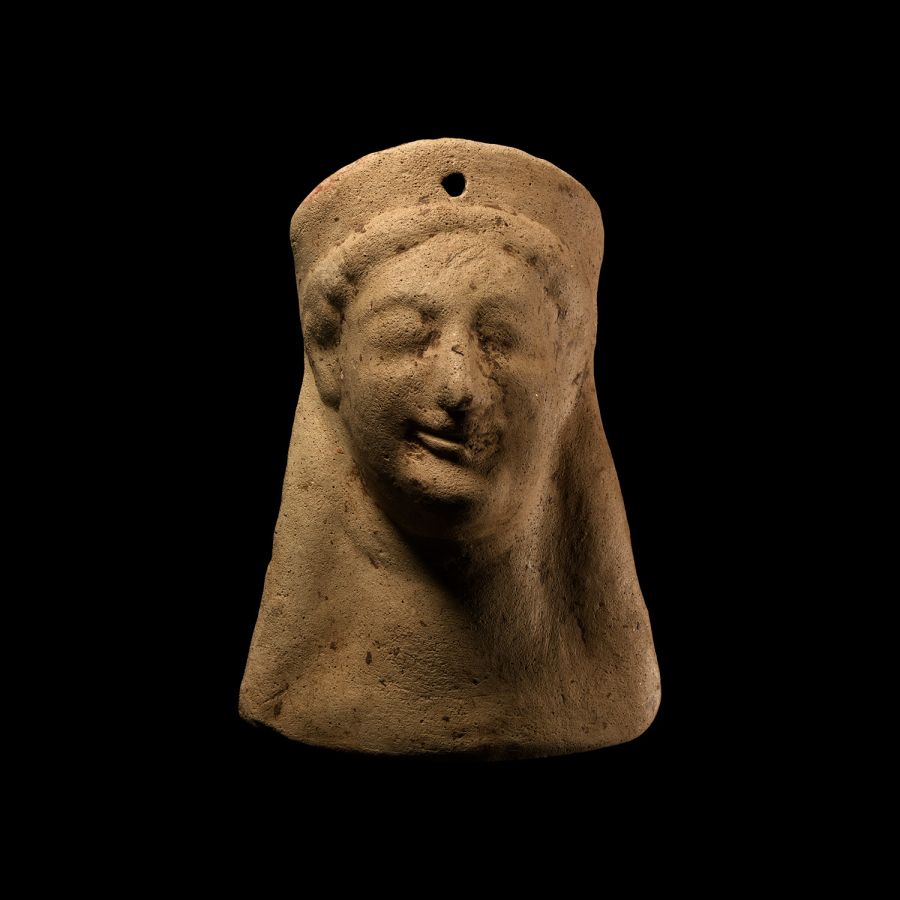
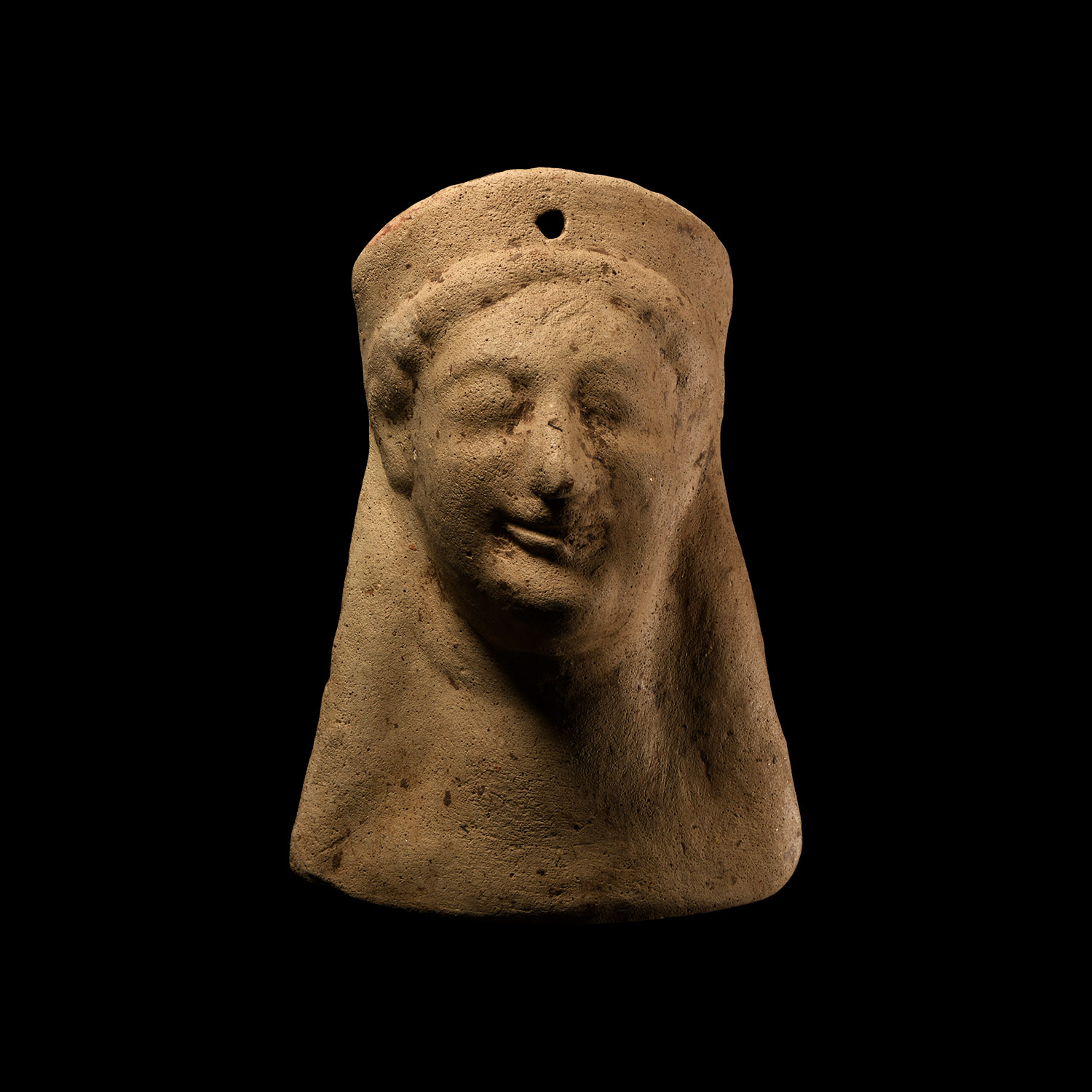
Greek Terracotta Protome Mask
LATE 6TH-EARLY 5TH CENTURY B.C.
5 1/8 in. (142 grams, 13 cm).
Modelled as a female head with rounded oval face, slightly bulging eyes and pronounced chin, indistinct smiling mouth with thin lips, outline of ears; low straight polos with fastening hole. [No Reserve]
ProvenanceAcquired 1970s-1996.
Property of a North American collector.
London collection, 2016.
Cf. Van Rooijen, G., Goddesses of Akragas, a study of terracotta votive figurines from Sicily, Leiden, 2021, no.96, for similar.
FootnotesThe figure belongs to a common type known from mainland Greece and the islands. The head clearly shows the so-called 'Archaic smile' visible on the dedicatory protomes of the same typology. They were terracotta votive offerings attached with a nail to the shrine of a goddess for ex-voto or to receive the grace of the represented goddess (Demeter?).
CONDITIONTimeLine Auctions follows a vetting process to ensure the authenticity and legality of all items, reinforcing our commitment to integrity and responsible trading. Each antiquity, antique, and coin lot undergoes thorough examination by a vetting committee of at least ten external specialists, professional trade association members, scientists, and archaeologists: Our Vetting Process
AUCTIONS:
TimeLine is a leading auction house specialising in antiquities, ancient art, collectables, natural history, coins, medals, and books. Our auctions offer museums, collectors, historians, and enthusiasts the opportunity to acquire unique and historically significant pieces.
-
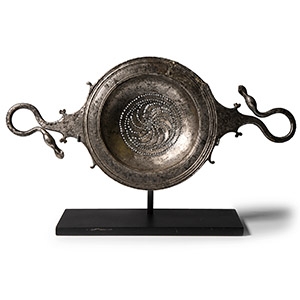
Greek Silver Wine Strainer
4th-3rd century B.C.Sold for (Inc. bp): £16,900
Composed of a shallow bowl and broad flange rim, two integral scalloped handles with scrolled flourishes, tapering to a loop handle with swan head terminals each with incised eye and beak detailing; perforated whirl within roundel to interior base; accompanied by a custom-made display stand. 160 grams, 22.2 cm wide (526 grams total including stand)
Ex private South German collection, 1980s. with Christie's, New York, 8 June 2012, lot 86. Accompanied by an academic report by Dr Raffaele D’Amato. Accompanied by copies of the relevant Christie's pages. This lot has been checked against the Interpol Database of stolen works of art and is accompanied by search certificate number no.11578-198980.
Elaborate silver strainers, such as this present example, were used at symposia and festive occasions for the purpose of preventing the dregs of wine from entering the wine cup. This and other related silver utensils became popular in the later 4th and 3rd century B.C. These highly decorated wine strainers were fitted with dual handles forming loops in the shape of twisting animals, here a swan. Usually they took the form of a shallow dish complete with four rings of perforations in the centre in order to drain the wine. Strainers of this type were used to separate out sediments which could be found in the thick Greek wine. Examples similar to this one have been found in royal tombs in northern Greece, as well as the tomb of a monarch in Sudan. -
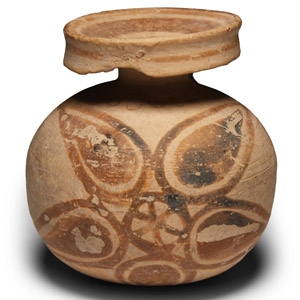
Greek Corinthian Terracotta Aryballos
Circa 6th century B.C.Sold for (Inc. bp): £416
Bulbous-bodied with a short neck, deep rim and strap handle; polychrome roundels to the mouth, orange line to the rim, dots around the shoulder and a five-petalled lotus flower blossoming on the main body, a five-rayed wheel at the centre of the flower and on the opposite side. 96 grams, 77 mm high
Ex P. A., Hertfordshire, UK, specialist collection of Greek art, 1980-1990s.
Corinthian aryballoi with floral quatrefoils or lotus flowers were produced in great numbers throughout the 6th century B.C. and probably into the 5th, and were also widely exported. The simple but distinctive decoration suggests that these vases may have had a specific contents, possibly used as an oil flask. -
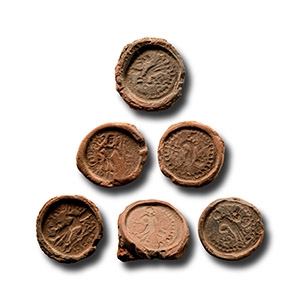
Indo-Greek Terracotta Forger's Mold Group
Circa 2nd-1st century B.C.Sold for (Inc. bp): £520
Group of discoid clay moulds for casting contemporary counterfeit coins. 40 grams total, 27-32 mm
Private collection formed in the 1990s. Acquired from a central London gallery. Property of an Essex gentleman.
