
Loading, please wait...
LOT 0544
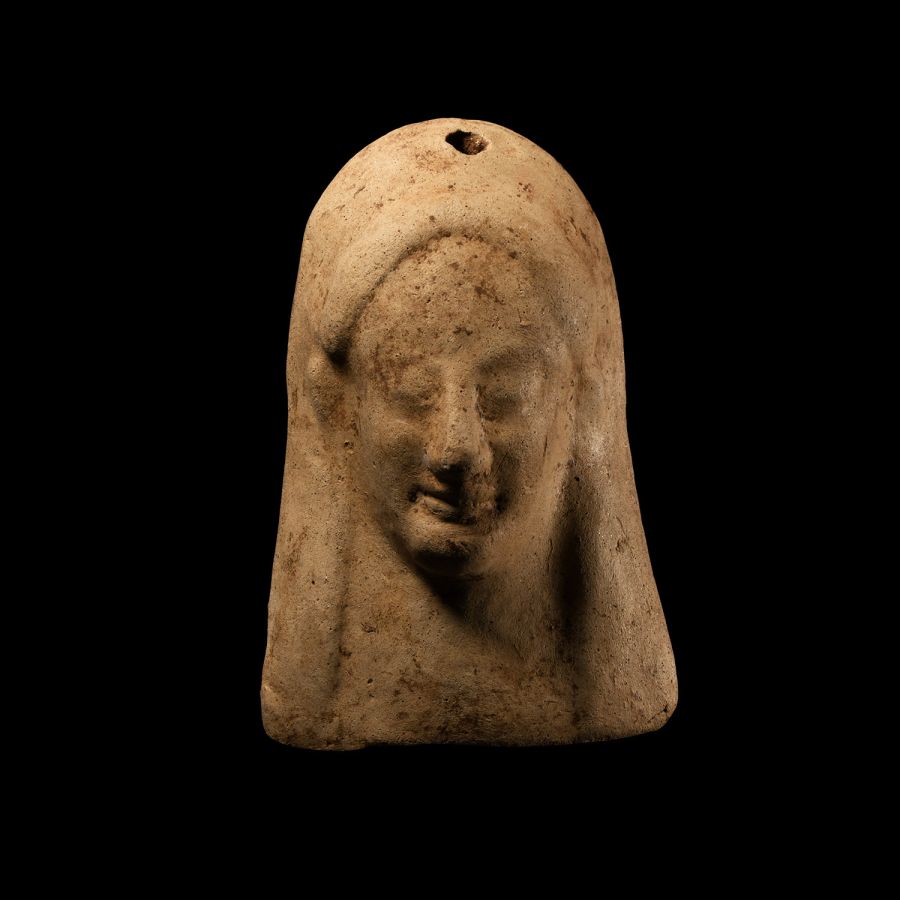
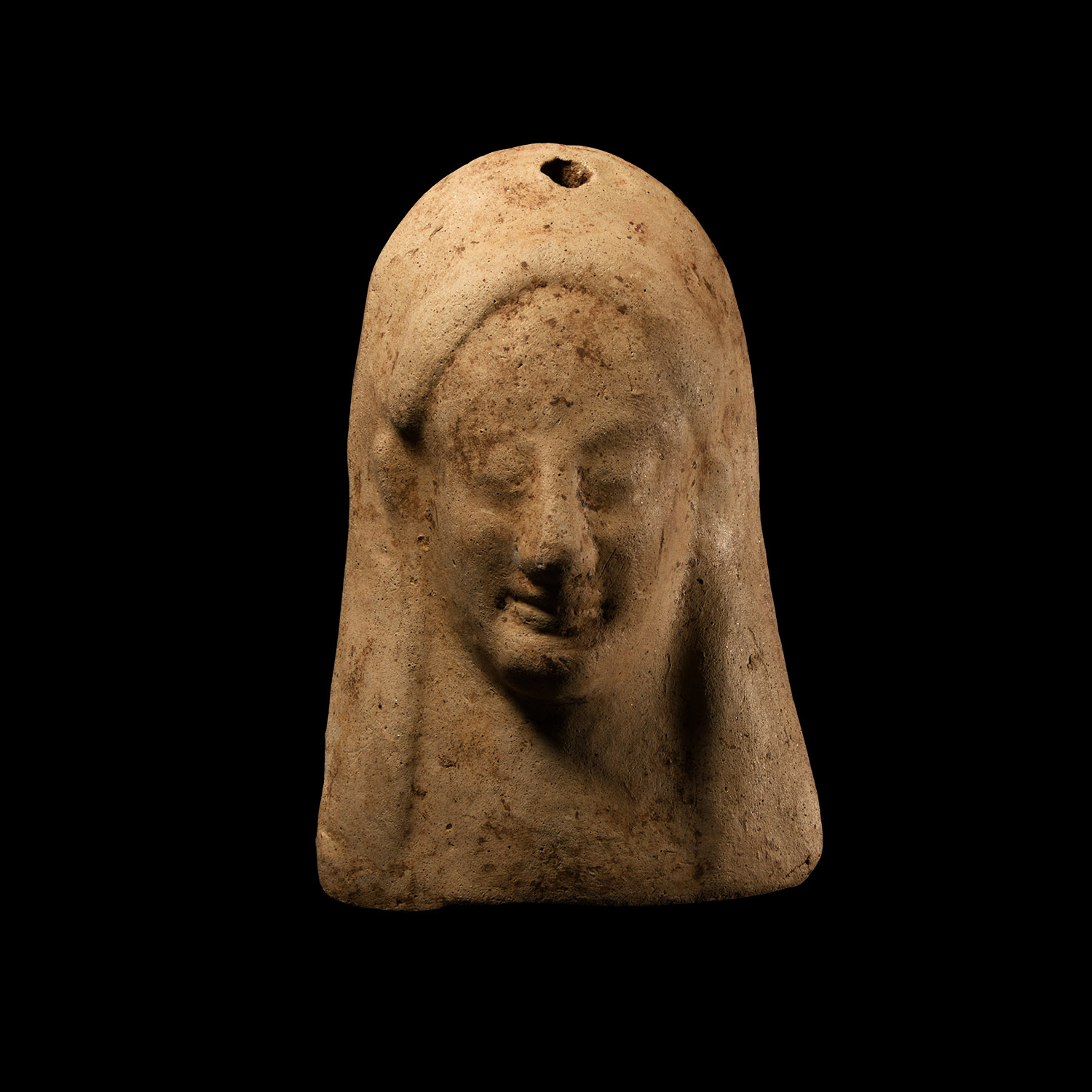
Greek Terracotta Protome Mask
LATE 6TH-EARLY 5TH CENTURY B.C.
4 3/4 in. (130 grams, 12 cm).
Modelled as a female head with rounded oval face, slightly bulging eyes and pronounced chin, indistinct smiling mouth with thin lips, outline of ears; low straight polos with fastening hole. [No Reserve]
ProvenanceAcquired 1970s-1996.
Property of a North American collector.
London collection, 2016.
Cf. Van Rooijen, G., Goddesses of Akragas, a study of terracotta votive figurines from Sicily, Leiden, 2021, no.163, for similar.
FootnotesThe figure belongs to a common type known from mainland Greece and the islands. The head clearly shows the so-called 'Archaic smile' visible on the dedicatory protomes of the same typology. They were terracotta votive offerings attached with a nail to the shrine of a goddess for ex-voto or to receive the grace of the represented goddess (Demeter?).
CONDITIONTimeLine Auctions follows a vetting process to ensure the authenticity and legality of all items, reinforcing our commitment to integrity and responsible trading. Each antiquity, antique, and coin lot undergoes thorough examination by a vetting committee of at least ten external specialists, professional trade association members, scientists, and archaeologists: Our Vetting Process
AUCTIONS:
TimeLine is a leading auction house specialising in antiquities, ancient art, collectables, natural history, coins, medals, and books. Our auctions offer museums, collectors, historians, and enthusiasts the opportunity to acquire unique and historically significant pieces.
-
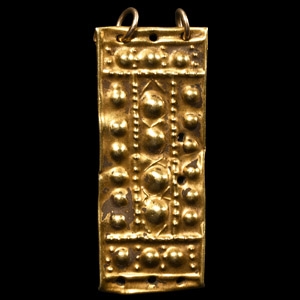
Proto-Etruscan Gold Repousse Mount with Bosses
11th-10th century B.C.Sold for (Inc. bp): £520
Comprising three horizontal rows of embossed dots, divided by pearled framework, three fastening holes on both sides, two later added gold loops to enable the piece to be worn as a pendant. 4.89 grams, 54 mm
Acquired 1980-2015. Ex Abelita family collection.
The embossed decoration finds parallels with embossed bronzes from Coste del Marano, where the model of a small boat is decorated in repoussé with the same bosses divided by similar dotted lines. -
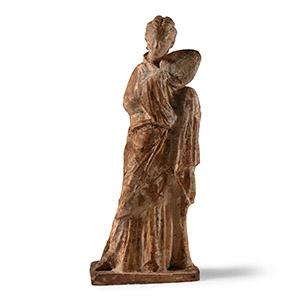
Greek Tanagra Female Figure with Fan
4th-3rd century B.C.Sold for (Inc. bp): £1,690
Modelled robed with a palmette fan; rectangular slot to reverse, hollow underside; with traces of white engobe and polychromy; recomposed from fragments. 189 grams, 16 cm high
Private collection Adry de Carbuccia, Sainte-Maxime, France, acquired prior to 1975. with Eurl Eve, Paris, 11 December 2013, lot 30. Accompanied by a copy of an Art Loss Register certificate number S00085753, dated 26 March 2014. Accompanied by a copy of a French cultural passport no.1537836. Accompanied by a copy of an original thermoluminescence analysis report no.QED1340/FG-0404 from QED Laboratoire. Accompanied by a copy of the relevant Eurl Eve catalogue pages. -
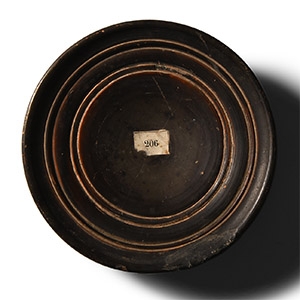
Greek Black Glazed Dish
4th century B.C.Sold for (Inc. bp): £286
With tiered foot, thick rim and ribbed upper face; old collector's ticket number '206'. 325 grams, 16 cm wide
From the collection of Louis-Gabriel Bellon (1819-1899), Saint-Nicolas-lez-Arras and Rouen, thence by descent. with Millon & Associes Auctions, Paris, 6th December 2021, lot 29.
