
Loading, please wait...
LOT 0546
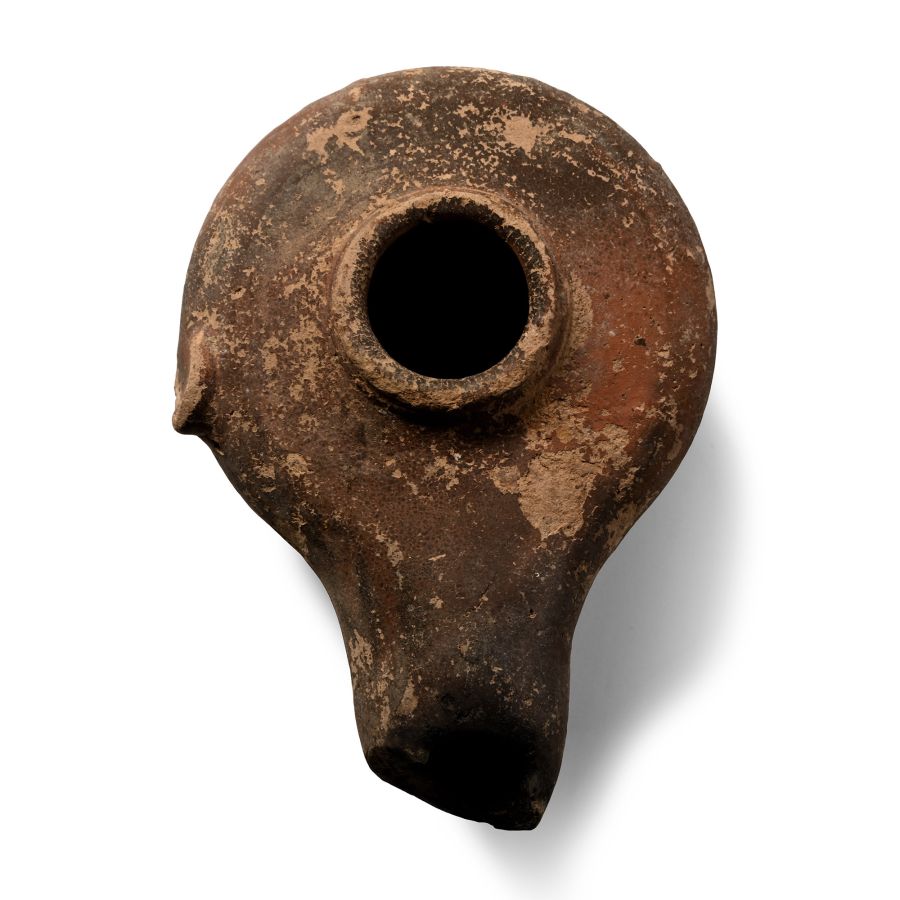
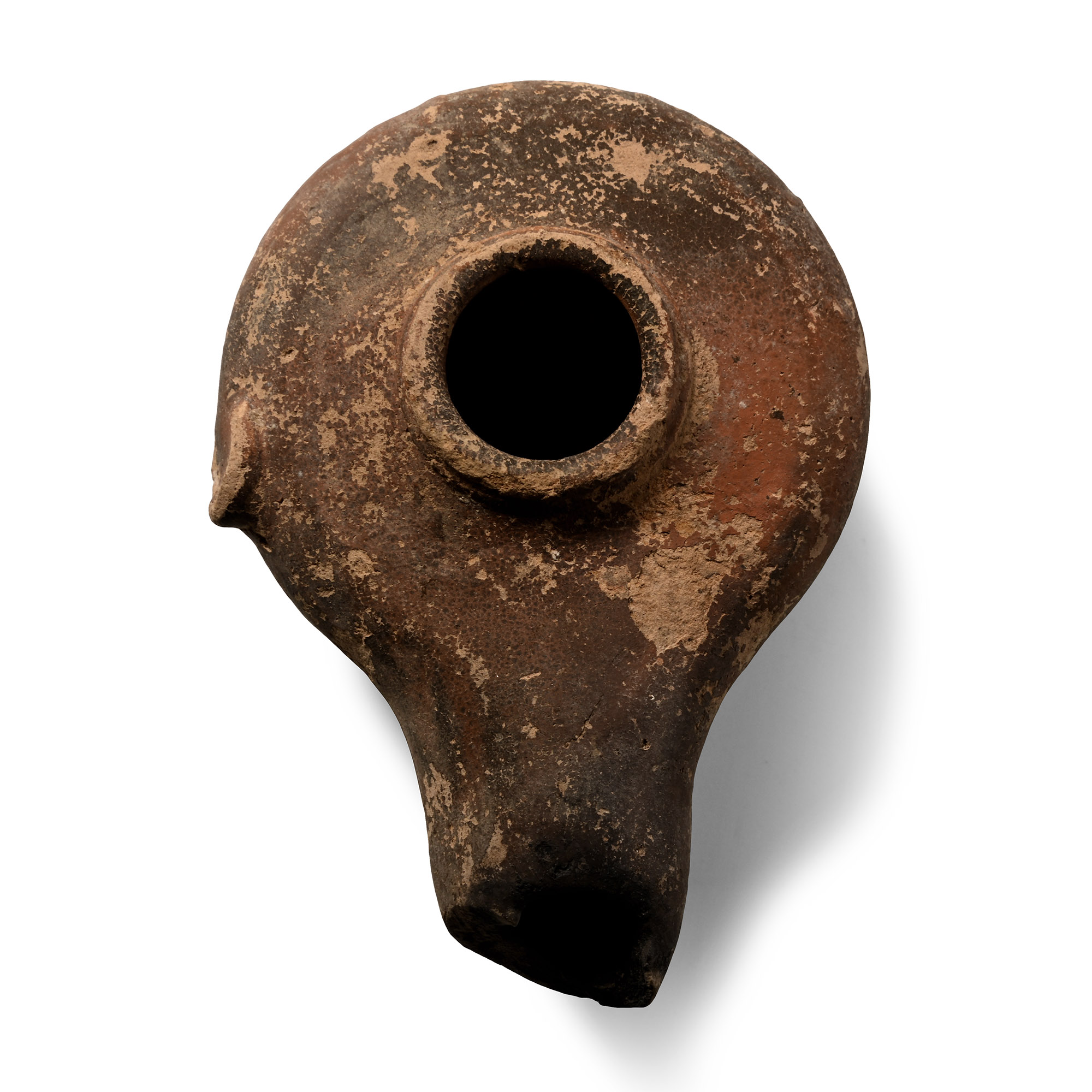
Greek Terracotta Oil Lamp
CYPRUS, CIRCA 4TH CENTURY B.C.
3 1/8 in. (60.5 grams, 80 mm).
Round body with raised rim on the filler hole, long tubular nozzle, and gently flaring foot; collection label on the base '4th c. BC, M6'. [No Reserve]
ProvenancePrivate collection, Oxfordshire, UK, by direct descent from the collection of Judge George Cyril Griffith-Williams (1893-1983), Supreme Court Judge of the Colony of Cyprus; items having been collected in the 1930s and 1940s in Cyprus during his tenure there.
CONDITIONTimeLine Auctions follows a vetting process to ensure the authenticity and legality of all items, reinforcing our commitment to integrity and responsible trading. Each antiquity, antique, and coin lot undergoes thorough examination by a vetting committee of at least ten external specialists, professional trade association members, scientists, and archaeologists: Our Vetting Process
AUCTIONS:
TimeLine is a leading auction house specialising in antiquities, ancient art, collectables, natural history, coins, medals, and books. Our auctions offer museums, collectors, historians, and enthusiasts the opportunity to acquire unique and historically significant pieces.
-
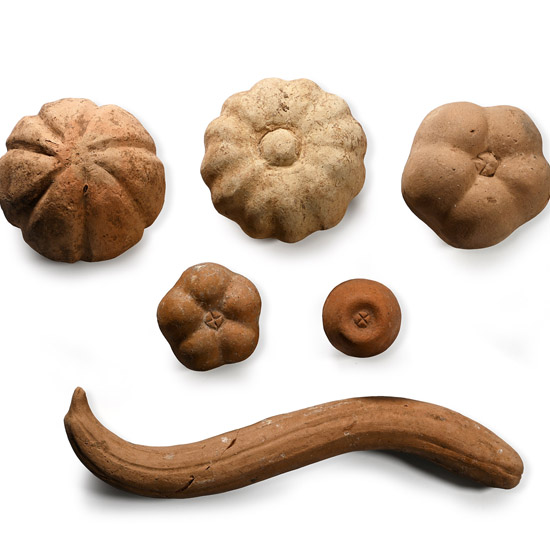
Greek Terracotta Model Fruit and Vegetable Group
4th century B.C.Sold for (Inc. bp): £143
Including pomegranates, apples and a gourd. 989 grams total, 4.5-18.7 cm
Estate of Mr Bruno Fellinger (1926-2016), Küsnacht, Switzerland. with Galerie Rhéa, Zurich, Switzerland. -
.jpg)
Greek Gold and Bead Drop Earrings
Hellenistic, 2nd-1st century B.C.Estimate: £8,000 - 10,000 (‡+bp*)
Opening Bid: £4,000
Matched pair of hooked wire earrings, each with an inset cabochon, articulated dangles and other ornaments. 5.15 grams total, 46 mm each
Private American collection, 1970s-1980s. with Robert Haber, New York, USA, circa 1990s. Private collection, Europe. Accompanied by a copy of an Art Loss Register certificate, 8 September 2004. This lot has been checked against the Interpol Database of stolen works of art and is accompanied by search certificate number no.13187-249264.
This pair belongs to the Hellenistic group of earrings with pendants, a broad group including pendants shaped as amphorae, birds, erotes and other exotic elements. Most of them come from sites around the Aegean or the Eastern Mediterranean and were probably produced in workshops in these regions. They usually date from the 2nd to the 1st centuries B.C. -
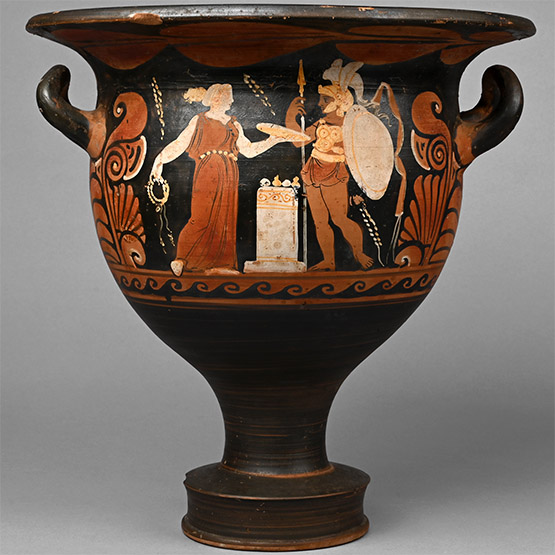
Greek Red-Figure Bell Krater with Warrior Funerary Offering Scene, Attributed to CA Painter
Campanian, 350-300 B.C.Sold for (Inc. bp): £5,980
Comprising a bell-shaped body with narrow stem and stepped pedestal foot, broad rim with square loop handles and palmettes beneath, frieze to sidewall: Side A: Oscan warrior with cuirass, helmet, shield and spear standing beside an altar with a female holding a patera in her extended hand, diadem in the other at her side; Side B: seated female with a patera and wreath facing a standing cloaked figure with thyrsus. 2.38 kg, 29.5 cm high
Private collection, Geneva, acquired in the late 1960s. Private collection, acquired in Geneva in 2000. Accompanied by collector's notes and old images. Accompanied by an original copy thermoluminescence analysis report no.QED1412/.SG-0602 from QED Laboratoire. Accompanied by an academic report by Dr Raffaele D'Amato. This lot has been checked against the Interpol Database of stolen works of art and is accompanied by search certificate number no.13219-249314.
The krater offers an interesting glimpse into the local life of Campania in the 4th century B.C. Particularly noteworthy is the depiction of the Oscan Samnite warrior, fully armed in the style of Campanian, Samnite, or Lucanian mercenaries, performing a funerary sacrifice. The depiction of the Chalcidian helmet, with its central crest and twin lateral plumes (geminae pinnae), dedicated to Mars, is extremely detailed. The style and the way in which the figures are realised, the conformation of the women, the details of the warrior, seem to point to the workshop of the CA Painter, a Campanian red-figure vase-painter whose name is unknown. Nevertheless, consistent individual characteristics of style suggest the existence of a unique artistic personality. Trendall called him the CA Painter because he was the chief painter in the first stage of Cumaean red-figure vase-painting, the initials standing for Cumaean (C), first stage (A).
