
Loading, please wait...
LOT 0604
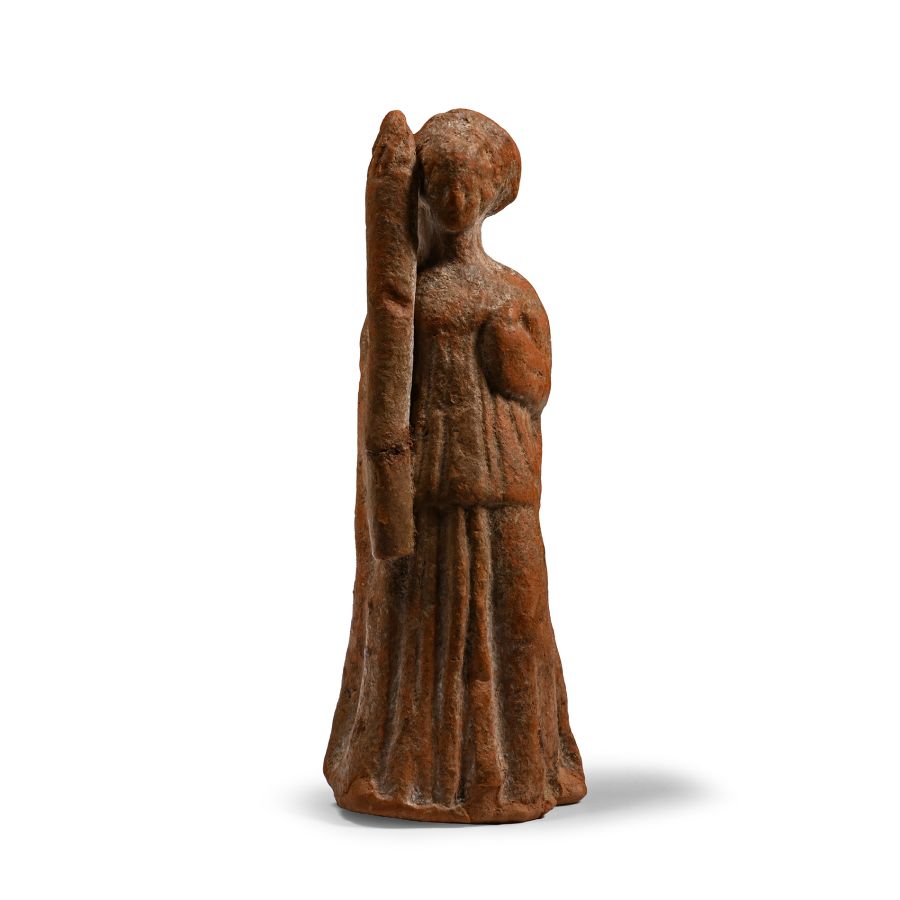
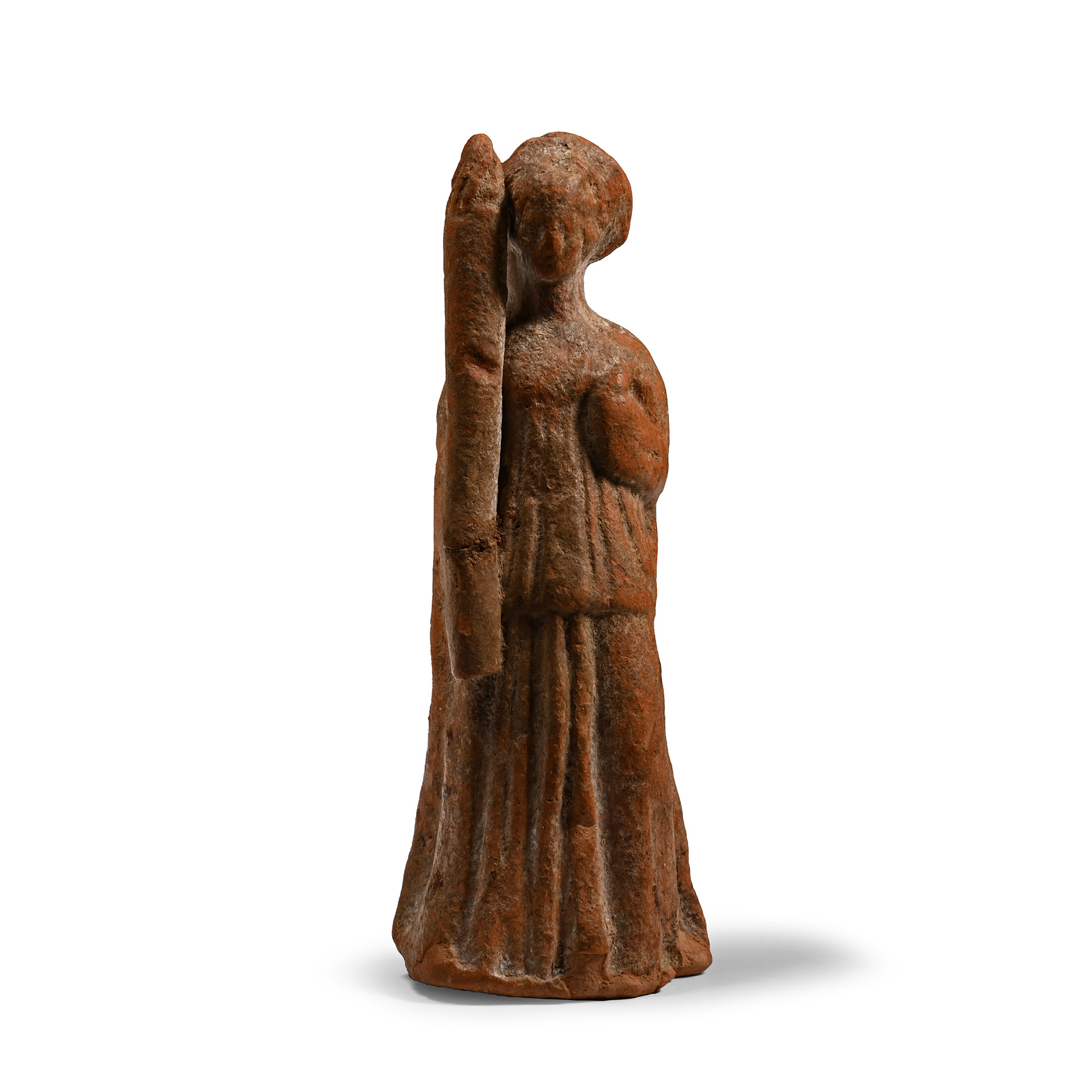
Greek Terracotta Goddess Figure
4TH-3RD CENTURY B.C.
4 3/4 in. (18 grams, 12 cm).
Tanagra type, hollow-formed with a void to the reverse, standing female in tiered robe wearing a diadem and with her hair drawn back, applied torch in her right hand.
ProvenanceEuropean art market.
Acquired in Münich in 2012.
European private collection.
This lot is accompanied by an illustrated lot declaration signed by the Head of the Antiquities Department, Dr Raffaele D’Amato.
This lot is accompanied by an illustrated lot declaration signed by the Head of the Antiquities Department, Dr Raffaele D'Amato.
See Dillon, S., The Female Portrait Statue in the Greek World, Cambridge, 2010.
CONDITIONTimeLine Auctions follows a vetting process to ensure the authenticity and legality of all items, reinforcing our commitment to integrity and responsible trading. Each antiquity, antique, and coin lot undergoes thorough examination by a vetting committee of at least ten external specialists, professional trade association members, scientists, and archaeologists: Our Vetting Process
AUCTIONS:
TimeLine is a leading auction house specialising in antiquities, ancient art, collectables, natural history, coins, medals, and books. Our auctions offer museums, collectors, historians, and enthusiasts the opportunity to acquire unique and historically significant pieces.
LOT 0604
Greek Terracotta Goddess Figure
Estimate £500 - 700€580 - 810 (for guidance only)$680 - 950 (for guidance only)
-

Large Greek Geometric Terracotta Oinochoe with Swastikas
8th century B.C.Estimate: £5,000 - 7,000 (‡+bp*)
Opening Bid: £2,000
With flared mouth, wide neck, bulbous body and ring foot, painted in brown and red matte glaze; geometric pattern spread over several registers separated by bundles of encircling stripes, triangles with hatching inside them, neck with metopes containing swastikas, rosettes and rhombuses with a band of rhombuses beneath; the shoulder with five line friezes arranged one above the other; the body decorated with meander and a band of rhombuses and triangles with hatching below, a broad black stripe (in places reddish as a result of misfiring) to the lower part; transition to the ring foot and ring foot painted black; wide strap handle attached to the shoulder and painted on the outside with a wavy line framed by dots, edge stripes and three small stars, the connecting bar patterned with stripes; museum-quality restoration. 2.04 kg, 35.5 cm
Ex Madame P., Paris. Accompanied by an academic report by Dr Raffaele D'Amato. This lot has been checked against the Interpol Database of stolen works of art and is accompanied by search certificate number no.12460-228686. This lot has been cleared against the Art Loss Register database, and is accompanied by an illustrated lot declaration signed by the Head of the Antiquities Department, Dr Raffaele D'Amato.
Vessels of the Geometric Period (900-700 BCE) are easily recognisable by their abstract decorative designs, which had their origin in woven textiles and baskets. While early period pottery typically has sparse geometric motifs on a black background, the amount of the decoration increased progressively to the point that objects from the late Geometric period are often entirely covered - in this example, even the strap handle. -
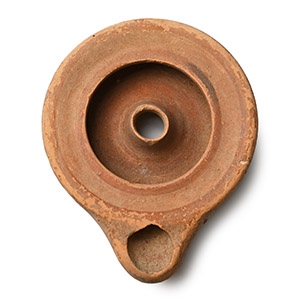
Greek Corinthian Terracotta Oil Lamp
6th century B.C.Sold for (Inc. bp): £156
With broad discus, D-shaped nozzle, central tubular projection into the oil chamber. 157 grams, 10.3 cm
From the private collection of a Canadian gentleman living in Essex, UK, formed since the 1920s-circa 1990. Property of an Essex lady until the late 1990s; thence by descent. From the private collection of an Essex gentleman since the late 1990s. This lot is accompanied by an illustrated lot declaration signed by the Head of the Antiquities Department, Dr Raffaele D'Amato. -
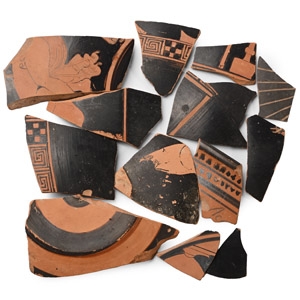
Greek Red-Figure Ware Pottery Collection
5th-4th century B.C.Sold for (Inc. bp): £650
Comprising fragments of vessels, most with decorative motifs, including one with a boar's head and another with lower part of the body of Ephebus. 64 grams total, 24-71 mm
From a deceased estate, UK. Acquired on the UK art market. This lot is accompanied by an illustrated lot declaration signed by the Head of the Antiquities Department, Dr Raffaele D'Amato.
Although Athens remains a prime source for red figure, the export trade, notable to Italy, shows a very wide distribution of this pottery far beyond the Greek world.
